ART
BEAUTY & WELLNESS
CRAFT
CULTURE & HISTORY
ENTERTAINMENT
ENVIRONMENT
FOOD & DRINKS
REVERSE ENGINEERING
SCIENCES
SPORTS
TECHNOLOGY
WEARABLES


The Hammock: A Slack Rope, a Swing and the Pull on the Anchors
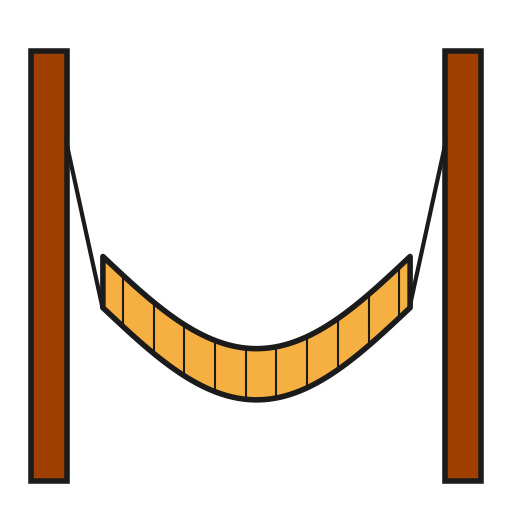
A hammock is a bed hung from two points. How tightly it is strung decides how hard it pulls on the trees or hooks, and how it swings decides how pleasant it is to lie in.
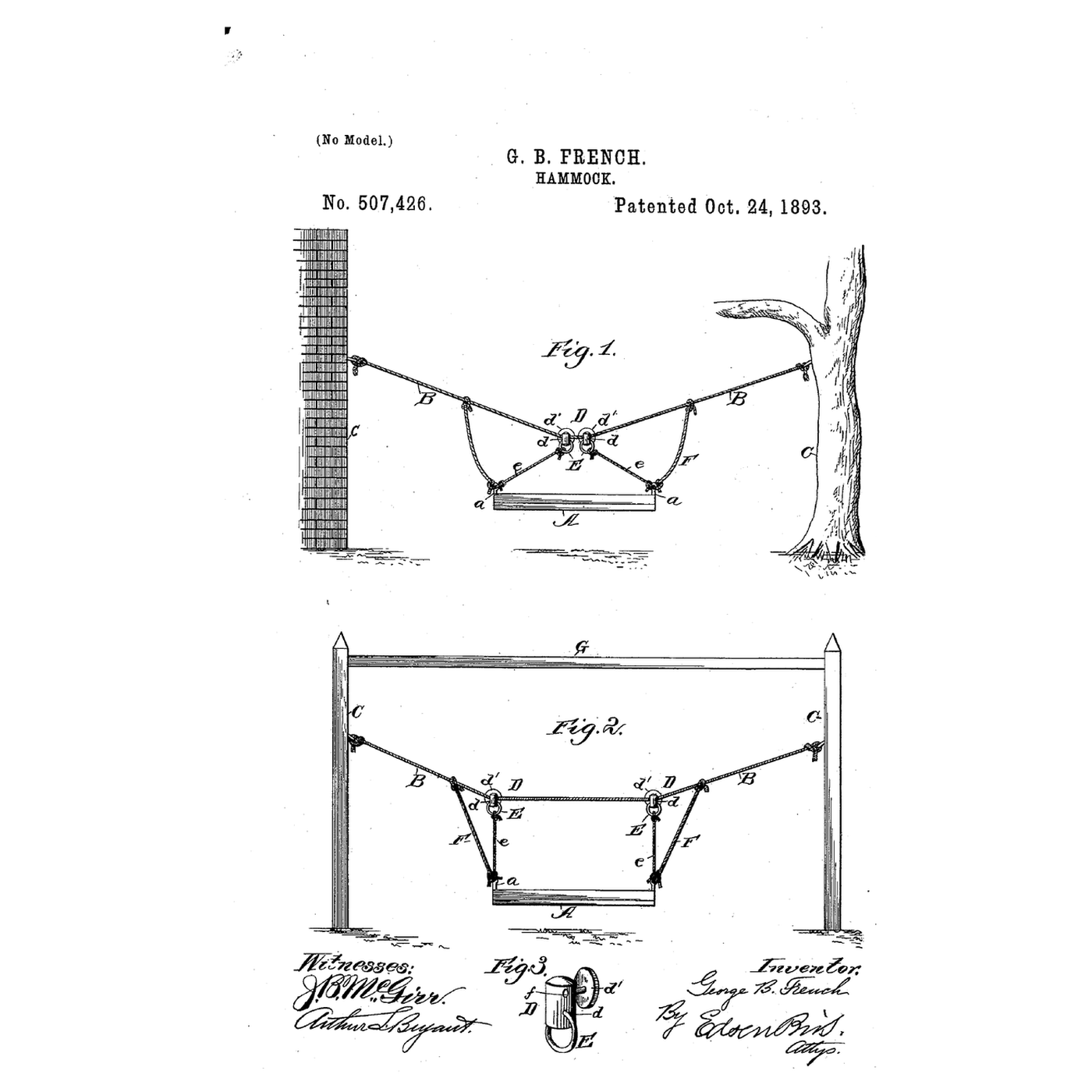
George B. French of Fremont, Nebraska, received US 507,426, dated 24 October 1893 (filed 19 August 1891), for a hammock whose frame, "covered with wire netting, canvas or slats", hangs from "a single transverse rope or wire" with sufficient slack, fixed to "a house and tree" or posts. Clasps with set screws slide along the rope to set how the frame swings, and guy ropes set its tilt, so "a person may recline at ease, with the body in a straight and natural position".
This rung works out the pull on the anchors and the swing, then measures both with a weight on a cord.
Beginner
About 2 hours
Instructions
1
1
Anchor pull and the swing
Anchor pull and the swing
Loading Jupyter Notebook...
2
2
A weight on a line
A weight on a line
A hanging hammock swings as a pendulum. The embedded blueprint times one and weighs gravity with it.
3
3
Read US 507,426
Read US 507,426
"My invention relates to improvements in hammocks, and it has for its object to provide a novel arrangement of the ropes supporting the body of the hammock whereby a vibratory movement may be easily obtained and regulated as desired, and wherein a person may recline at ease, with the body in a straight and natural position".
"The vibratory motion of a weight supported by a slack rope or wire depends, first, upon the amount of power applied thereto; second, upon the position upon the rope where the weight is attached; third, upon the distance of the weight from the slack rope if suspended therefrom." A weight "would take and sustain a longer vibratory motion, with the same power, if distant from the slack rope than it would if but slightly removed therefrom".
"A single rope, wire or cable B is attached at its ends to suitable uprights or supports C, such as a house and tree as shown in Fig. 1 or posts suitably secured in the ground as shown in Fig. 2, and said rope B is of such length as to have sufficient slack to answer the purpose of my invention."
4
4
Measure the pull and the swing
Measure the pull and the swing
Tie a cord between two fixed points about 1.5 m apart, one end through a spring scale so you can read the tension. Hang a known weight (a bucket of water on the scale first) from the middle. Read the tension and measure the cord's angle below horizontal with a protractor. Shorten and lengthen the cord and repeat: compare each reading with W / (2 sin θ). Use a scale rated above the largest reading the notebook predicts, and keep the cord well away from flat.
Now hang the bucket below the middle on a second cord, at 30 cm, 60 cm and 100 cm. Give it the same small push each time and time ten swings with a stopwatch, and how long until the swing is a quarter of its start. That is French's claim, tested.
Before hanging a real hammock, work out the pull on each anchor from its angle, and use anchors and straps rated well above it.
Materials for this step:
 Rope3 m
 Water5 liters
Tools needed:
 Spring Scale
 Protractor
 Tape Measure
 Bucket
 Stopwatch
 Hammock
5
5
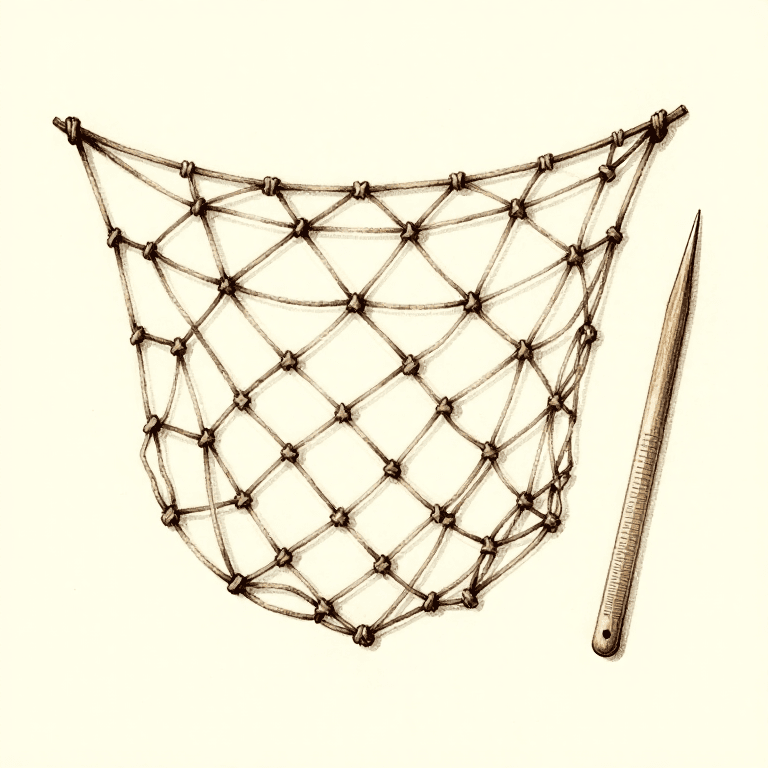
The netted bed
The netted bed
The oldest hammocks are nets. The embedded blueprint knots mesh netting from cord.
6
6
A hammock that sags, tips or pulls too hard
A hammock that sags, tips or pulls too hard
Hammock troubleshooting.
Flow
Loading...
7
7
History and honest limits
History and honest limits
**George B. French** of Fremont, Nebraska, filed US 507,426 on 19 August 1891; it is dated 24 October 1893. His claims cover the slack rope, the sliding clasps with set screws, the suspended frame and the guy ropes.
**Honest limits.** The patent gives no sizes or loads. The person's weight, span, rope lengths and loss per swing are examples; a real rope stretches, which the notebook leaves out.
This blueprint makes
Related Blueprints
These blueprints share knowledge with this one — techniques, materials, or principles that connect them in the learning graph.



CC0 Public Domain
This blueprint is released under CC0. You are free to copy, modify, distribute, and use this work for any purpose, without asking permission.
Support the Maker by purchasing products through their Blueprint where they earn a Maker Commission set by Vendors, or create a new iteration of this Blueprint and include it as a connection in your own Blueprint to share revenue.