ART
BEAUTY & WELLNESS
CRAFT
CULTURE & HISTORY
ENTERTAINMENT
ENVIRONMENT
FOOD & DRINKS
REVERSE ENGINEERING
SCIENCES
SPORTS
TECHNOLOGY
WEARABLES


The Hinged-Bowl Lemon Squeezer: Two Cast Handles, One Bowl Inside the Other
The wooden lemon squeezers of the day soon soaked up stale juice and smelled of it.
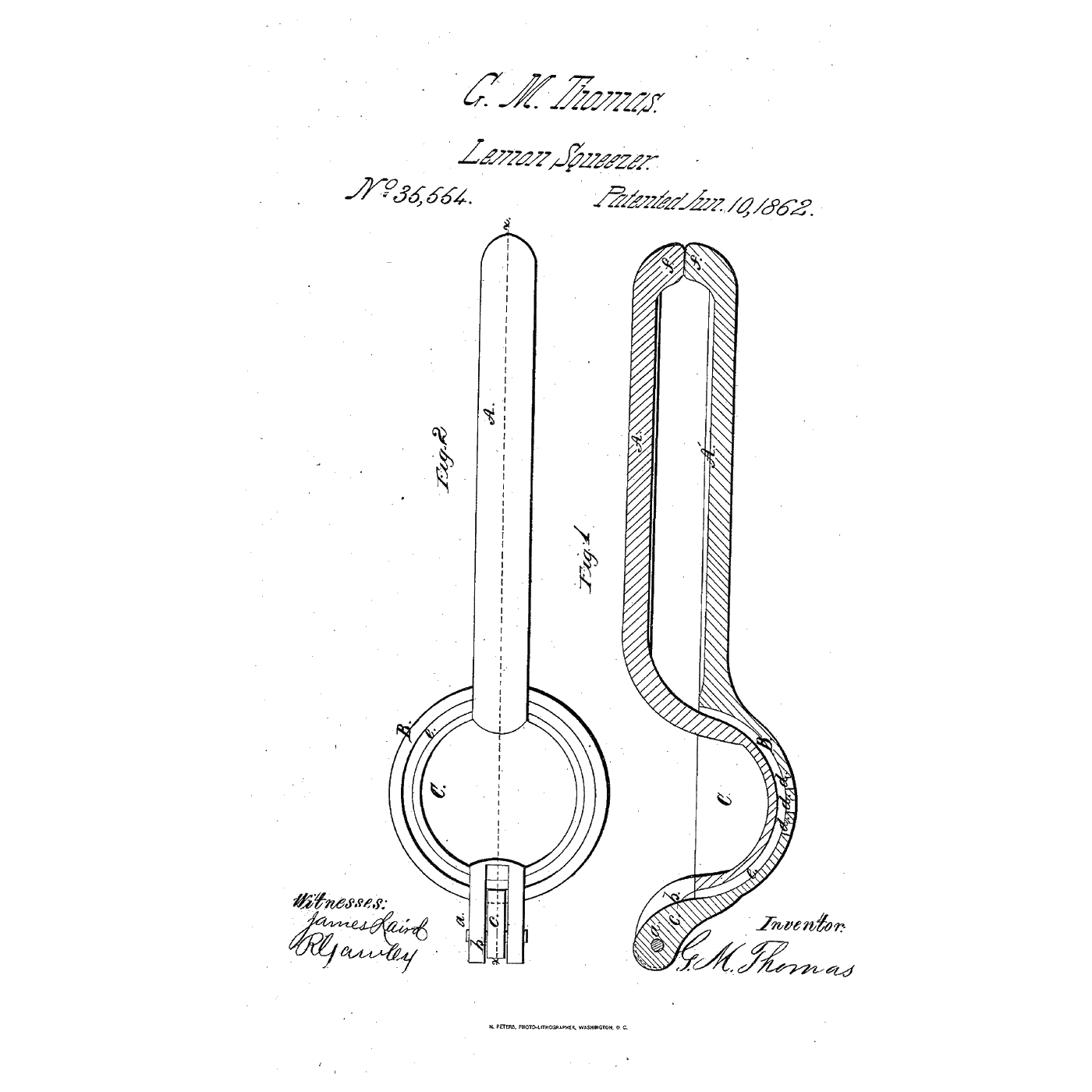
George M. Thomas of New York received US 35,554, dated 10 June 1862, for "constructing the squeezer of cast metal and of such form or in such a manner that a very durable, economical, and light implement for the purpose is obtained, and one that may be manipulated or operated with greater facility than the ordinary kinds in general use." Two handles are pinned together at their front ends; the lower carries a perforated bowl, the upper a smaller half-sphere that fits inside it with a space between; the half lemon is put in the lower bowl and the handles are pressed together. The lower bowl hangs below its handle, so the squeezer can rest on a glass.
This rung works out the force of the handles, with a work check, then makes the squeezer from flat bar, a tin cup and a hardwood dome and squeezes lemons with it.
Intermediate
About 4 hours
Instructions
1
1
Force at the bowls
Force at the bowls
Loading Jupyter Notebook...
2
2
A squeezer before it
A squeezer before it
The embedded blueprint presses the lemon on a cone under a lever-driven cap. Thomas puts the bowl and its half-sphere on the two handles themselves.
3
3
Read US 35,554
Read US 35,554
"The lower handle, A′, is provided with a bowl, B, of semispherical form, and perforated at its bottom, as shown at d in Fig. 1. The inner surface of the bowl B is enameled, or should be, in order to prevent oxidation. The bowl B and handle A′ are cast in one piece, and the bowl projects below the handle, the latter being on a level or in the same plane with the upper edge of the former."
"The lemon is squeezed by being divided, as usual, and one-half at a time placed in the bowl B, and forcing the bowl C down upon it by pressing the handles A A′ together."
4
4
Make the squeezer and press lemons
Make the squeezer and press lemons
**Handles.** Cut two 25 cm lengths of 20 × 5 mm mild steel flat bar. Drill both 1 cm from one end for an M6 pivot bolt, and bend the other ends slightly apart as the stops f.
**Lower bowl.** Cut the bottom 3 cm off a clean tin can about 7 cm across, punch holes in its base with a nail, and rivet its rim to the lower handle 5 cm behind the pivot so it hangs below.
**Upper dome.** Rasp a hardwood block into a half-sphere that fits inside the cup with about 5 mm to spare, and screw it to the upper handle opposite the cup.
**Test.** Bolt the handles together. Halve a lemon, put one half cut side down in the cup over a glass, and press the handles together, reading your squeeze with the spring scale hooked on the handles' ends. Weigh the juice, and compare with a half squeezed by hand.
Materials for this step:
 Mild Steel Flat Bar0.5 meter
 Tin Can1 piece
 Hardwood Block1 piece
 Wood Screws2 pieces
 Steel Rivets4 pieces
 Hex Bolt Assortment1 piece
 Hex Nut1 piece
 Lemon2 pieces
Tools needed:
 Hacksaw
 Cordless Drill
 Drill Bit Set
 Files (Hand File)
 Bench Vise
 Tin Snips
 Nails
Nails Hammer
 Rivet Set
 Rasp
Rasp Screwdriver Set
 Adjustable Wrench
 Kitchen Knife
 Digital Kitchen Scale
 Force Meter (Spring Scale)
 Drinking Glass
 Leather Work Gloves
5
5
A squeezer that sprays, slips or leaves juice
A squeezer that sprays, slips or leaves juice
Hinged-bowl lemon squeezer troubleshooting.
Flow
Loading...
6
6
History and honest limits
History and honest limits
**George M. Thomas** of New York, New York, received US 35,554, dated 10 June 1862. His handles A A′ were joined by a fulcrum pin a through a slot b in the upper handle, the bowl C was cast with the upper handle and smaller than B to leave a space e, and the handles' ends were curved at f as stops. He thought cast iron, japanned, the best material, and did not claim a cast-metal squeezer as such, but one with two handles on a fulcrum pin and bowls fitting one within the other below the handles.
**Honest limits.** Flat bar, a tin cup and a hardwood dome stand in for his cast-iron handles and bowls. The notebook ignores friction; its forces and lengths are examples. Your juice weights are the result.
Materials
8- 0.5 meterPlaceholder
- 1 piecePlaceholder
- 1 piecePlaceholder
- 2 piecesPlaceholder
- 4 piecesPlaceholder
- 1 piecePlaceholder
- 1 piecePlaceholder
- 2 piecesPlaceholder
Tools Required
17- Placeholder
- 1 vendor sell this, none ship to you yetPlaceholder
- Placeholder
- Placeholder
- Placeholder
- Placeholder
- Placeholder
- Placeholder
- Placeholder
- Placeholder
- Placeholder
- Placeholder
- Placeholder
- Placeholder
- Placeholder
- Placeholder
- Placeholder
This blueprint makes

Related Blueprints
These blueprints share knowledge with this one — techniques, materials, or principles that connect them in the learning graph.



CC0 Public Domain
This blueprint is released under CC0. You are free to copy, modify, distribute, and use this work for any purpose, without asking permission.
Support the Maker by purchasing products through their Blueprint where they earn a Maker Commission set by Vendors, or create a new iteration of this Blueprint and include it as a connection in your own Blueprint to share revenue.