ART
BEAUTY & WELLNESS
CRAFT
CULTURE & HISTORY
ENTERTAINMENT
ENVIRONMENT
FOOD & DRINKS
REVERSE ENGINEERING
SCIENCES
SPORTS
TECHNOLOGY
WEARABLES


The Icebox: Drain the Melt, Shut the Ice Off When the Door Opens
Before electric refrigerators, a kitchen kept food cold with a block of ice in an insulated cabinet. The ice bought a fixed amount of cooling; everything that wasted it had to be designed out.
Simon Gasper of Indianapolis received US 190,846, dated 15 May 1877 (filed 4 October 1876), for a refrigerator meant "to preserve the ice from rapidly melting, to retain the air free from excessive humidity, and to protect the ice from the effects of currents of warm air entering the main chamber". The ice sits on lattice over zinc-covered sloping shelves that drain the melt away; slides worked by the door close the ice off whenever the door is open; and inside, warm air rises to the ice, is cooled and sinks into the storage chamber.
This rung budgets the ice, then tests a drained and an undrained ice pack in two insulated boxes.
Beginner
About 1 day
Instructions
1
1
The ice budget
The ice budget
Loading Jupyter Notebook...
2
2
The ice delivered to the box
The ice delivered to the box
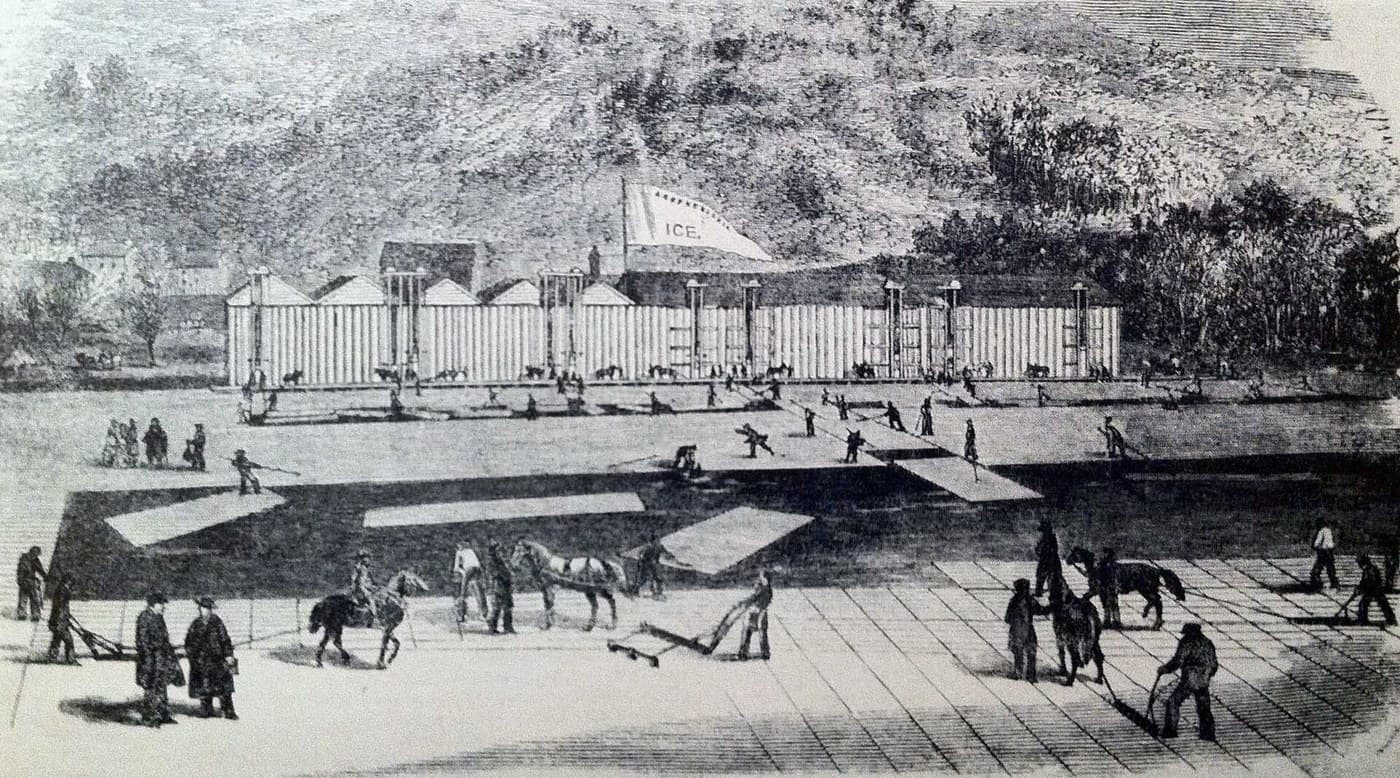
An icebox needed ice from somewhere. The embedded blueprint harvests it from a lake.
3
3
Read US 190,846
Read US 190,846
"The objects of my invention are to preserve the ice from rapidly melting, to retain the air free from excessive humidity, and to protect the ice from the effects of currents of warm air entering the main chamber upon the door communicating therewith being opened."
"The ice-shelves are formed of two inclined planes, covered with zinc or other sheet metal ... and on top of these shelves is laid a lattice-work of wood or metal strips, upon which the ice is laid, and by means of which the drip-water from the dissolving ice is drained off", "thus securing the ice from contact with the water, which, being of a higher temperature, would cause more rapid dissolution if allowed to surround the ice".
Slides "upon the door communicating with the main chamber being opened, close the apertures having access to the ice-shelves, thus excluding warm currents of air." "While the doors communicating with the exterior are closed, a constant circulation of air takes place within the refrigerator. The more rarefied portions, ascending ... and coming in contact with the ice, are condensed, and descend into the cold-air chamber and storage-chamber".
4
4
Drained ice and ice in its melt
Drained ice and ice in its melt
Line two identical storage boxes with foam board, and make lids of foam board too. Freeze two equal blocks of ice in loaf pans and weigh each.
In the first box stand the block on a rack over a tray so the melt drips away from it. In the second put the block straight on the floor of the box so it sits in its own melt. Put a thermometer in each and close them.
After six hours, and again after twelve, record the air temperature, lift each block out, wipe it and weigh it. Plot ice left over time for both: that is Gasper's drainage at work. Then open one lid every half hour for a day and compare.
Materials for this step:
 Water2 liters
 Extruded Polystyrene Foam Board1 piece
Tools needed:
 Storage Box
 Loaf Pan
 Digital Scale
 Kitchen Thermometer
 Icebox
5
5
An icebox that melts ice fast or smells
An icebox that melts ice fast or smells
Icebox troubleshooting.
Flow
Loading...
6
6
History and honest limits
History and honest limits
**Simon Gasper** of Indianapolis filed US 190,846 on 4 October 1876; it is dated 15 May 1877. A valved ventilator on top lets air compressed by the closing door escape.
**Honest limits.** The latent heat is a physical constant; the wall conductivities, sizes, temperatures and door air volume in the notebook are examples. Your weighings are the measurement.
Tools Required
5- Placeholder
- Loaf Pan10% commissionPlaceholder
- Placeholder
- Placeholder
- Placeholder
This blueprint makes
Related Blueprints
These blueprints share knowledge with this one — techniques, materials, or principles that connect them in the learning graph.




CC0 Public Domain
This blueprint is released under CC0. You are free to copy, modify, distribute, and use this work for any purpose, without asking permission.
Support the Maker by purchasing products through their Blueprint where they earn a Maker Commission set by Vendors, or create a new iteration of this Blueprint and include it as a connection in your own Blueprint to share revenue.