ART
BEAUTY & WELLNESS
CRAFT
CULTURE & HISTORY
ENTERTAINMENT
ENVIRONMENT
FOOD & DRINKS
REVERSE ENGINEERING
SCIENCES
SPORTS
TECHNOLOGY
WEARABLES
Masking Tape: Crepe Paper and an Adhesive That Never Dries
Painting a car in two colours needs a sharp line between them. The paint shops of the 1920s masked with gummed paper, which had to be wetted on and soaked off, or with cloth-backed adhesive tape, whose edges frayed and stretched and whose adhesive the lacquer solvents loosened.
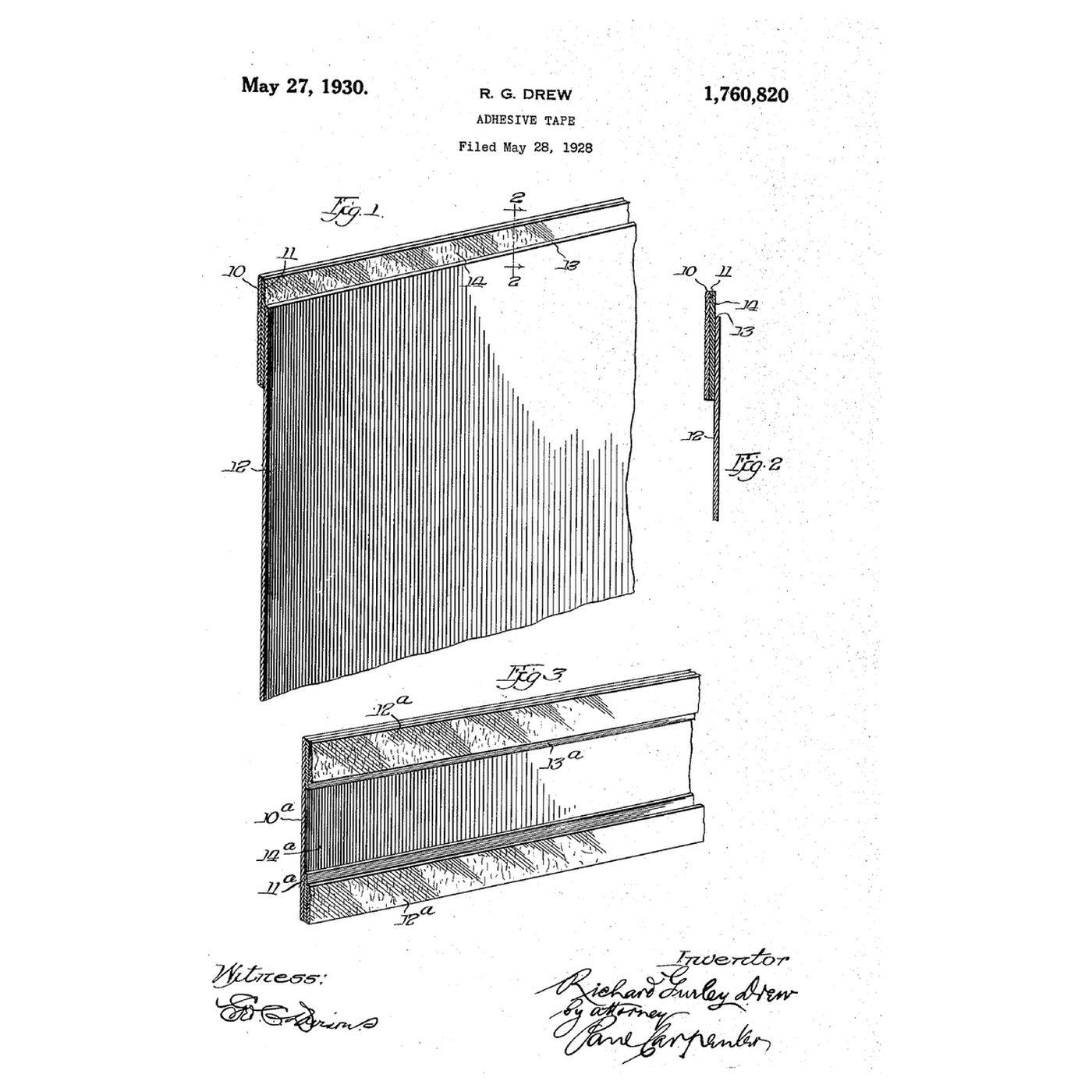
Richard Gurley Drew of St. Paul, assignor to Minnesota Mining & Manufacturing, filed US 1,760,820 on 28 May 1928; it was granted on 27 May 1930 (the specification is stamped as reissued in April 1934). His tape is paper, creped or crimped so it stretches, coated with an adhesive that is "normally non-drying" and sticks by pressure alone, and treated so that paint solvents do not reach the adhesive through the backing.
This rung works out why crepe lets tape follow curves and how the peel angle sets the force to remove it, and masks a two-colour panel.
Beginner
About 2 hours
Instructions
1
1
Curves, stretch and peel
Curves, stretch and peel
Loading Jupyter Notebook...
2
2
An earlier pressure-sensitive tape
An earlier pressure-sensitive tape
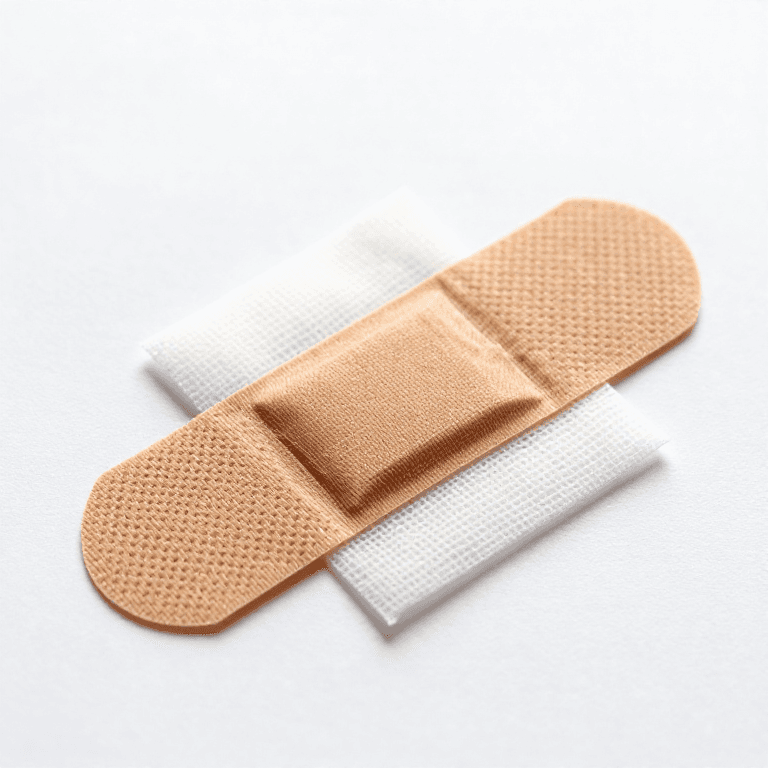
The adhesive bandage used a pressure-sensitive adhesive on a backing a few years before. The embedded blueprint shows it.
3
3
Read US 1,760,820
Read US 1,760,820
Drew's invention relates to "pressure energizable adhesives, adhesive sheets or coatings, preferably water insoluble and normally non-drying." He describes it for the paint shop: "in finishing automobile bodies with lacquers, paints or the like of a plurality of colors, difficulty is found in limiting the application owing to the diffusion of the spray"; to get "a clear and cleancut line of demarcation between several colors", masks of adhesive tape had been used.
Ordinary gummed paper tape, wetted to stick, "adheres so tenaciously that to remove the same requires softening of the adhesive material with large quantities of water", and the soaked paper tears. Cloth-backed tape costs more, and "the woven fabric is distensible to an extent which will make its edges irregular and unsuitable for stripping".
His material may be applied "to paper which is toweled or crimped or otherwise shaped to present a surface other than flat and which has an extensibility beyond that of the flat paper web."
4
4
Mask a two-colour panel
Mask a two-colour panel
Paint a piece of plywood one colour of acrylic and let it dry fully. Lay masking tape along a straight line and round a curve drawn with the compass; note the smallest radius the tape follows without wrinkling or tearing. Press the edges down firmly.
Paint the second colour over the edge of the tape. Pull the tape while the paint is still slightly soft, back over itself at a low angle, and compare with a strip pulled straight up. Look at the line with a hand lens: a clean line, a bleed under the edge, or lifted base paint.
Materials for this step:
 Plywood Sheet1 piece
Tools needed:
 Paintbrush Set
 Ruler
Ruler Sandpaper Assortment
 Hand Lens - 10x
 Craft Knife
 Masking Tape
 Acrylic Paint Set
5
5
Masking tape that lets you down
Masking tape that lets you down
Masking tape troubleshooting.
Flow
Loading...
6
6
History and honest limits
History and honest limits
**Richard Gurley Drew** filed US 1,760,820 on 28 May 1928 as a continuation in part of an application of 11 April 1927, assigned to **Minnesota Mining & Manufacturing Company**; it was granted on 27 May 1930.
**Honest limits.** The stretch limits and adhesive energy in the notebook are assumed examples; the peel formula ignores the backing's stiffness.
Materials
1- 1 piecePlaceholder
Tools Required
7- Placeholder
- Placeholder
- Placeholder
- Placeholder
- Placeholder
- Placeholder
- Placeholder
Related Blueprints
These blueprints share knowledge with this one — techniques, materials, or principles that connect them in the learning graph.
Adhesive Bandage
by Bob
SCIENCES
35
0
0
0
0
0
Vulcanizing Rubber with Sulfur — The Accidental Discovery That Put Tyres on the Road
by Charlie
Industrial
111
0
0
0
3
0
Drying Is Not Evaporating: Three Different Mechanisms, Three Different Films
by Mary
Chemistry
46
0
0
0
0
0

Adhesion: Four Tests, and Three of Them Destroy the Part
by Charlie
Chemistry
47
0
0
0
0
0

Making Paper from Wood Pulp — The Groundwood Process That Made Paper Cheap
by Glorfindel
Papercraft
57
0
0
0
1
0
CC0 Public Domain
This blueprint is released under CC0. You are free to copy, modify, distribute, and use this work for any purpose, without asking permission.
Support the Maker by purchasing products through their Blueprint where they earn a Maker Commission set by Vendors, or create a new iteration of this Blueprint and include it as a connection in your own Blueprint to share revenue.