ART
BEAUTY & WELLNESS
CRAFT
CULTURE & HISTORY
ENTERTAINMENT
ENVIRONMENT
FOOD & DRINKS
REVERSE ENGINEERING
SCIENCES
SPORTS
TECHNOLOGY
WEARABLES
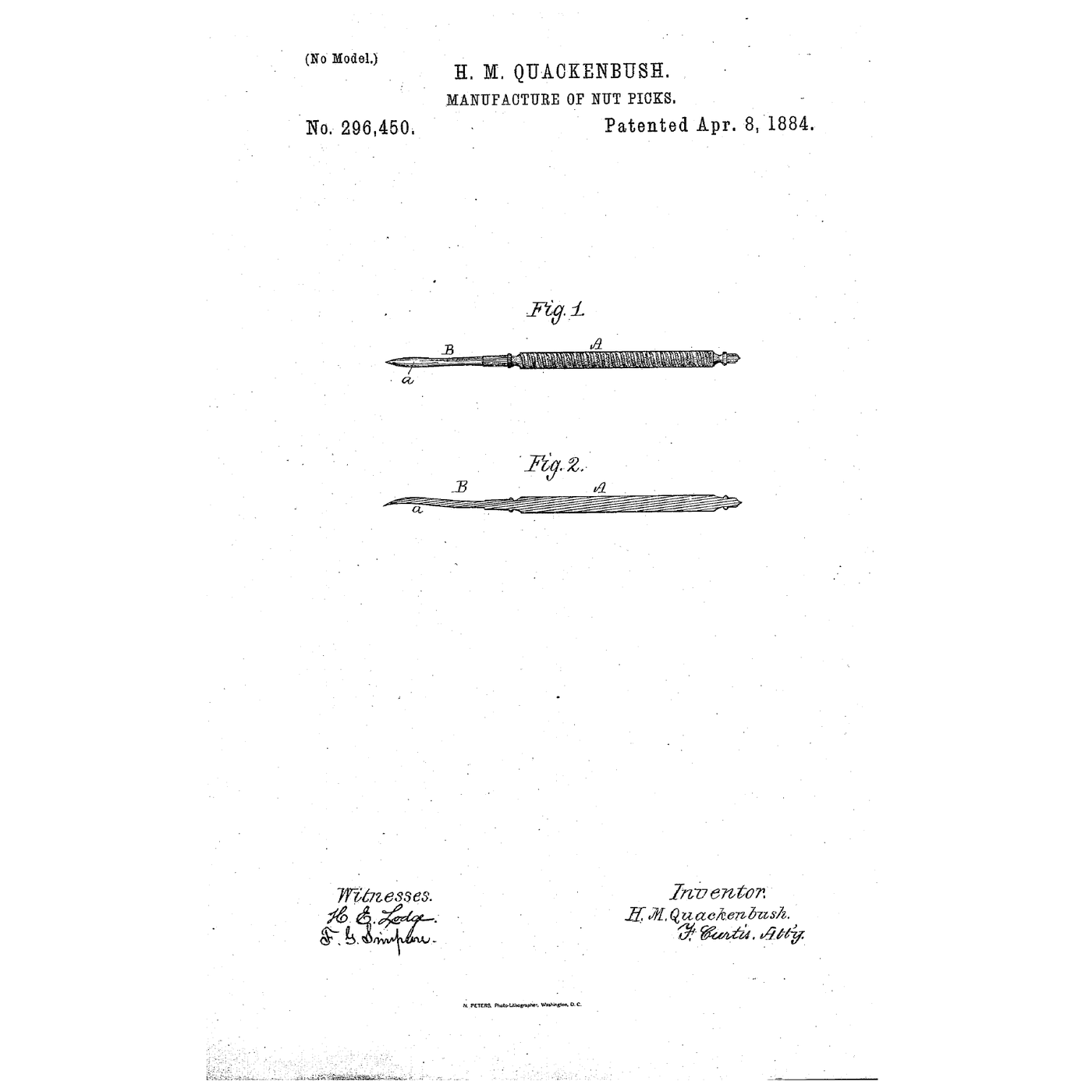


The One-Piece Nut Pick: A Point Hardened by Squeezing
A nut pick screwed together from a handle and a separate point works loose, and a soft point bends in the first hard shell.
Henry Marcus Quackenbush of Herkimer, New York, received US 296,450, dated 8 April 1884, for making nut picks from "one homogeneous piece of metal": a round wire whose handle is embossed so it does not slip in the hand, whose point is turned down in a lathe and then pressed in a die, giving, he wrote, "a point which is stiffer and harder than if the metal is left in its original density".
This rung works out what squeezing the point changes and what it does not, then makes two picks from steel rod, one hammered hard and one softened, and finds the pull that bends each.
Beginner
About 2 hours
Instructions
1
1
Stiffness against strength
Stiffness against strength
Loading Jupyter Notebook...
2
2
Hardening by squeezing
Hardening by squeezing
The embedded blueprint hardens bronze by working it cold and softens it by annealing. Quackenbush's die hardens a steel point the same way.
3
3
Read US 296,450
Read US 296,450
"Heretofore in the construction of these nut-picks it has been customary to form them from two pieces of metal, the body or handle portion and the point, which have been united by a screw-thread, and in forming the point the flat portion of the latter has been removed by 'milling,' and the curvature of the point afterward given to it."
"The ornamented handle imparts a high degree of finish to the instrument, and prevents its slipping in the user's hand."
4
4
Make two picks and bend them
Make two picks and bend them
**Handle.** Cut two 15 cm lengths of 4 mm mild steel rod. File a criss-cross pattern into 9 cm of each with the edge of the file, so the fingers grip it.
**Point.** Chuck the other end in the cordless drill, run it slowly and hold a file against it to taper the last 3 cm to about 2 mm, then to a point.
**Harden and soften.** Lay one point on the anvil and hammer the last 15 mm lightly from two sides into a flat, slightly curved blade: that is Quackenbush's squeeze. Hammer the second point the same, then heat it red with the torch and let it cool slowly in the air, which softens it again.
**Test.** Clamp each pick in the vice 15 mm behind the tip. Hook the spring scale on the tip, pull sideways in 2 N steps, let go after each step and note the force at which the point stays bent. Compare with the notebook, then pick out five walnuts with the hard one.
Materials for this step:
 Mild Steel Rod0.3 meter
 Walnut5 pieces
Tools needed:
 Hacksaw
 Files (Hand File)
 Cordless Drill
 Anvil
Anvil Hammer
 Propane Torch
 Bench Vise
 Force Meter (Spring Scale)
 Digital Caliper 6-Inch
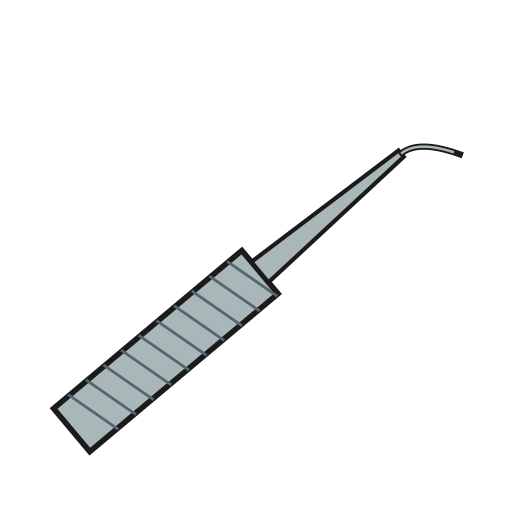 Nut Pick
 Leather Work Gloves
 Clear Safety Glasses
 Emery Cloth
5
5
A pick that bends, slips or snaps
A pick that bends, slips or snaps
One-piece nut pick troubleshooting.
Flow
Loading...
6
6
History and honest limits
History and honest limits
**Henry Marcus Quackenbush** of Herkimer, New York, filed US 296,450 on 24 March 1882; it is dated 8 April 1884. He embossed or ornamented the rod before turning the point, then compressed the point in a die, "condensing the metal simultaneously with imparting the desired longitudinal curvature", and polished or plated the finished pick.
**Honest limits.** Filing stands in for his embossing and lathe, and hand hammering on an anvil for his die. The notebook treats the point as a straight round beam; its yield strengths and sizes are examples. Your bend forces are the result.
Tools Required
13- Placeholder
- Placeholder
- 1 vendor sell this, none ship to you yetPlaceholder
- Placeholder
- Placeholder
- Placeholder
- Placeholder
- Placeholder
- Placeholder
- Placeholder
- Placeholder
- Placeholder
- Placeholder
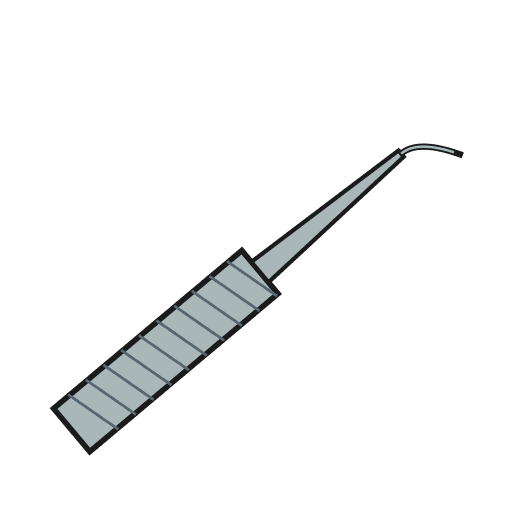
This blueprint makes
Related Blueprints
These blueprints share knowledge with this one — techniques, materials, or principles that connect them in the learning graph.


CC0 Public Domain
This blueprint is released under CC0. You are free to copy, modify, distribute, and use this work for any purpose, without asking permission.
Support the Maker by purchasing products through their Blueprint where they earn a Maker Commission set by Vendors, or create a new iteration of this Blueprint and include it as a connection in your own Blueprint to share revenue.