ART
BEAUTY & WELLNESS
CRAFT
CULTURE & HISTORY
ENTERTAINMENT
ENVIRONMENT
FOOD & DRINKS
REVERSE ENGINEERING
SCIENCES
SPORTS
TECHNOLOGY
WEARABLES

The Pouch-Ticket Coupon Punch: Change in the Ticket, the Coupon in a Locked Box
Street-railway conductors made change from their own pockets, and a company could not tell what a dishonest one kept.
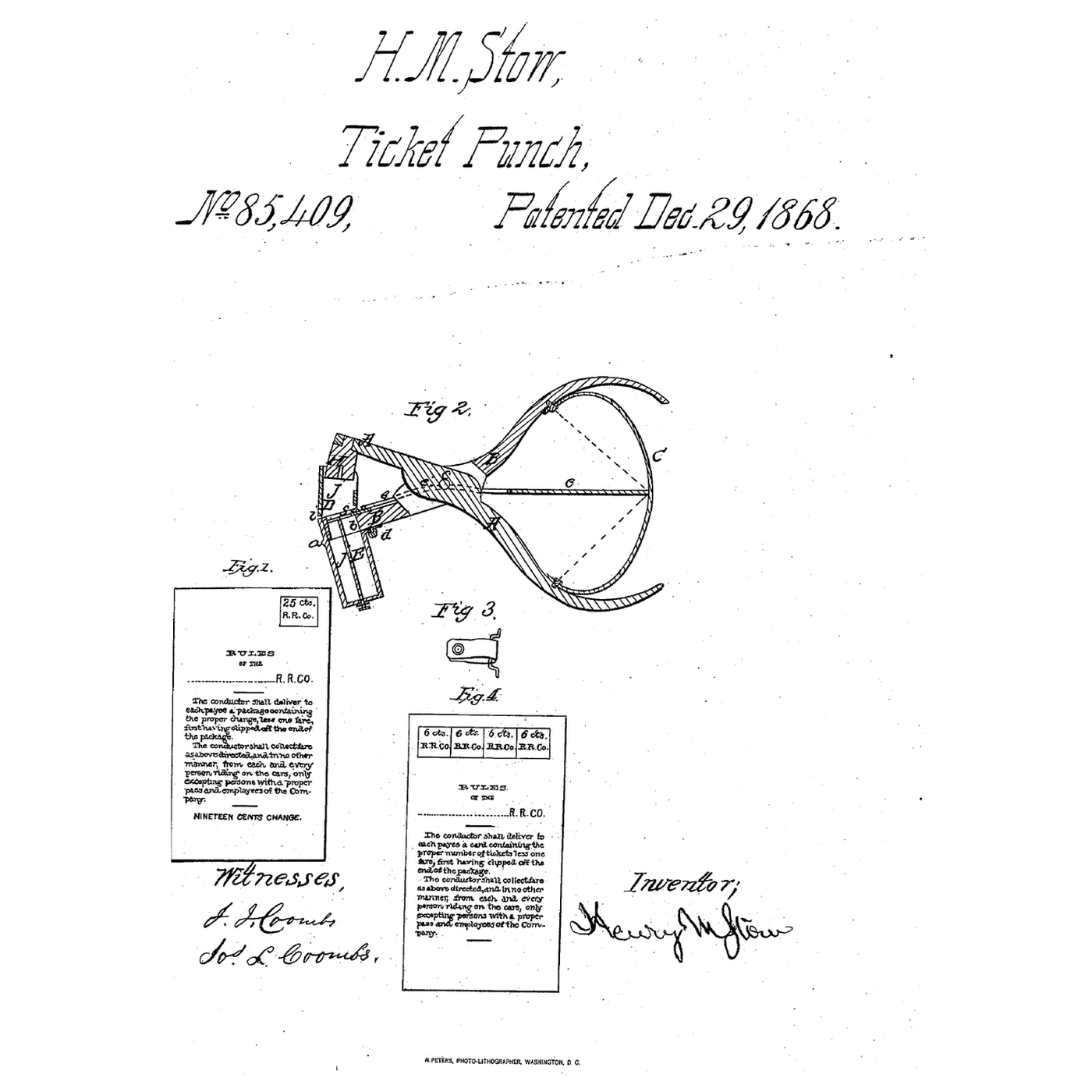
Henry M. Stow of San Francisco received US 85,409, dated 29 December 1868, for pouch coupon tickets and a punch for cutting coupons from them: "Each ticket is printed on one side of a small paper pouch" holding the right change for one of the common coins, "less one fare", with the amount paid on a coupon; the instrument "severs the coupon from the ticket, and deposits it (the coupon) in a locked box attached to the instrument, from which it cannot be removed without unlocking the box."
This rung checks that the coupons always balance the cash, then makes pouch tickets and a boxed cutter and runs a day of fares with card tokens.
Beginner
About 2 hours
Instructions
1
1
Coupons against cash
Coupons against cash
Loading Jupyter Notebook...
2
2
An account that cannot be altered
An account that cannot be altered
The embedded blueprint keeps an account both parties can check. Stow's locked-in coupons do the same for the conductor and the company.
3
3
Read US 85,409
Read US 85,409
"One of the great difficulties which street-railroad companies have hitherto had to contend with is the dishonesty of conductors in failing to account faithfully for the fares collected by them on their routes. My invention is intended to obviate this difficulty, as well as greatly to facilitate the making of change by the conductors."
"It is manifest that it will be impossible for the conductor to appropriate any money to his own use without detection, except by receiving fare and giving no ticket therefor, and this could not be practiced to any considerable extent without detection."
4
4
Make pouch tickets and run a day of fares
Make pouch tickets and run a day of fares
**Tokens.** Cut card tokens and mark them 1, 5, 10, 25 and 50 as "cents".
**Pouches.** Fold small pouches from card stock, one per ticket. Draw a coupon on one corner of each and write the amount paid on it: 10, 25 or 50. Put the change inside with a fare of 6: 4, 19 or 44 in tokens. Make some blank tickets with a 6 coupon and no change.
**Box.** Make a plywood box with a slot in the top and a lid held by one wood screw.
**Run.** A "conductor" sells tickets to passengers paying in tokens, cuts each coupon off with scissors over the slot so it drops into the box, and keeps the cash.
**Account.** Unscrew the box, add up the coupons, and count the conductor's cash. They must match, as the notebook shows. Then let the conductor "forget" one ticket and see the gap appear.
Materials for this step:
 Card Stock3 pieces
 Plywood Sheet1 piece
 Wood Screws1 piece
 Wood Glue5 ml
Tools needed:
 Scissors
 Craft Knife
 Coping Saw
 Screwdriver Set
 Ruler
Ruler Pencil
5
5
An account that does not balance
An account that does not balance
Pouch-ticket account troubleshooting.
Flow
Loading...
6
6
History and honest limits
History and honest limits
**Henry M. Stow** of San Francisco received US 85,409, dated 29 December 1868. He intended the system for city railways but also for other conveyances and toll roads; tickets issued by the company rather than the conductor were to differ in colour or otherwise, and his instrument's box carried a detective-lock.
**Honest limits.** Card pouches, card tokens, scissors and a screwed box stand in for his printed pouches, coins, punch and locked box. The notebook uses Stow's own 6-cent fare and change figures; the day's mix of tickets is an example. Your balanced account is the result.
Materials
4- 3 piecesPlaceholder
- 1 piecePlaceholder
- 1 piecePlaceholder
- 5 mlPlaceholder
Related Blueprints
These blueprints share knowledge with this one — techniques, materials, or principles that connect them in the learning graph.


CC0 Public Domain
This blueprint is released under CC0. You are free to copy, modify, distribute, and use this work for any purpose, without asking permission.
Support the Maker by purchasing products through their Blueprint where they earn a Maker Commission set by Vendors, or create a new iteration of this Blueprint and include it as a connection in your own Blueprint to share revenue.