ART
BEAUTY & WELLNESS
CRAFT
CULTURE & HISTORY
ENTERTAINMENT
ENVIRONMENT
FOOD & DRINKS
REVERSE ENGINEERING
SCIENCES
SPORTS
TECHNOLOGY
WEARABLES
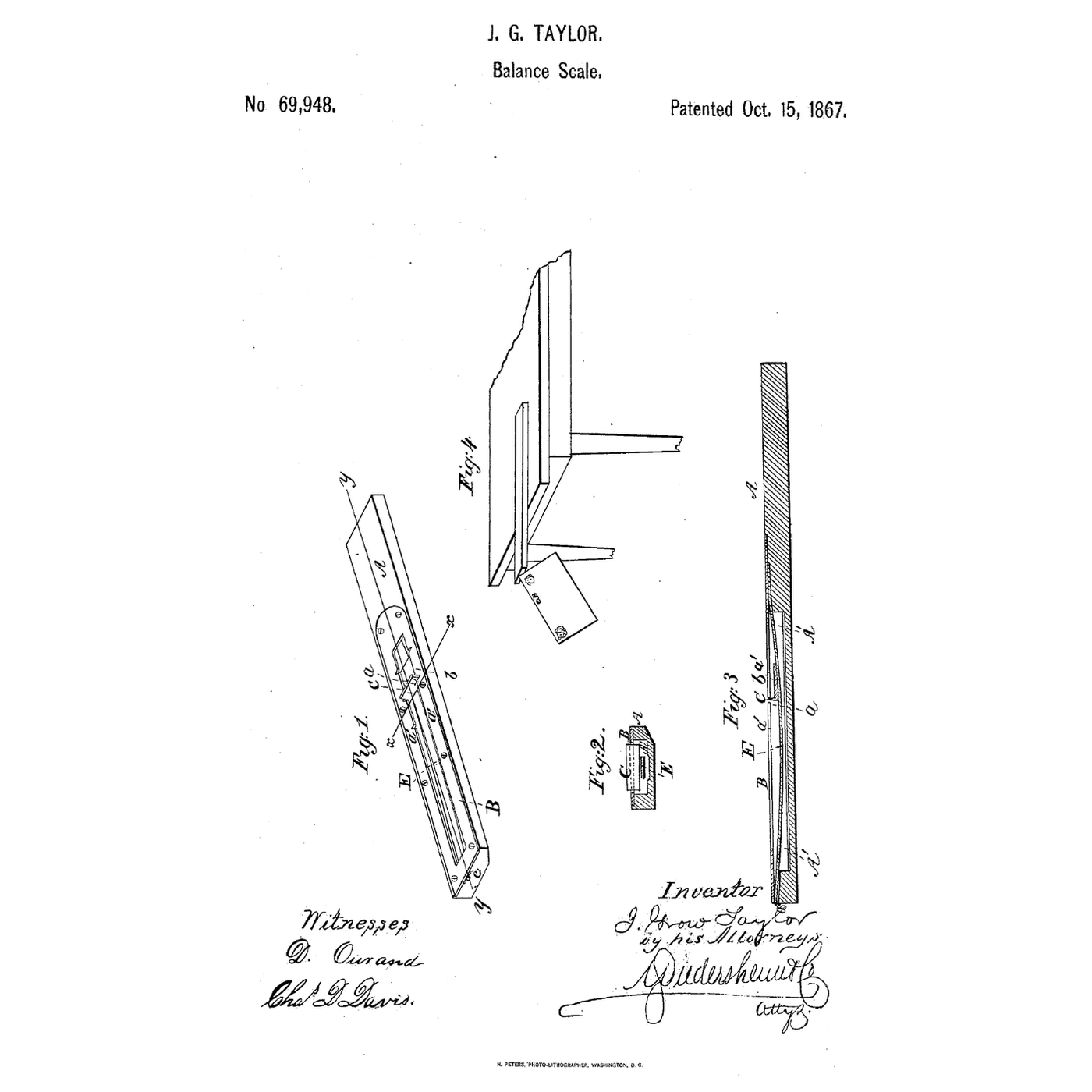


The Ruler Letter Scale: A Ruler That Weighs With Its Own Weight
Every desk has a ruler, but a letter scale is another thing to buy and to find room for.
T. Grow Taylor of Lawrenceville, New York, received US 69,948, dated 15 October 1867, for "adapting an ordinary rule or ruler to be used as a letter-scale by certain appliances whereby the functions of both will be retained, yet both act independently of each other": a notched plate in a channel on top of the ruler, an angular slide whose short arm forms the fulcrum, and a spring with a hook to hold the letter. Laid over the edge of a desk, the ruler balances the letter by its own weight.
This rung works out where the notches go, then fits a slide, notched plate and hook to a ruler and weighs letters with it.
Beginner
About 2 hours
Instructions
1
1
Notches from the ruler's own weight
Notches from the ruler's own weight
Loading Jupyter Notebook...
2
2
The ruler as its own counterweight
The ruler as its own counterweight
The embedded blueprint works out the lever law. Taylor's ruler needs no counterweight: its own weight, at its middle, balances the letter.
3
3
Read US 69,948
Read US 69,948
"C represents a slide, moving in the channel A′, and retained in place by the frame or plate B. The slide consists of an angular block, having its short arm a to protrude beyond the short plate B, and which will form the fulcrum of the scale."
"The rule is to be placed in the position shown in fig. 4, that is, with the slide underneath, and the weighing end to project over the end of a table, desk, or other resting place. The letter may be held by its flap catching in the hook, or may be pierced in one corner by the pin."
4
4
Fit the ruler and weigh letters
Fit the ruler and weigh letters
**Plate.** Weigh the ruler on the kitchen scale and run the notebook with its mass and length. Cut a strip of aluminium sheet 15 × 2 cm and file notches in one edge at the notebook's distances from the letter end.
**Slide.** Cut a small angular block from hardwood block with a short arm that sticks out below the ruler as the fulcrum. Tape the plate along the ruler's top so the slide runs under its notched edge and clicks into each notch.
**Hook.** Screw a strip of spring steel along the ruler's end with its tip bent into a hook, to hold a letter by its flap.
**Test.** Set the slide at the half-ounce notch, lay the ruler over the edge of the table with the slide on the edge, and hang letters weighed on the kitchen scale. Note which tip the ruler and which balance, and compare with their weights.
Materials for this step:
 Aluminium Sheet1 piece
 Hardwood Block1 piece
 Spring Steel Strip1 piece
 Wood Screws2 pieces
Tools needed:
 Ruler
Ruler Tin Snips
 Needle File Set
 Hacksaw
 Cordless Drill
 Drill Bit Set
 Screwdriver Set
 Flat-Nose Pliers
 Digital Kitchen Scale
 Digital Caliper 6-Inch
 Pencil
 Masking Tape
5
5
A ruler scale that reads wrong or will not balance
A ruler scale that reads wrong or will not balance
Ruler letter scale troubleshooting.
Flow
Loading...
6
6
History and honest limits
History and honest limits
**T. Grow Taylor** of Lawrenceville, St. Lawrence County, New York, signed US 69,948 on 13 April 1867; it is dated 15 October 1867 and antedated 17 April 1867. (The specification prints his name as T. Grow Taylor; the drawing sheet's header reads J. G. Taylor. Which initial is right is not settled here.) His inner notch marked half an ounce and the next a full ounce, the notches could be cut in the channel instead of a plate, and he offered gum or a pin in place of the hook.
**Honest limits.** A taped aluminium plate, a hardwood slide and a spring-steel hook stand in for his fitted parts. The notebook ignores the hook's weight; the ruler's mass and length are examples. Your weighings are the result.
Materials
4- 1 piecePlaceholder
- 1 piecePlaceholder
- 1 piecePlaceholder
- 2 piecesPlaceholder
Tools Required
12- Placeholder
- Placeholder
- Placeholder
- Placeholder
- 1 vendor sell this, none ship to you yetPlaceholder
- Placeholder
- Placeholder
- Placeholder
- Placeholder
- Placeholder
- 1 vendor sell this, none ship to you yetPlaceholder
- Placeholder
Related Blueprints
These blueprints share knowledge with this one — techniques, materials, or principles that connect them in the learning graph.



CC0 Public Domain
This blueprint is released under CC0. You are free to copy, modify, distribute, and use this work for any purpose, without asking permission.
Support the Maker by purchasing products through their Blueprint where they earn a Maker Commission set by Vendors, or create a new iteration of this Blueprint and include it as a connection in your own Blueprint to share revenue.