ART
BEAUTY & WELLNESS
CRAFT
CULTURE & HISTORY
ENTERTAINMENT
ENVIRONMENT
FOOD & DRINKS
REVERSE ENGINEERING
SCIENCES
SPORTS
TECHNOLOGY
WEARABLES
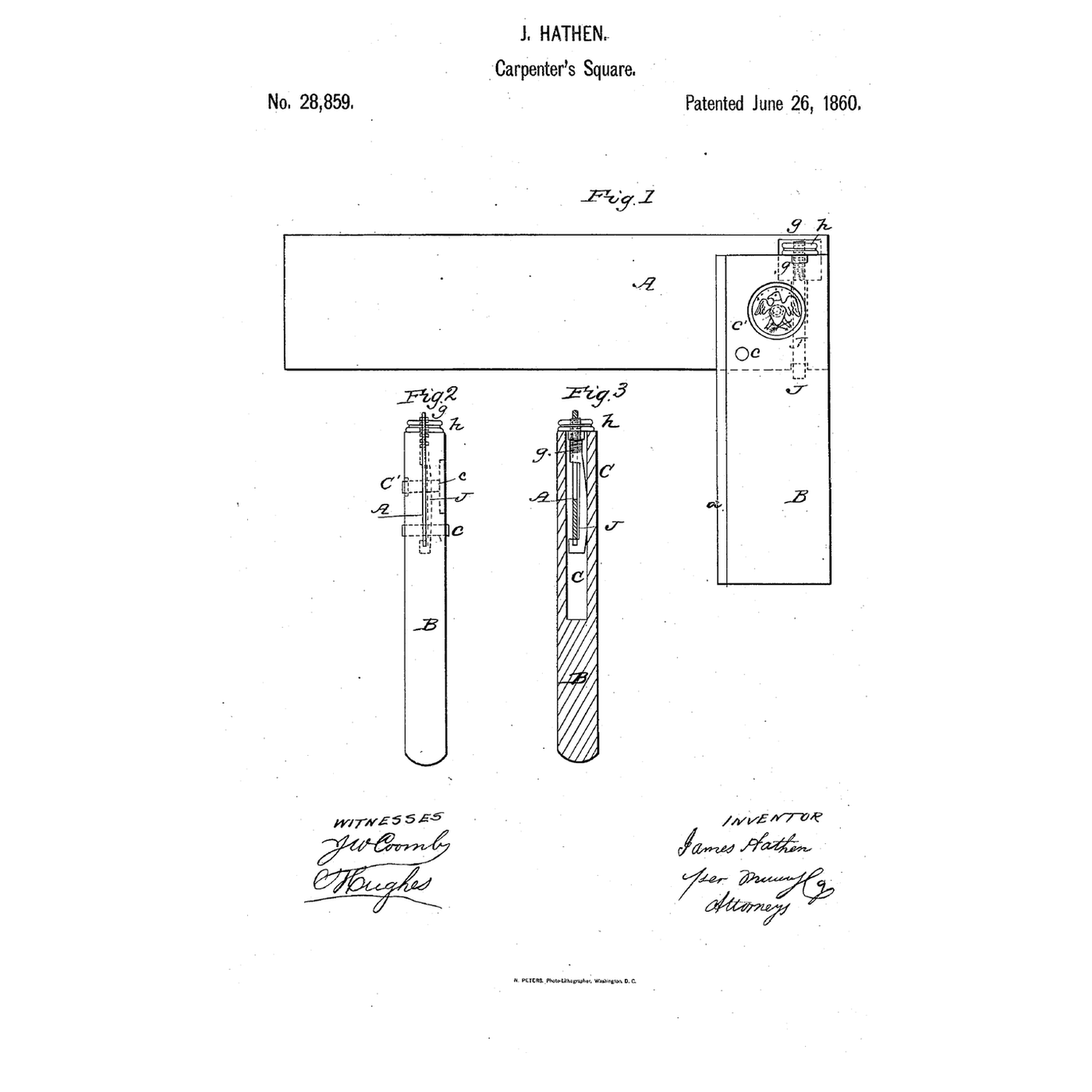


The Screw-Set Carpenter's Square: A Hidden Clamp That Sets the Blade True
A carpenter's square with its blade pinned into a wooden stock works loose, goes out of true, and cannot be set right again, because pins cannot be driven through stock and blade with any great accuracy.
James Hathen of Philadelphia, Pennsylvania, received US 28,859, dated 26 June 1860, for "attaching the blade to the stock by one or more adjustable screws, applied at either end of the stock, and in connection with a clamping plate or plates, and a pivot connection of the blade, made to secure the blade fixedly in its proper right angular position, and to adjust the blade in case it should be out of true". A slotted piece of metal, bearing on a beveled shoulder cut in the blade, is drawn up by a screw and a milled nut on the stock's head; the whole is hidden in the stock.
This rung works out how far a turn of the nut moves the blade's end, then builds the square with a hidden clamp and sets it true by the flip test.
Intermediate
About 5 hours
Instructions
1
1
One turn of the nut
One turn of the nut
Loading Jupyter Notebook...
2
2
An adjustable square before it
An adjustable square before it
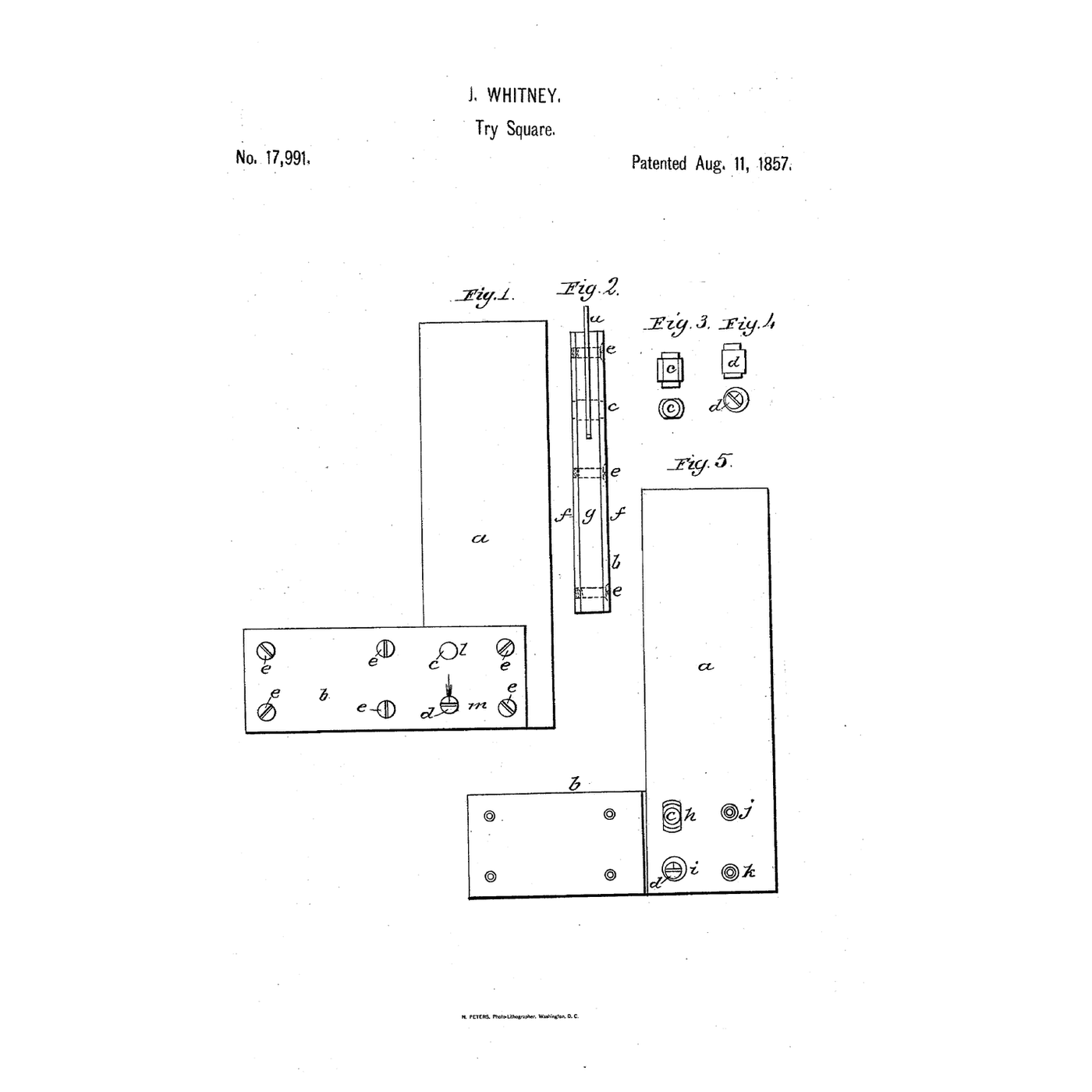
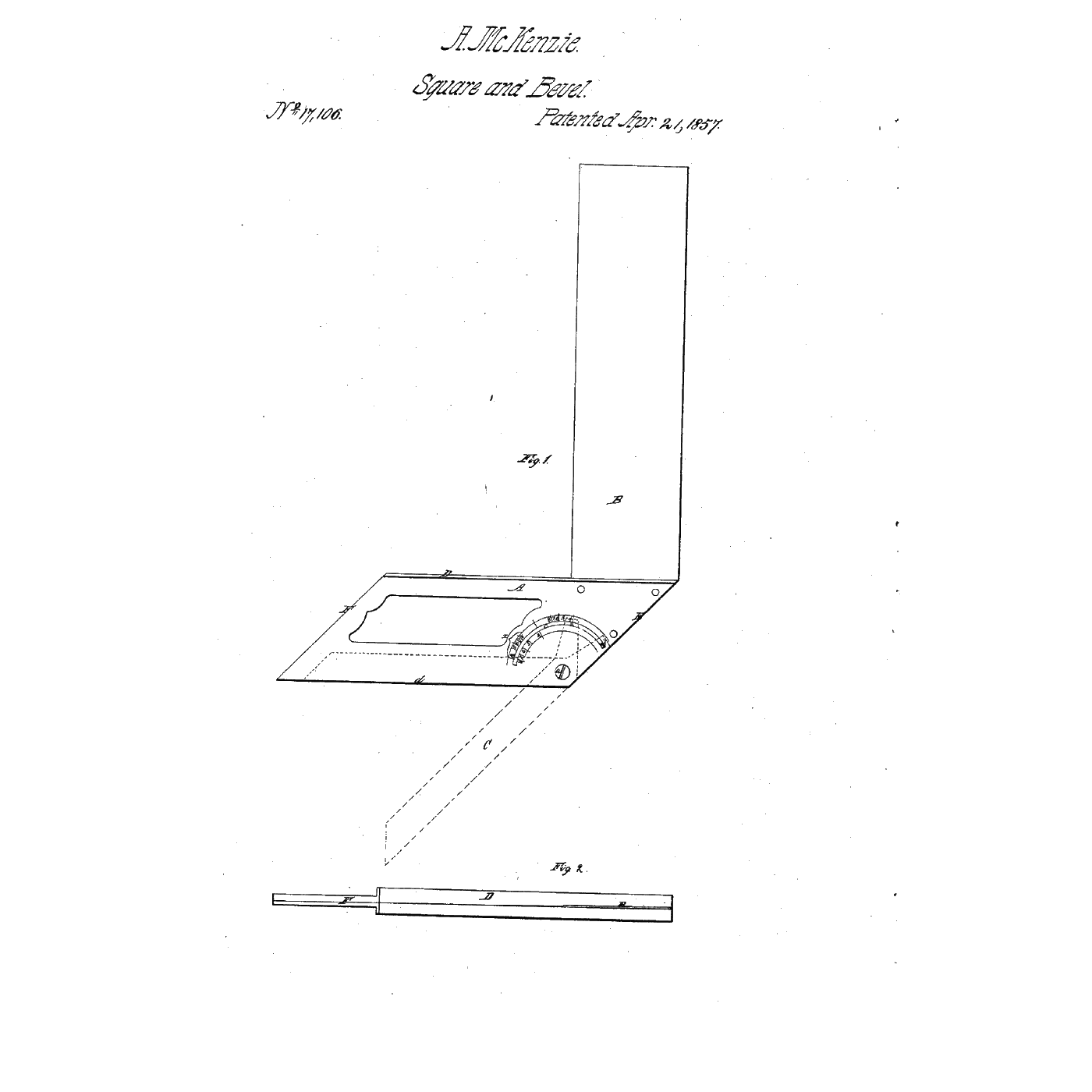
The embedded blueprint sets a try square's tongue with an eccentric pin. Hathen draws the blade down on a beveled shoulder with a screw and nut hidden in the stock.
3
3
Read US 28,859
Read US 28,859
"To this end I employ a slotted piece of metal J, having a shoulder on its lower end, on which the lower edge of the tongue or blade A, rests—a piece being cut out of the blade to allow it to fit well down on the beveled shoulder of the piece J, and to keep the piece from slipping out of its place. This piece J, terminates at its upper end in a screw g, that projects above the head of the stock B, and into the T-slot as shown in Figs. 1 and 3, and receives a milled nut h, which presses on the head or end of the stock B, when screwed up, and draws upon the blade A."
"It will thus be seen that to 'set' or fix the blade at an exact angle, after the pins have been inserted that secures it to the stock, it is only necessary to turn the nut h, when the blade may be drawn or forced to its proper position to a nicety, and it may afterwards be kept so."
4
4
Build the square and set it true
Build the square and set it true
**Stock.** Plane a hardwood stock 25 cm × 5 cm × 22 mm and saw a slit into one end, across its width, that the blade fits. Mortise a recess C inside the slit near the head and drill down from the head's end into it for an M5 screw.
**Blade.** Cut a 35 cm blade from aluminium flat bar. Near the end that enters the stock, file a notch with a beveled lower edge.
**Clamp J.** Cut a short strip of steel with a bent-over shoulder that fits the blade's notch, and silver-solder an M5 screw to its upper end as g. Put it in the recess so the screw passes up through the head, and fit a knurled or wing nut on it as h.
**Pins.** Put the blade in the slit, drill one hole through stock and blade near the pivot end and fit a pin as c; fit a second, looser pin c′ nearer the head.
**Set it true.** Draw a line along a straight board's edge with the square, flip it and draw again. Turn the nut until the two lines agree, and note how much it took.
Materials for this step:
 Hardwood Board1 piece
 Aluminium Flat Bar0.4 meter
 Mild Steel Flat Bar0.1 meter
 Machine Screws1 piece
 Hex Nut2 pieces
 Silver Solder Set (Easy/Medium/Hard)1 piece
 Flux1 piece
 Nails2 pieces
 Pine Board1 piece
Tools needed:
 Hand Saw
 Chisel Set - Wood
 Cordless Drill
 Drill Bit Set
 Files (Hand File)
 Hacksaw
 Bench Vise
 Propane Torch
 Screwdriver Set
 Pencil
 Ruler
Ruler Clear Safety Glasses
5
5
A square that will not set, or drifts again
A square that will not set, or drifts again
Screw-set carpenter's square troubleshooting.
Flow
Loading...
6
6
History and honest limits
History and honest limits
**James Hathen** of Philadelphia, Pennsylvania, received US 28,859, dated 26 June 1860; Charles Disston was one of his witnesses. The stock B was wooden with the usual metal face plate a, the blade was inserted in a slit cut transversely into its end, and all the parts were within the stock except the thumb screw. His claim is one or more adjusting clamps J at either end of the stock, used with the pins c and c′.
**Honest limits.** Aluminium flat bar and a soldered strip stand in for his steel blade and clamp, and the face plate is left out. The notebook treats the blade as turning about one pin; its pitch and lengths are examples. Your flip test is the result.
Materials
9- 1 piecePlaceholder
- 0.4 meterPlaceholder
- 0.1 meterPlaceholder
- 1 piecePlaceholder
- 2 piecesPlaceholder
- 1 piecePlaceholder
- 1 piecePlaceholder
- 2 piecesPlaceholder
- 1 piecePlaceholder
Tools Required
12- Placeholder
- Placeholder
- 1 vendor sell this, none ship to you yetPlaceholder
- Placeholder
- Placeholder
- Placeholder
- Placeholder
- Placeholder
- Placeholder
- 1 vendor sell this, none ship to you yetPlaceholder
- Placeholder
- Placeholder
This blueprint makes

Related Blueprints
These blueprints share knowledge with this one — techniques, materials, or principles that connect them in the learning graph.
CC0 Public Domain
This blueprint is released under CC0. You are free to copy, modify, distribute, and use this work for any purpose, without asking permission.
Support the Maker by purchasing products through their Blueprint where they earn a Maker Commission set by Vendors, or create a new iteration of this Blueprint and include it as a connection in your own Blueprint to share revenue.