ART
BEAUTY & WELLNESS
CRAFT
CULTURE & HISTORY
ENTERTAINMENT
ENVIRONMENT
FOOD & DRINKS
REVERSE ENGINEERING
SCIENCES
SPORTS
TECHNOLOGY
WEARABLES


The Self-Winding Chalk-Line Reel: A Coil Spring That Reels the Line Back
Winding a carpenter's chalk line back by hand after every snap wastes time and leaves the line in a tangle.
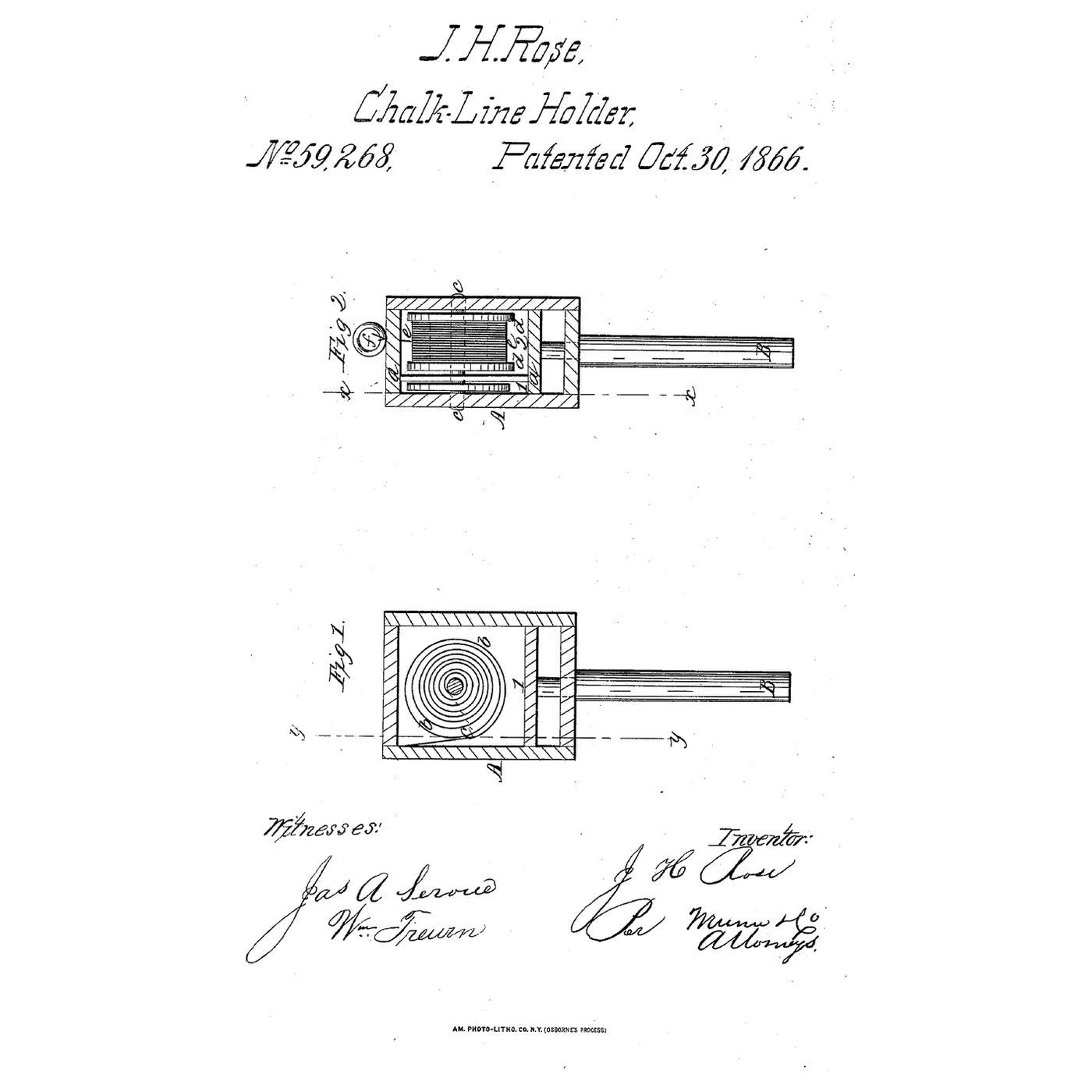
Jonathan H. Rose of Mount Sterling, Illinois, received US 59,268, dated 30 October 1866, for a chalk-line winder "by means of a self-acting coil-spring, which, with the reel, is inclosed in a small hand-box, thereby furnishing a convenient and useful instrument for a workman, saving much time in winding the chalk-line and keeping clean and in good order, always ready for use." Drawing the line out winds the spring; letting it go, "the spring will draw the chalk-line back into the box".
This rung works out how many turns the spring must hold, then builds the box with a coiled spring-steel spring and times the line reeling back.
Intermediate
About 3 hours
Instructions
1
1
Turns the spring must store
Turns the spring must store
Loading Jupyter Notebook...
2
2
The spring that does the work
The spring that does the work
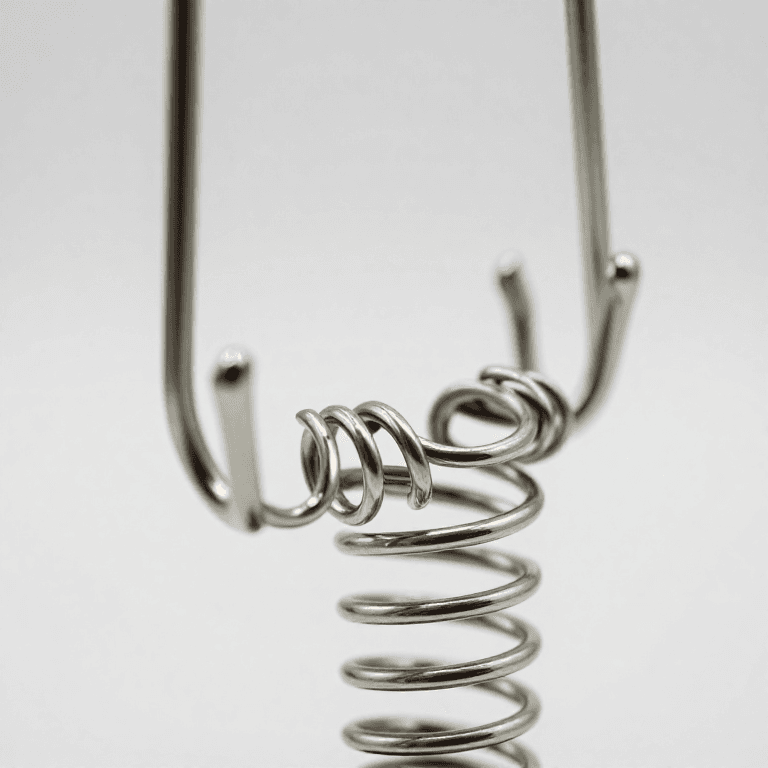
The embedded blueprint explains how a spring's proportions set its force. Rose's flat coil spring has to store a turn for every loop of line drawn out.
3
3
Read US 59,268
Read US 59,268
"A represents a small flat rectangular wooden box, with a handle, B, at one end. The box is divided into two compartments by a thin partition, a a. A narrow compartment, No. 1, contains a long flat coil-spring, b b, the outer end of which is fastened to one side of the box, as shown in Fig. 1, and the other or central end of the spring to a spindle, c c, running through the center of the partition a a".
"The chalk-line is placed upon the reel so that when it is wound up the coil-spring b is fully expanded, and when it is drawn out for use by the holding-ring f the spring will be contracted or closed around the spindle c c by the turning of the spindle".
4
4
Build the reel and time the rewind
Build the reel and time the rewind
**Box.** From plywood make a box 12 × 12 × 5 cm inside with a thin partition dividing it into a 1.5 cm and a 3.5 cm compartment, and glue a dowel handle to one end. Drill a 6 mm hole through the partition's centre and both sides for the spindle.
**Spring.** Coil 1.2 m of spring steel strip into a flat spiral, fix its outer end to the narrow compartment's wall with a screw, and its inner end into a slot sawn in a 6 mm dowel spindle.
**Reel.** Glue two 8 cm plywood discs to the spindle in the wide compartment, 1 cm apart. Wind 2 m of cotton twine on it with the spring relaxed, thread the end out through a small hole, and tie on a ring. Put marking chalk in the wide compartment.
**Test.** Pull the line out 1 m and 2 m, counting the reel's turns through the hole, and let go; time the rewind with the stopwatch. Compare the turns with the notebook, and snap a chalk line with it.
Materials for this step:
 Plywood Sheet1 piece
 Hardwood Dowels0.2 meter
 Spring Steel Strip1 piece
 Wood Screws4 pieces
 Wood Glue10 ml
 Cotton Twine2 meters
 Marking Chalk30 g
Tools needed:
 Hand Saw
 Coping Saw
 Hole Saw Kit
 Cordless Drill
 Drill Bit Set
 Flat-Nose Pliers
 Screwdriver Set
 Stopwatch
 Ruler
Ruler Chalk Line
 Leather Work Gloves
 Clear Safety Glasses
5
5
A reel that will not rewind, jams or springs back violently
A reel that will not rewind, jams or springs back violently
Self-winding chalk-line reel troubleshooting.
Flow
Loading...
6
6
History and honest limits
History and honest limits
**Jonathan H. Rose** of Mount Sterling, Brown County, Illinois, signed US 59,268 on 14 July 1866; it is dated 30 October 1866. His claim is the coil spring, spindle and reel combined with the partitioned box and handle.
**Honest limits.** A plywood box and a hand-coiled strip of spring steel stand in for his wooden box and long flat coil spring, and the line is short to suit that spring. The notebook ignores the line's thickness building up on the reel; its lengths and radii are examples. Your turn counts and times are the result.
Materials
7- 1 piecePlaceholder
- 0.2 meterPlaceholder
- 1 piecePlaceholder
- 4 piecesPlaceholder
- 10 mlPlaceholder
- 2 metersPlaceholder
- 30 gPlaceholder
Tools Required
12- Placeholder
- Placeholder
- Placeholder
- 1 vendor sell this, none ship to you yetPlaceholder
- Placeholder
- Placeholder
- Placeholder
- Placeholder
- Placeholder
- Placeholder
- Placeholder
- Placeholder
This blueprint makes
Related Blueprints
These blueprints share knowledge with this one — techniques, materials, or principles that connect them in the learning graph.



CC0 Public Domain
This blueprint is released under CC0. You are free to copy, modify, distribute, and use this work for any purpose, without asking permission.
Support the Maker by purchasing products through their Blueprint where they earn a Maker Commission set by Vendors, or create a new iteration of this Blueprint and include it as a connection in your own Blueprint to share revenue.