ART
BEAUTY & WELLNESS
CRAFT
CULTURE & HISTORY
ENTERTAINMENT
ENVIRONMENT
FOOD & DRINKS
REVERSE ENGINEERING
SCIENCES
SPORTS
TECHNOLOGY
WEARABLES


The Self-Winding Garden Line: A Spring and Pinion Reel the Line Back, and It Can Chalk Itself
A line for laying out garden beds and walls tangles when it is wound back by hand, gets thrown about and lost.
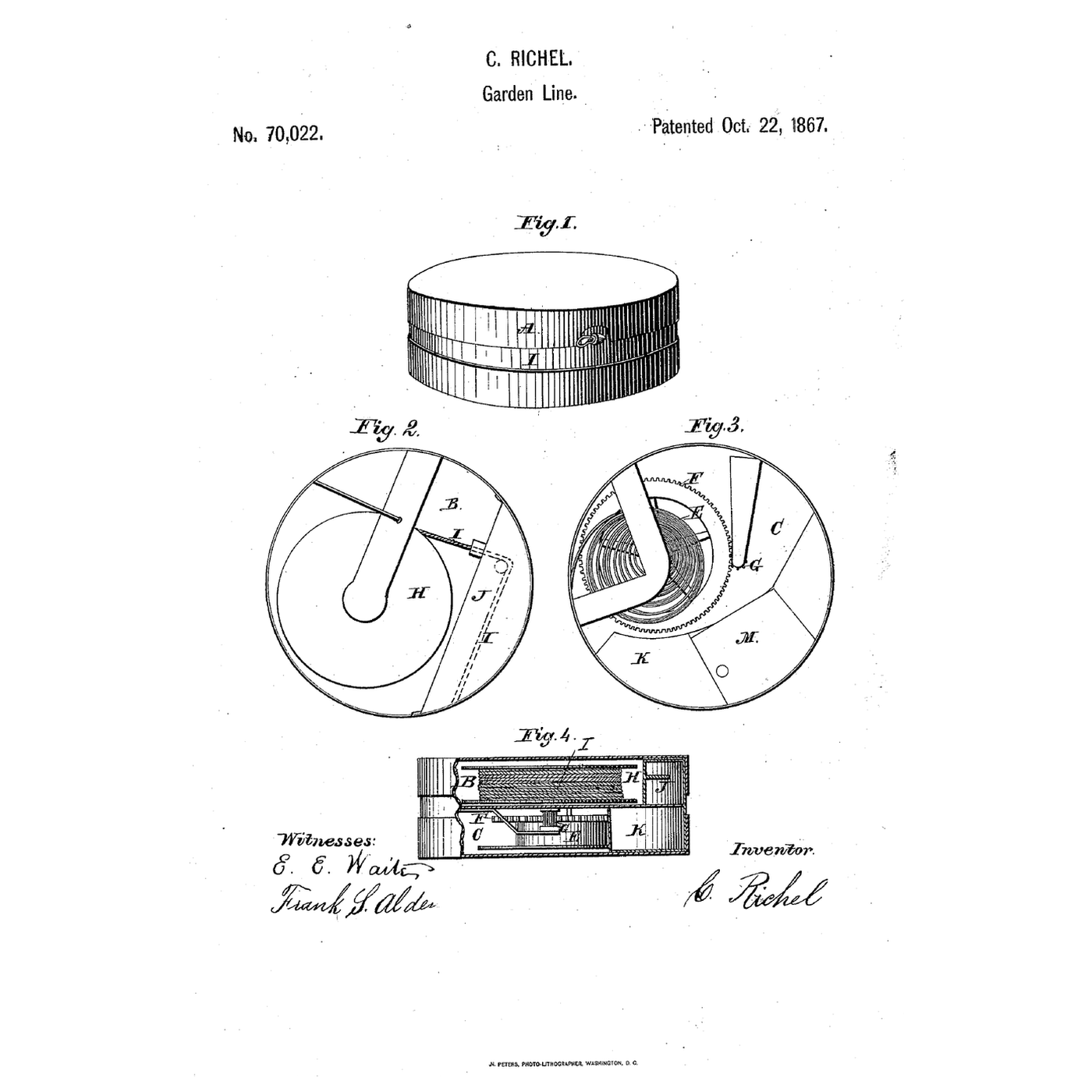
C. Richel of Cleveland, Ohio, received US 70,022, dated 22 October 1867, for a metal case divided by a diaphragm into two sections: in one a coiled spring on a spindle with a cog-wheel, in the other a spool on the shaft of a pinion the cog-wheel drives. "By the operation of drawing out the line the coiled spring are tensioned more or less, according to the length of the cord drawn out, but which, on liberating the line, will immediately recoil and wind it up again on the spool". A chamber in the lower section filled with chalk dust makes it a self-chalking builders' line too.
This rung works out how the pinion lets a short spring wind a long line, then builds the two-section case from a tin with a coiled spring, printed gears and a spool, and lays out a bed with it.
Intermediate
About 5 hours
Instructions
1
1
Spring, wheel and pinion
Spring, wheel and pinion
Loading Jupyter Notebook...
2
2
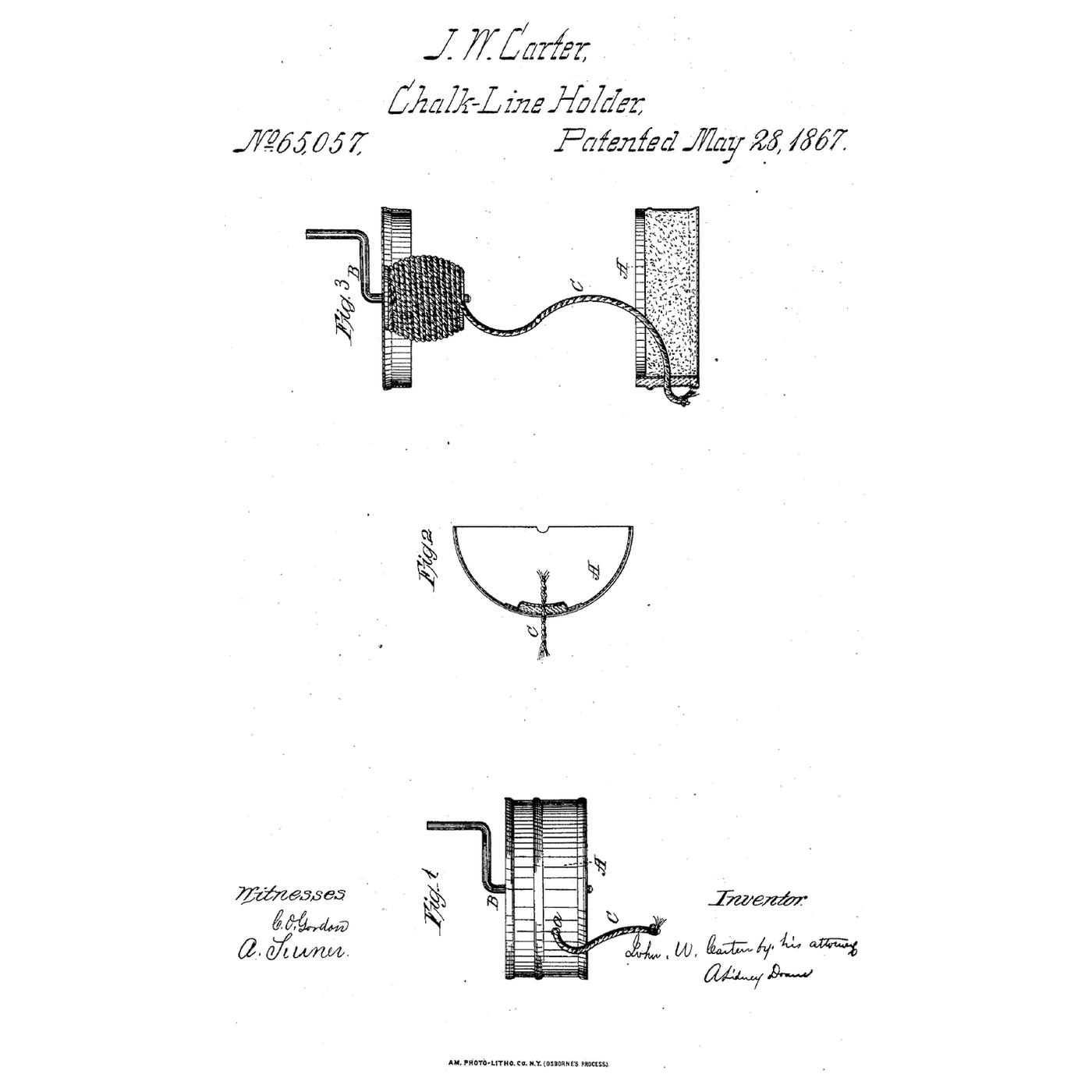
A chalk-line reel before it
A chalk-line reel before it
The embedded blueprint winds its chalked line back with a crank. Richel winds his back with a spring through a pinion, and can chalk it the same way.
3
3
Read US 70,022
Read US 70,022
"In fig. 1, A represents a metallic case or box, the size of which being according to the length of the line wound up within the same. This box is divided into two sections, B and C, fig. 4, by a diaphragm, D. In section C is arranged a coiled spring, E, fig. 3. On the spindle to which the spring is attached is keyed a cog-wheel, F, which is made to engage in a pinion, G."
"This apparatus is very convenient for all purposes requiring the use of a line, as laying out gardens, walls, beds, rows, &c. It can also be used by builders as a guide-line or chalk-line, and for which either purpose it may be self-chalking, if so desired, by filling the chamber K with chalk dust."
4
4
Make the reel and lay out a bed
Make the reel and lay out a bed
**Case.** Use a round tin about 10 cm across and 5 cm deep. Cut a disc of tin as the diaphragm D and fix it across the middle on small brackets, dividing the tin into two sections.
**Spring and wheel.** Coil a strip of spring steel round a spindle in the lower section, fix its inner end to the spindle and its outer end to the tin's wall, and fit a printed cog-wheel F on the spindle, with about six times as many teeth as the pinion.
**Pinion and spool.** Mount a printed pinion G meshing with the wheel, its shaft passing through the diaphragm into the upper section, and fit a printed spool H on it there. Wind cord on the spool and lead its end out through a hole in the case to a ring or knob L.
**Chalk chamber.** Glue a small tin compartment with a sliding cover in the lower section, filled with chalk dust, which the cord passes through, if a chalk line is wanted.
**Test.** Draw the line out 5 m between two stakes to lay out a bed, then let it go and time how quickly it winds back. Count the turns of the spool per turn of the spring.
Materials for this step:
 Tin Can2 pieces
 Spring Steel Strip0.8 meter
 PLA Filament1 piece
 Mild Steel Rod0.1 meter
 Two-Part Epoxy1 piece
 Cotton Twine10 meters
 Marking Chalk1 piece
 Wooden Dowel0.6 meter
Tools needed:
 FDM 3D Printer
 Tin Snips
 Cordless Drill
 Drill Bit Set
 Round-nose Pliers
 Flat-Nose Pliers
 Files (Hand File)
 Stopwatch
 Leather Work Gloves
5
5
A reel that will not wind, winds too hard or jams
A reel that will not wind, winds too hard or jams
Self-winding garden line troubleshooting.
Flow
Loading...
6
6
History and honest limits
History and honest limits
**C. Richel** of Cleveland, Cuyahoga County, Ohio, received US 70,022, dated 22 October 1867. The line's free end was led from the spool through a chamber J to a ring or knob L outside; access to the chamber K was by a sliding cover M, and a supplementary cover on the side made removal of the chamber easier. His claim is the spring mechanism in combination with the chalk-box and line.
**Honest limits.** A tin case, printed gears and a coiled strip stand in for his metal case and works. The notebook ignores friction and assumes an even spring torque; its turns, ratio and sizes are examples. Your laid-out bed is the result.
Materials
8- 2 piecesPlaceholder
- 0.8 meterPlaceholder
- 1 piecePlaceholder
- 0.1 meterPlaceholder
- 1 piecePlaceholder
- 10 metersPlaceholder
- 1 piecePlaceholder
- 0.6 meterPlaceholder
Tools Required
9- Placeholder
- Placeholder
- 1 vendor sell this, none ship to you yetPlaceholder
- Placeholder
- Placeholder
- Placeholder
- Placeholder
- Placeholder
- Placeholder
Related Blueprints
These blueprints share knowledge with this one — techniques, materials, or principles that connect them in the learning graph.

CC0 Public Domain
This blueprint is released under CC0. You are free to copy, modify, distribute, and use this work for any purpose, without asking permission.
Support the Maker by purchasing products through their Blueprint where they earn a Maker Commission set by Vendors, or create a new iteration of this Blueprint and include it as a connection in your own Blueprint to share revenue.