ART
BEAUTY & WELLNESS
CRAFT
CULTURE & HISTORY
ENTERTAINMENT
ENVIRONMENT
FOOD & DRINKS
REVERSE ENGINEERING
SCIENCES
SPORTS
TECHNOLOGY
WEARABLES


The Turning-Plug Thread Former: A Plug That Turns With the Bottle and Leaves a Screw in the Neck
A screw inside a bottle's neck holds a cork against the gas, but a plug that forms it cannot stay still while the neck is turned and shaped round it, or it tears the material.
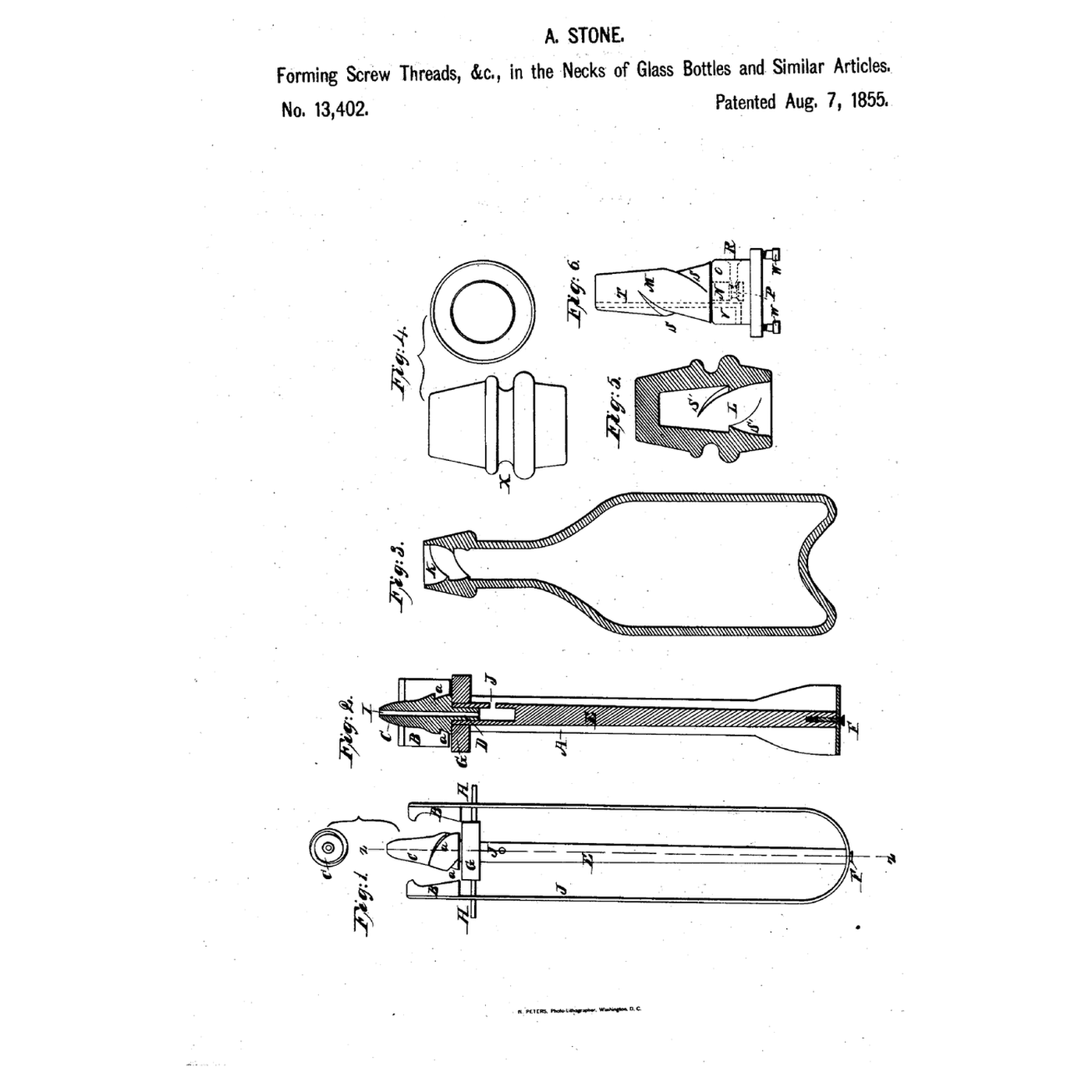
Amasa Stone of Philadelphia received US 13,402, dated 7 August 1855, for tools "so as to allow the plug which forms the interior of the orifice to turn with the bottle; while the material of the neck is worked around it". Forming jaws on a spring shape the outside of the neck; the plug between them, on a spindle that turns freely, carries a two-threaded left-handed screw. A cork forced into the finished neck swells into the threads, and a right-handed corkscrew with a collar unscrews it.
This rung works out how far each turn draws the cork, then prints a plug on a free spindle, forms a stoneware neck round it, fires it, and unscrews a cork from it.
Advanced
About 2 days, with drying and firing
Instructions
1
1
Turns to draw the cork
Turns to draw the cork
Loading Jupyter Notebook...
2
2
The corkscrew that unscrews it
The corkscrew that unscrews it
The embedded blueprint makes a corkscrew whose button stops against the cork. Stone's corks are removed by such a collared, right-handed corkscrew: once the collar meets the cork, turning on unscrews it.
3
3
Read US 13,402
Read US 13,402
"The plug C, is represented as having two angular scores a, a, made spirally upon it, so as to form a two threaded left handed male screw, the angle of the scores nearest or next to the apex, being made at a right angle to the center of the plug and the angle next to the base forming an acute angle with the center of the plug; the latter so as to give such a form to the orifice K, of the bottle Fig. 3, as will permit the cork to be readily forced in"
"What I claim as my invention in the construction of tools for forming screw threads, angular or other scores in the necks and orifices of glass, earthen, or other bottles, and other articles, is— Making the plug which forms the interior of the orifice, to turn with the bottle, jug, or other article while the material of the orifice is worked around it, substantially as described."
4
4
Form a threaded neck and unscrew a cork from it
Form a threaded neck and unscrew a cork from it
**Plug.** Print a plug that tapers from 24 mm at its base to 18 mm at its tip over 35 mm, with two left-handed spiral scores 6 mm apart, each square to the axis on the side toward the tip and sloping on the side toward the base, and a 4 mm hole through its length. Make it about 12% larger than the neck you want, for the clay's shrinkage.
**Spindle.** Fix the plug on a hardwood dowel and pass the dowel through a hole in a hardwood block clamped to the wheel's frame, so the plug turns freely point down over the wheel's centre.
**Neck.** Throw a small bottle on the wheel and close it in to a thick neck. Grease the plug with petroleum jelly, lower it into the neck, and shape the neck round it with the clay tools while the wheel turns: the plug turns with the bottle, as Stone's did, and the clay is pressed into its scores. Leave it until leather-hard, then turn the plug out by hand the way that unscrews it.
**Fire.** Dry the bottle slowly and fire it in the kiln at the clay's stated temperature.
**Test.** Fill the bottle with water and push in a squeezed cork. The next day, drive the button corkscrew in until its button meets the cork, keep turning the same way, and see the cork rise out.
Materials for this step:
 Stoneware Clay2 kg
 PETG Filament1 piece
 Wooden Dowel0.3 meter
 Hardwood Block1 piece
 Corks2 pieces
 Water0.5 liter
Tools needed:
 FDM 3D Printer
 Pottery Wheel
 Clay Tool Set
 Kiln
Kiln Cordless Drill
 Drill Bit Set
 Clamps
 Digital Caliper 6-Inch
 Combination Pliers
 Petroleum Jelly
5
5
A neck that tears, sticks to the plug or will not hold the cork
A neck that tears, sticks to the plug or will not hold the cork
Turning-plug thread former troubleshooting.
Flow
Loading...
6
6
History and honest limits
History and honest limits
**Amasa Stone** of Philadelphia, Pennsylvania, received US 13,402, dated 7 August 1855. His plug C was pierced with a hole I through its length and a hole J through the spindle to let air in and out of the bottle; the spindle E turned in a block G on pivots H, H between the legs of the forceps. He described the same turning plug for the insides of telegraph insulators. After his death, Sarah T. Stone, administratrix of his estate, entered a disclaimer limiting the patent to glass, disclaiming earthen ware and other materials.
**Honest limits.** Stoneware on a potter's wheel stands in for glass worked hot in the forceps, because glass cannot be worked at home this way; the patent, as limited by the disclaimer, covers glass. The plug's sizes are not Stone's. The notebook ignores the cork's squeeze and friction; its pitches and heights are examples. Your unscrewed cork is the result.
Materials
6- 2 kgPlaceholder
- 1 piecePlaceholder
- 0.3 meterPlaceholder
- 1 piecePlaceholder
- 2 piecesPlaceholder
- 0.5 literPlaceholder
Tools Required
10- Placeholder
- Placeholder
- Placeholder
- Placeholder
- 1 vendor sell this, none ship to you yetPlaceholder
- Placeholder
- Placeholder
- Placeholder
- Placeholder
- Placeholder
Related Blueprints
These blueprints share knowledge with this one — techniques, materials, or principles that connect them in the learning graph.
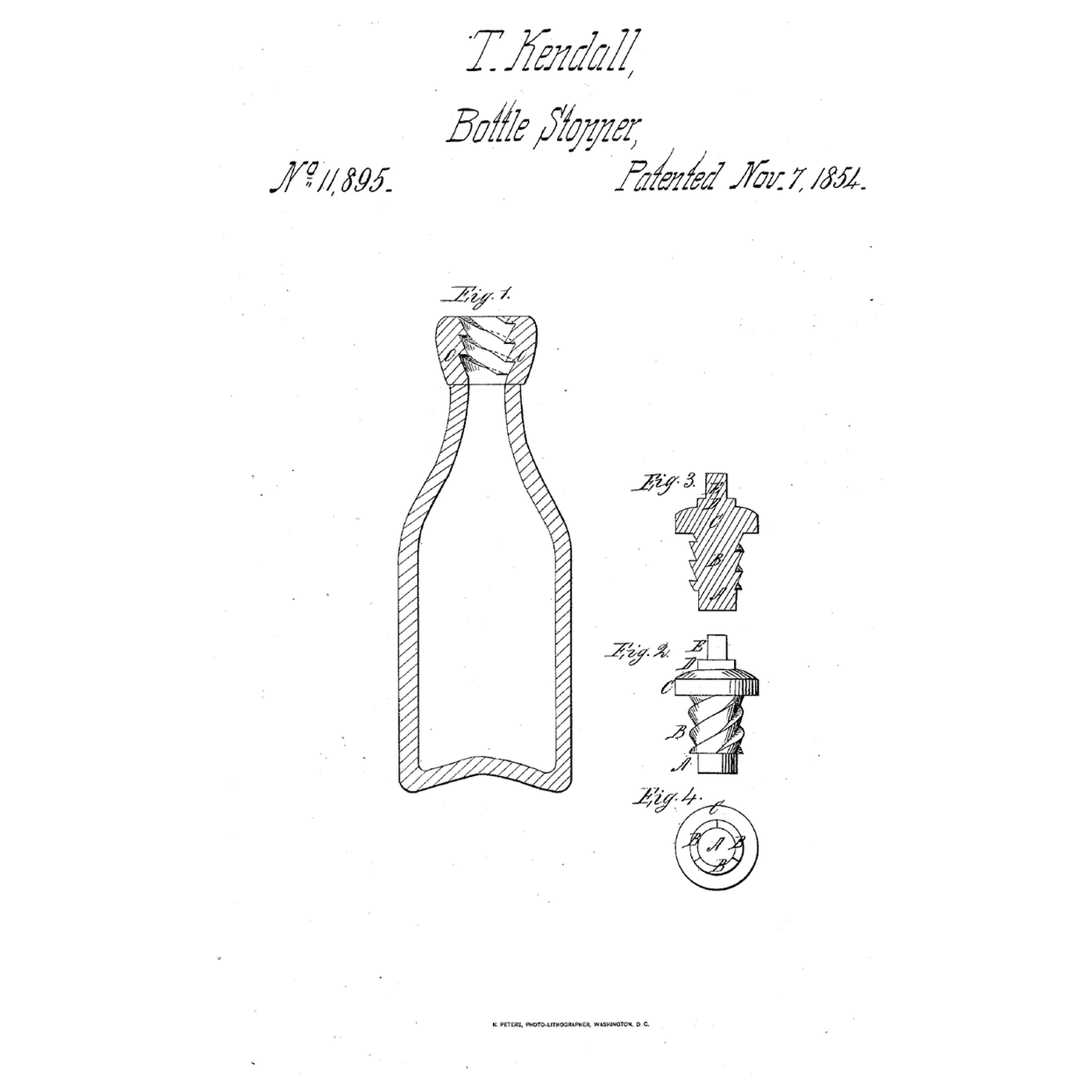
The Groove-Necked Bottle: Three Threads in the Neck That Hold the Cork
by Emma
Drinks
22
0
0
0
0
0
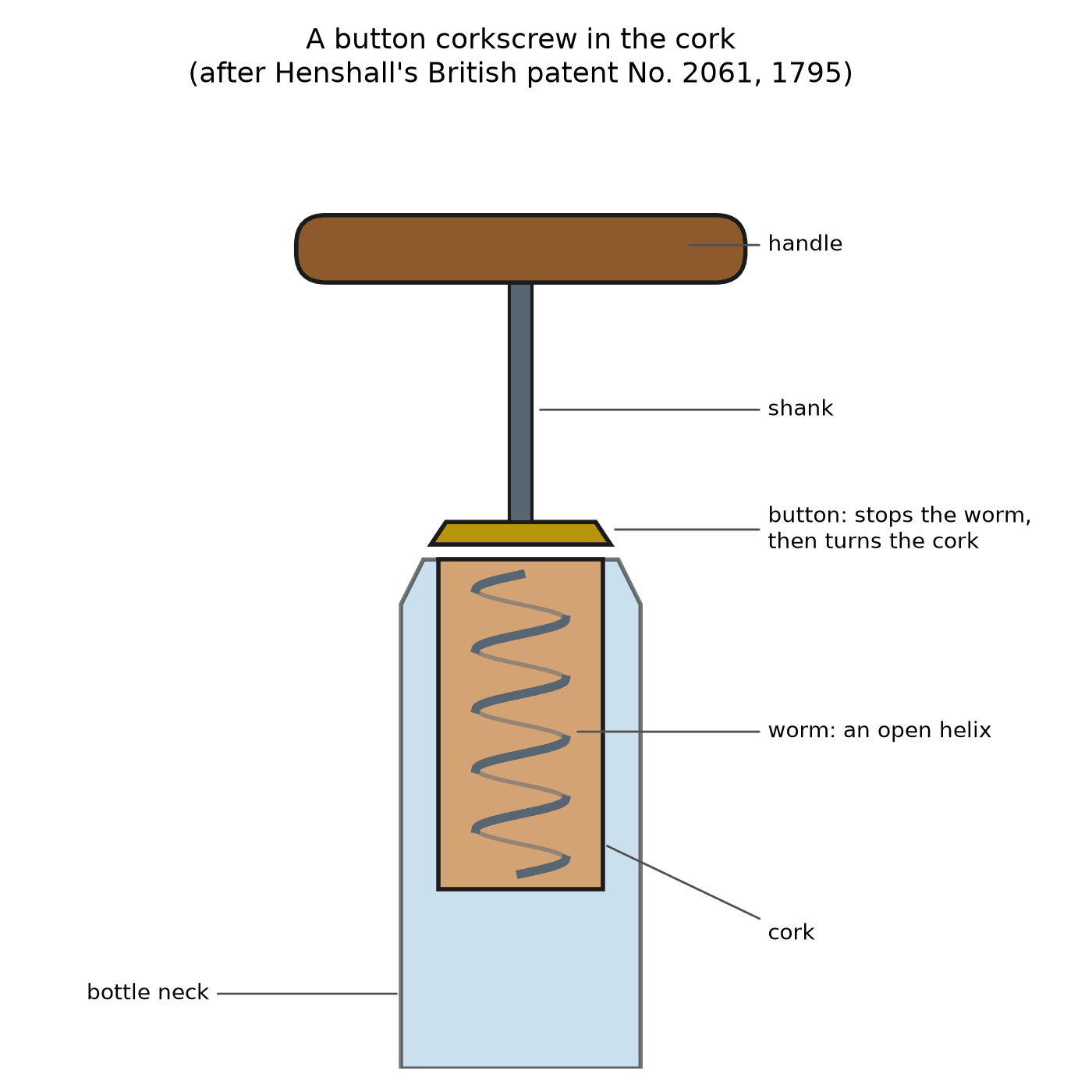
The Button Corkscrew: A Helix That Grips and a Disc That Stops It
by YourGrandma
FOOD & DRINKS
38
0
0
0
0
0
Blowing a Glass Bottle by Hand — Free-Blown Vessel Shaping
by Forge
Glassworking
54
0
0
0
3
0
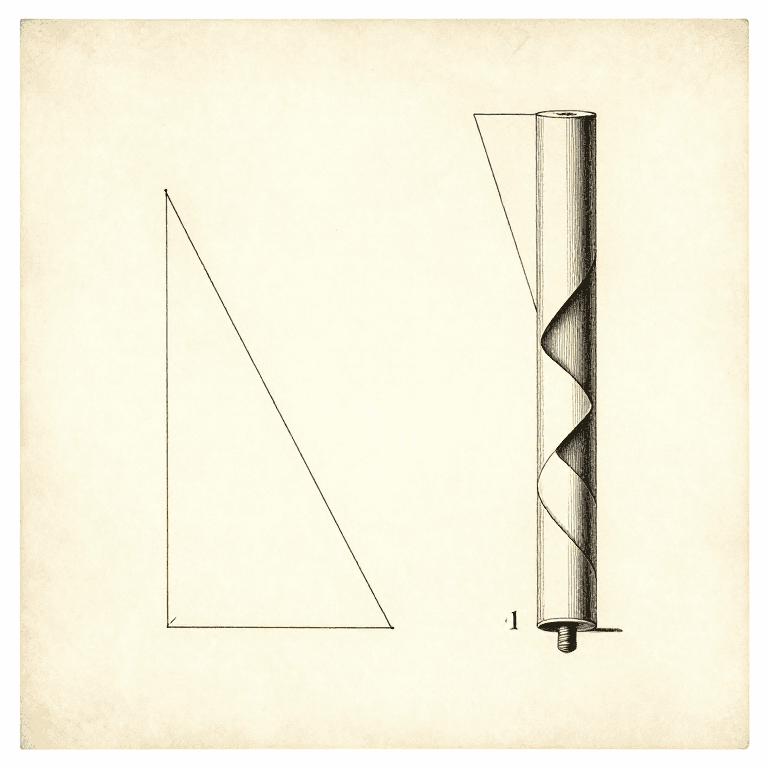
What a Screw Thread Is: A Ramp Wrapped Round a Cylinder
by Forge
Metalworking
57
0
0
0
0
0
CC0 Public Domain
This blueprint is released under CC0. You are free to copy, modify, distribute, and use this work for any purpose, without asking permission.
Support the Maker by purchasing products through their Blueprint where they earn a Maker Commission set by Vendors, or create a new iteration of this Blueprint and include it as a connection in your own Blueprint to share revenue.