ART
BEAUTY & WELLNESS
CRAFT
CULTURE & HISTORY
ENTERTAINMENT
ENVIRONMENT
FOOD & DRINKS
REVERSE ENGINEERING
SCIENCES
SPORTS
TECHNOLOGY
WEARABLES
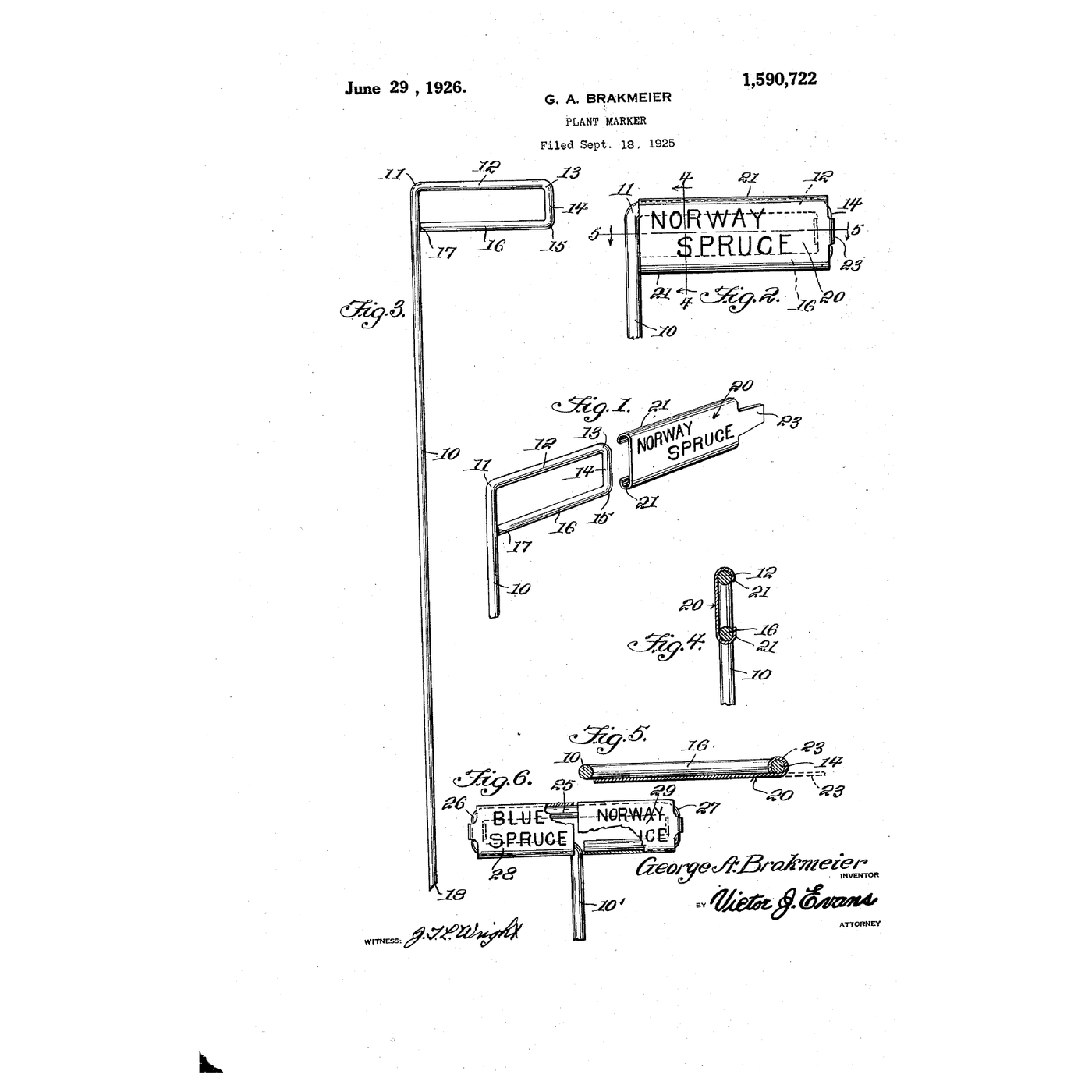


The Wire-Loop Plant Marker: The Handle You Push With Carries the Name
A thin marker stake is hard to push into firm ground without bending it or hurting the hand.
George A. Brakmeier of Louisville, Kentucky, received US 1,590,722, patented 29 June 1926, for a marker whose heavy-wire standard is bent at the top into an offset rectangular loop: the loop is the handle for pushing it in, and a name plate with rolled flanges then slides over the loop's long sides and is locked by a tongue bent round its end.
This rung works out when pushing on the loop bends the wire, then bends the standard, weighs the push that drives it into soil and slides a rolled plate onto it.
Beginner
About 2 hours
Instructions
1
1
Bending at the corner
Bending at the corner
Loading Jupyter Notebook...
2
2
A one-wire marker before it
A one-wire marker before it
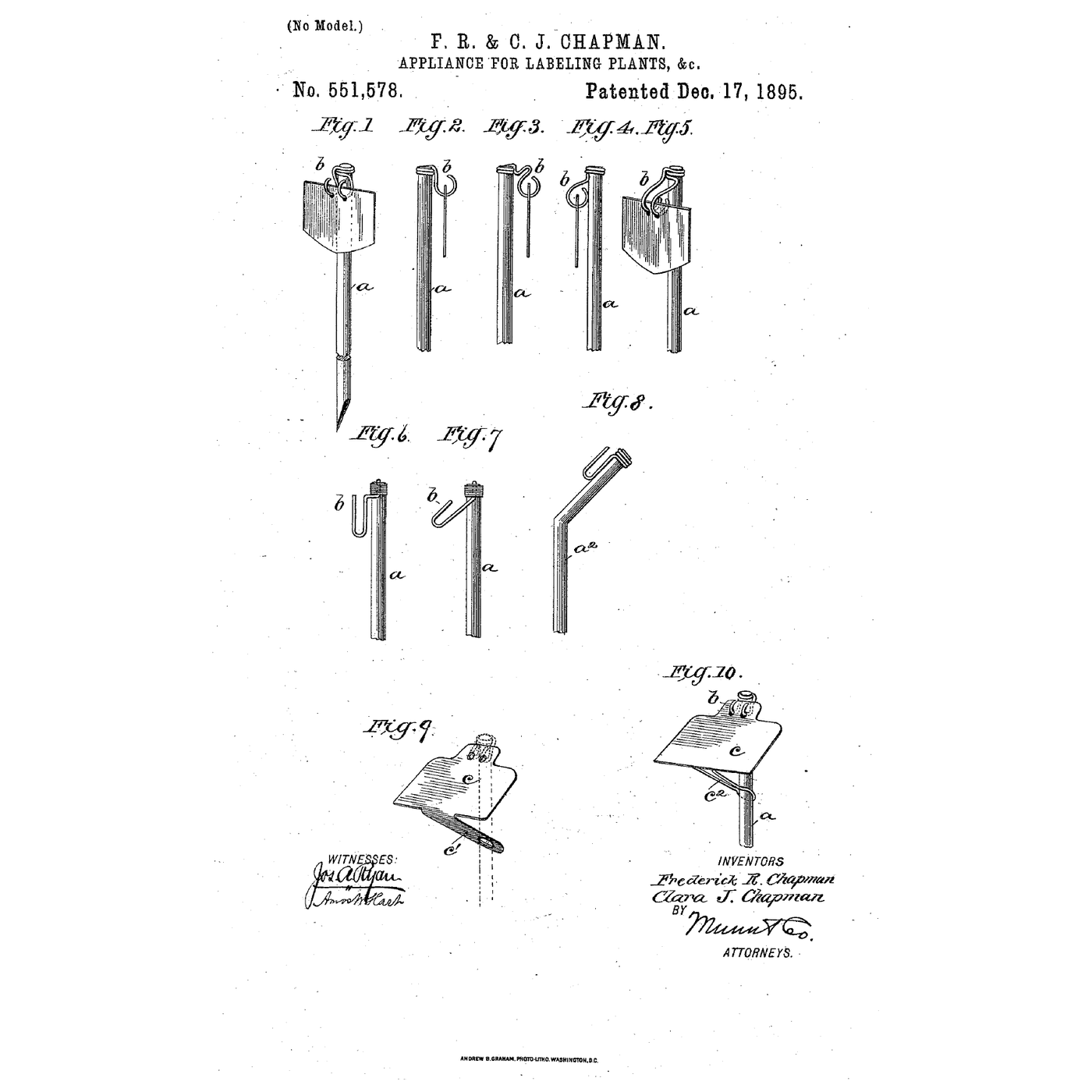
The embedded blueprint hooks a stamped plate into loops of one bent wire. Brakmeier's loop is also the handle, and the plate slides on over it.
3
3
Read US 1,590,722
Read US 1,590,722
"The looped portion thus provided constitutes in a very real sense a handle member, and permits the standard, which is sharpened at its lower end 18 to be thrust into the ground by exerting moderate pressure on the looped portion."
"A tongue 23 is provided on the extreme end of the marker, constituting the outer end when the parts are in assembled position, and this tongue is designed to be bent around the element 14 of the looped member and to constitute a retaining device."
4
4
Cut and point the standard
Cut and point the standard
Cut 600 mm of 4 mm galvanised steel wire with the hacksaw. File one end to a point.
Materials for this step:
 Galvanised Steel Wire1 piece
Tools needed:
 Hacksaw
 Bench Vise
 Files (Hand File)
 Ruler
Ruler Clear Safety Glasses
5
5
Bend the loop
Bend the loop
Bend the wire 90° in the vice 340 mm from the point, then 90° down after 100 mm, then 90° back toward the upright after 30 mm. Saw off the end where it meets the upright. Tap each bend square.
Tools needed:
Bench Vise HammerRuler
 Leather Work Gloves
6
6
Roll the plate
Roll the plate
Cut aluminium sheet 90 × 44 mm with a 10 × 15 mm tongue at one end. Stamp the plant's name in the middle. Roll 7 mm of each long edge round a 4 mm drill bit with the pliers.
Materials for this step:
 Aluminium Sheet1 piece
Tools needed:
 Tin Snips
 Metal Stamping Kit (Jewelry)Hammer
 Flat-Nose Pliers
 Drill Bit Set
7
7
Push it in and weigh the push
Push it in and weigh the push
Stand a pot of firm soil on the kitchen scale and zero it. Press the standard 200 mm in by the loop's middle and note the peak reading; grams × 0.0098 = newtons. Check the loop's corner against the ruler for a lasting bend.
Materials for this step:
 Garden Soil1 piece
Tools needed:
 Flower Pot
 Digital Kitchen ScaleRulerLeather Work Gloves
8
8
Fit the plate
Fit the plate
Slide the plate's flanges along the loop's long sides and bend the tongue round its end.
Tools needed:
Flat-Nose Pliers9
9
A marker that bends, spins or drops its plate
A marker that bends, spins or drops its plate
Wire-loop plant marker troubleshooting.
Flow
Loading...
10
10
History and honest limits
History and honest limits
**George A. Brakmeier** of Louisville, Kentucky, filed US 1,590,722 on 18 September 1925; it was patented 29 June 1926. The standard may be formed of heavy wire or a rod of suitable size; the plate's flanges fit over the loop's sides, so it is mounted by thrusting it toward the standard after the standard is in the ground. His Figure 6 bends the loop out to both sides, carrying two plates. His claims cover a standard with a handle and a flanged plate with a tongue engaging it.
**Honest limits.** He gives no sizes; ours are examples. The notebook treats the push as one force at the loop's middle. Your pushes and bends are the result.
Materials
3- 1 piecePlaceholder
- 1 piecePlaceholder
- 1 piecePlaceholder
Tools Required
13- Placeholder
- Placeholder
- Placeholder
- Placeholder
- Placeholder
- Placeholder
- Placeholder
- Placeholder
- Placeholder
- Placeholder
- Placeholder
- Placeholder
- Placeholder
Related Blueprints
These blueprints share knowledge with this one — techniques, materials, or principles that connect them in the learning graph.



CC0 Public Domain
This blueprint is released under CC0. You are free to copy, modify, distribute, and use this work for any purpose, without asking permission.
Support the Maker by purchasing products through their Blueprint where they earn a Maker Commission set by Vendors, or create a new iteration of this Blueprint and include it as a connection in your own Blueprint to share revenue.