ART
BEAUTY & WELLNESS
CRAFT
CULTURE & HISTORY
ENTERTAINMENT
ENVIRONMENT
FOOD & DRINKS
REVERSE ENGINEERING
SCIENCES
SPORTS
TECHNOLOGY
WEARABLES


The Embossed Soft-Metal Label: A Name Pressed In, Not Written On
Pencil and paint on wood or card wash off and wear away, and a label cannot be changed without replacing it.
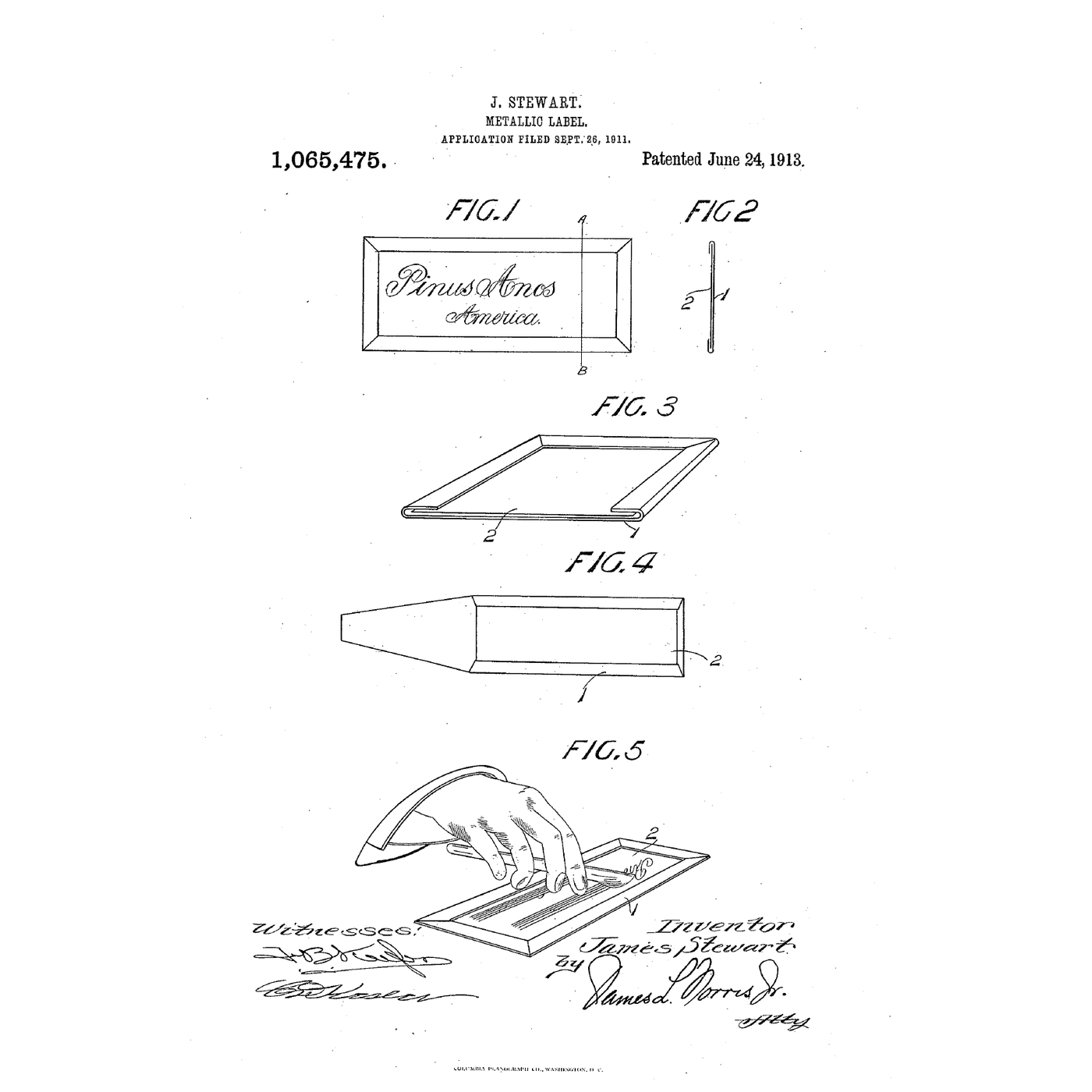
James Stewart, a plumber of 3 Dowling Street, Dunedin, New Zealand, received US 1,065,475, dated 24 June 1913, for a metallic label "upon which a mark or name written or printed is not liable to become obliterated or wear out quickly as in the case of wood or cardboard labels": a piece of fine-gauge sheet lead held in a zinc frame, on which a pencil or stylus presses the name in, and which can be rubbed smooth and written again.
This rung works out why lead took the mark and aluminium foil needs a backing, then makes the label with soft tooling foil and tests it against pencil on wood.
Beginner
About 1 hour
Instructions
1
1
Pressure under the point
Pressure under the point
Loading Jupyter Notebook...
2
2
The Dunedin label before it
The Dunedin label before it
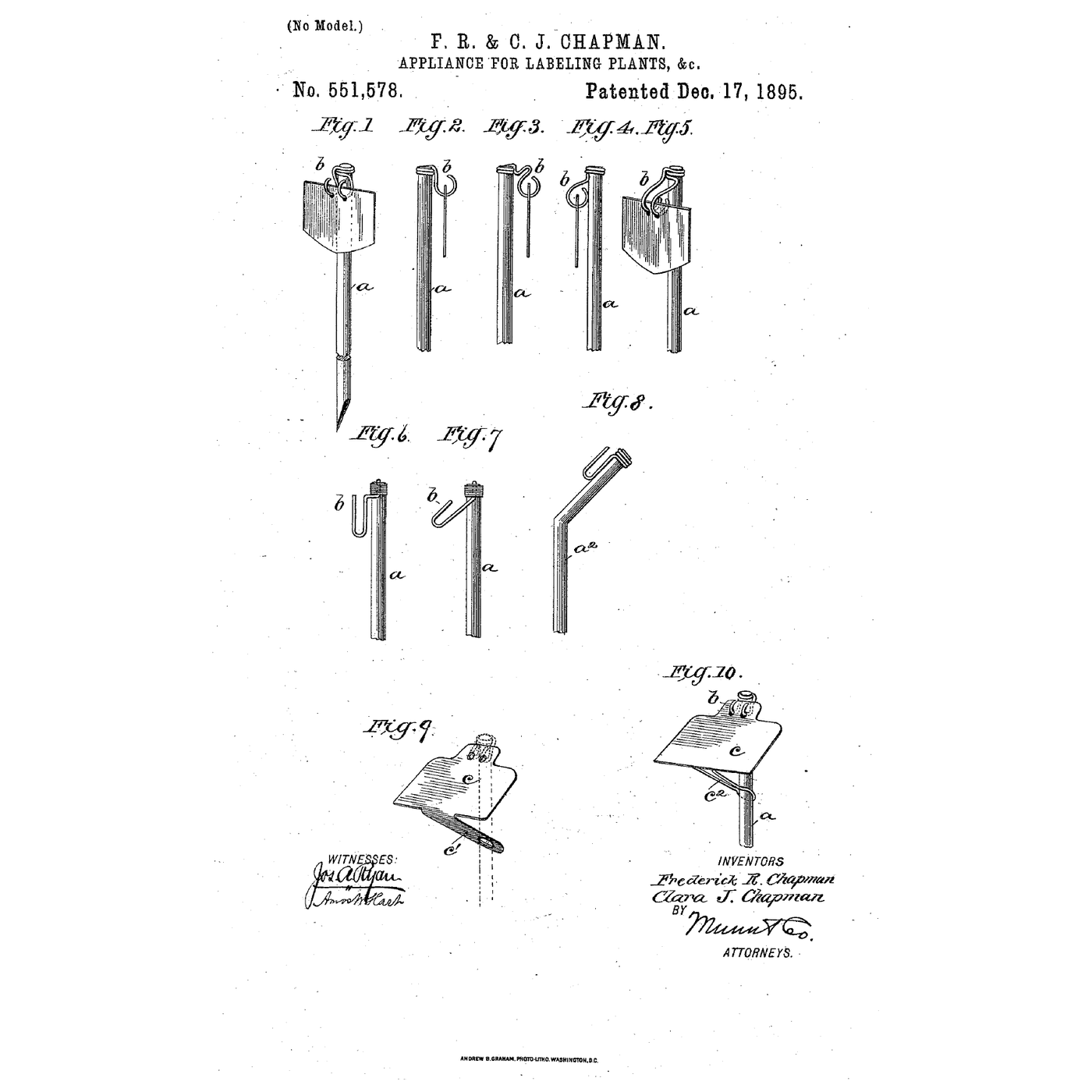
The embedded blueprint hangs metal labels on a double hook, patented in Dunedin in 1895. Stewart, also of Dunedin, made the writing on the label last.
3
3
Read US 1,065,475
Read US 1,065,475
"The invention consists in the provision of a piece of sheet lead, preferably of fine gage, partially incased and removably held in a frame of zinc or the like metal, or in any suitable material that forms a backing for the lead".
"To obtain a deeper impression a piece of paper may be inserted between the sheet lead and the backing."
"When it is desired to use the label for a fresh purpose such as, for instance, a change of names from one flower to another, the existing name may be erased by rubbing the lead surface with any hard instrument, as a knife handle."
4
4
Make the label and scrub it
Make the label and scrub it
**Frame.** Cut a piece of aluminium sheet 110 × 50 mm with the tin snips. With the flat-nose pliers fold 5 mm over along both long edges and one end, each into a channel, leaving the other end open.
**Insert.** Cut the soft aluminium foil from the embossing kit to slide into the channels, with a piece of paper cut to the same size behind it. Slide both in and fold the open end shut.
**Write.** Write the plant's name firmly with the pencil. Write a second name on a foil offcut with no paper behind it and compare how deep the letters go.
**Test.** Write the same name in pencil on a wooden stake. Rub each 20 times with emery cloth, wet, and compare what can still be read. Then rub the foil smooth with the knife handle and write a new name.
Materials for this step:
 Aluminium Foil1 piece
 Aluminium Sheet1 piece
 Card Stock1 piece
 Wooden Stake1 piece
Tools needed:
 Tin Snips
 Flat-Nose Pliers
 Ruler
Ruler Pencil
 Kitchen Knife
 Plant Label
 Emery Cloth
5
5
A label whose name will not show or will not last
A label whose name will not show or will not last
Embossed soft-metal label troubleshooting.
Flow
Loading...
6
6
History and honest limits
History and honest limits
**James Stewart**, plumber, a subject of King George V living at 3 Dowling Street, Dunedin, filed US 1,065,475 on 26 September 1911; it is dated 24 June 1913. His frame was preferably zinc, folded round the edges of the lead, and his drawings show a label to tie on and a pointed plant label.
**Honest limits.** Soft aluminium tooling foil replaces Stewart's sheet lead, which is poisonous, and an aluminium frame his zinc one. Foil on paper embosses by bending, not by the direct indentation the notebook computes for lead. The yield strengths are typical values; the point and forces are examples. Your scrub test is the result.
Materials
4- 1 piecePlaceholder
- 1 piecePlaceholder
- 1 piecePlaceholder
- 1 piecePlaceholder
Related Blueprints
These blueprints share knowledge with this one — techniques, materials, or principles that connect them in the learning graph.





CC0 Public Domain
This blueprint is released under CC0. You are free to copy, modify, distribute, and use this work for any purpose, without asking permission.
Support the Maker by purchasing products through their Blueprint where they earn a Maker Commission set by Vendors, or create a new iteration of this Blueprint and include it as a connection in your own Blueprint to share revenue.