Collaboration
ART
BEAUTY & WELLNESS
CRAFT
CULTURE & HISTORY
ENTERTAINMENT
ENVIRONMENT
FOOD & DRINKS
REVERSE ENGINEERING
SCIENCES
SPORTS
TECHNOLOGY
WEARABLES
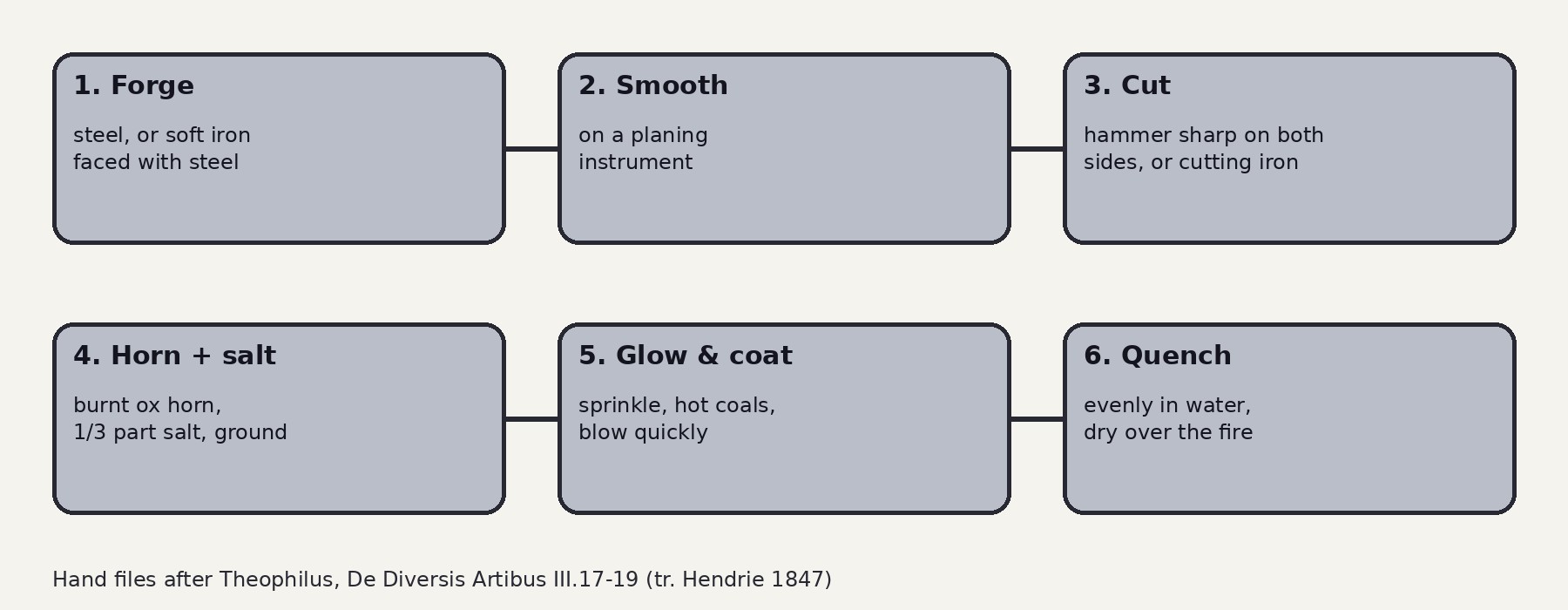


Hand Files Cut With a Double-Edged Hammer and Tempered in Burnt Ox Horn and Salt (Theophilus, 12th Century)
How a medieval metalworker made his own files, from Theophilus's De Diversis Artibus (12th century): files of steel, or of soft iron faced with steel, forged to size, smoothed and cut with a double-edged hammer or cutting iron, then hardened by sprinkling them glowing with burnt ox horn and salt and quenching. Small soft-iron files are packed in lard, goatskin and clay instead.
Advanced
About 1 day per few files
Instructions
1
1
The hardening mix
The hardening mix
Loading Jupyter Notebook...
2
2
Read De Diversis Artibus, Book III
Read De Diversis Artibus, Book III
"Files are made from pure steel, large and moderately sized, triangular and round. Others also are made which are stronger in the middle, from soft iron inside, but outwardly they are covered with steel."
3
3
Forge and smooth the blanks
Forge and smooth the blanks
Beat steel (or soft iron covered with steel) to the size and shape wanted: large or moderate, triangular or round; for small files, square, round, triangular or thin. Smooth them on a planing instrument (a filing or scraping bed).
Materials for this step:
 Carbon Steel Bar (0.6% C)1 piece
 Wrought Iron Bar1 piece
Tools needed:
 Forge
 Bellows
 Anvil
 Hammer
 Forge Tongs
 Files (Hand File)
4
4
Cut the teeth
Cut the teeth
Mark out the teeth with a hammer sharp on both sides, or with the cutting iron, until the file is cut all over.
Tools needed:
Hammer File-Cutting ChiselAnvil
 Bench Vise
5
5
Temper with horn and salt
Temper with horn and salt
Burn an ox horn in the fire, scrape it, mix it with a third part of salt and grind it hard. Heat the file until it glows, sprinkle the mixture over it everywhere, lay hot coals on and blow quickly over the whole without letting the coating fall off; then draw it out and quench it evenly in water, and dry it slightly over the fire. He tempers all steel things this way.
Materials for this step:
 Cattle Horn1 piece
 Salt1 piece
Tools needed:
ForgeBellows Mortar and PestleForge Tongs
 Quench Bucket
6
6
Or pack small soft-iron files
Or pack small soft-iron files
For small soft-iron files, after cutting, anoint them with the grease of an old hog, bind them with small straps of buck-goat skin tied with flaxen thread, and cover each with beaten clay, leaving the handles (tangs) bare. Dry them, put them in the fire and blow strongly until the skin is burned, take them quickly out of the clay, quench evenly in water, and dry them at the fire.
Materials for this step:
 Pig Fat (Leaf and Back Fat)1 piece
 Goatskin Leather1 piece
 Linen Thread1 piece
 Clay1 piece
Tools needed:
ForgeBellowsForge TongsQuench Bucket Leather Knife
7
7
Troubleshooting
Troubleshooting
File troubleshooting.
Flow
Loading...
8
8
History and honest limits
History and honest limits
From Theophilus Presbyter, **De Diversis Artibus** (12th century), Book III, chapters XVII-XIX, translated by Robert Hendrie (1847) (checked on the archive.org scan essayuponvarious00hend, pp. 223-225). He gives no sizes, temperatures or tooth spacing. The tools and the case-hardening explanation are ours.
Materials
8- 1 piecePlaceholder
- 1 piecePlaceholder
- 1 piecePlaceholder
- 1 piecePlaceholder
- 1 piecePlaceholder
- 1 piecePlaceholder
- 1 piecePlaceholder
- 1 piecePlaceholder
This blueprint makes
Related Blueprints
These blueprints share knowledge with this one — techniques, materials, or principles that connect them in the learning graph.
CC0 Public Domain
This blueprint is released under CC0. You are free to copy, modify, distribute, and use this work for any purpose, without asking permission.
Support the Maker by purchasing products through their Blueprint where they earn a Maker Commission set by Vendors, or create a new iteration of this Blueprint and include it as a connection in your own Blueprint to share revenue.