Collaboration
ART
BEAUTY & WELLNESS
CRAFT
CULTURE & HISTORY
ENTERTAINMENT
ENVIRONMENT
FOOD & DRINKS
REVERSE ENGINEERING
SCIENCES
SPORTS
TECHNOLOGY
WEARABLES
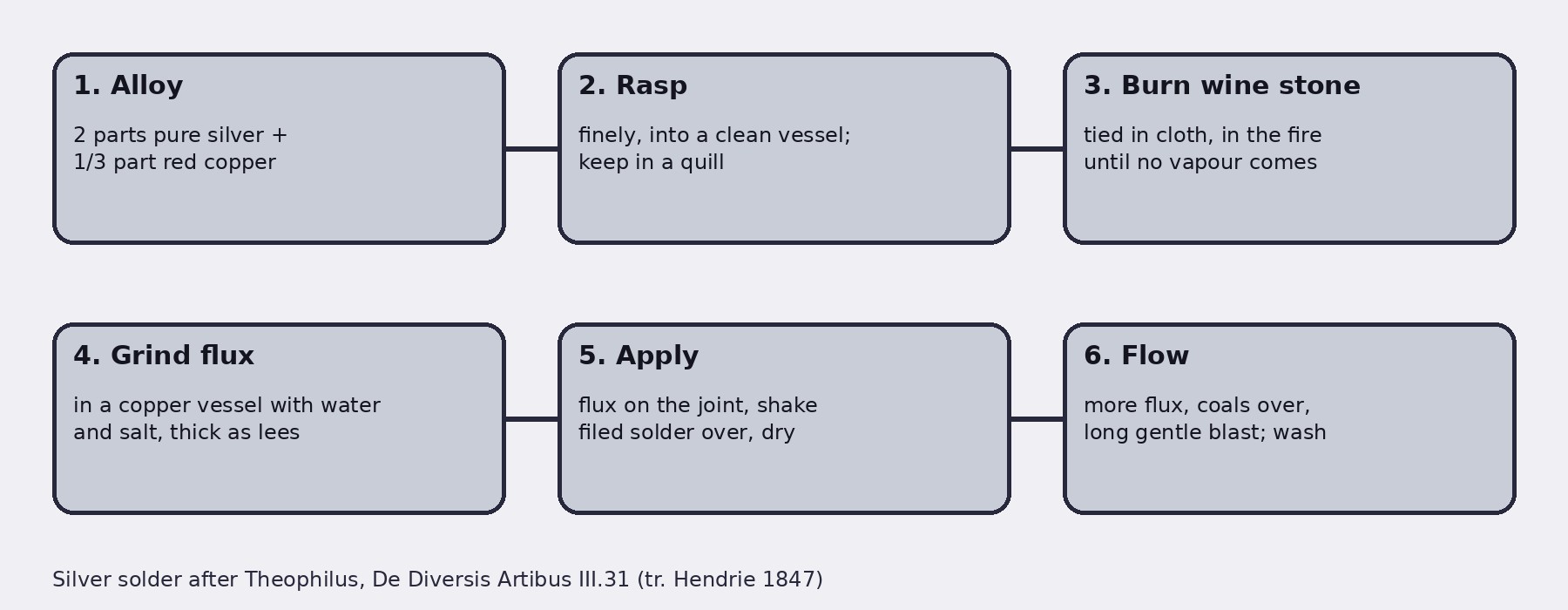


Silver Solder of Silver and Red Copper With a Burnt Wine-Stone Flux (Theophilus, 12th Century)
How Theophilus soldered silver in the 12th century: an alloy of two parts pure silver and a third part red copper, rasped to filings, laid on a joint painted with a flux of burnt wine-stone (tartar) ground with water and salt, and flowed in the coals with a long gentle blast.
Intermediate
About half a day
Instructions
1
1
The alloy
The alloy
Loading Jupyter Notebook...
2
2
Read De Diversis Artibus, Book III
Read De Diversis Artibus, Book III
"Weigh two parts of pure silver, and a third (part) of red copper, and mix and finely rasp into a clean vessel."
3
3
Make the solder
Make the solder
Weigh two parts of pure silver and a third part of red copper, melt them together, and rasp the alloy finely into a clean vessel; keep the filings in a quill.
Materials for this step:
 Fine Silver1 piece
 Copper1 piece
Tools needed:
 Balance Scale
 Crucible
 Crucible Tongs
 Blacksmith Forge
 Bellows
 Rasp
 Quill Pen
4
4
Make the flux
Make the flux
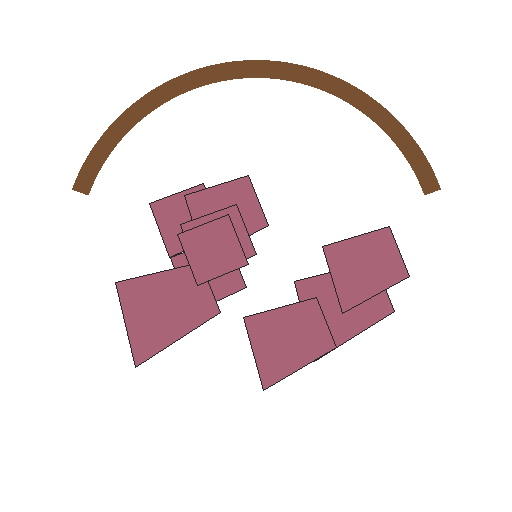
Take wine-stone from a vessel in which good wine has stood a long time, tie pieces in a cloth and put it in the fire until no more vapour comes from it. When cool, blow off the cloth ash and grind the burnt stone in a copper vessel with a round mallet, mixing in water and salt until it is as thick as lees.
Materials for this step:
 Wine Stone1 piece
 Cotton Cloth1 piece
 Salt1 piece
Tools needed:
Blacksmith Forge 20-Liter Bucket
 Wooden Mallet
5
5
Solder
Solder
With a thin piece of wood paint the flux round the joint inside and out, shake the filed solder over it with a small iron, and dry it. Paint more flux on, more thickly than before, put the work in the fire, cover it with coals and blow gently with a long breath until the solder has melted. Take it out, let it cool slightly and wash it. If the joint is not firm, do it again. Then file and scrape it smooth.
Tools needed:
Blacksmith ForgeBellowsCrucible Tongs Files (Hand File)
6
6
Troubleshooting
Troubleshooting
Soldering troubleshooting.
Flow
Loading...
7
7
History and honest limits
History and honest limits
From Theophilus, **De Diversis Artibus**, Book III, chapter XXXI, translated by Robert Hendrie (1847) (checked on the archive.org scan essayuponvarious00hend, pp. 241-243). "A third (part)" can be read two ways; both are shown. Melting the alloy before rasping, the tools and the diagram are ours.
Materials
5- 1 piecePlaceholder
- 1 piecePlaceholder
- 1 piecePlaceholder
- 1 piecePlaceholder
- 1 piecePlaceholder
This blueprint makes
Related Blueprints
These blueprints share knowledge with this one — techniques, materials, or principles that connect them in the learning graph.
CC0 Public Domain
This blueprint is released under CC0. You are free to copy, modify, distribute, and use this work for any purpose, without asking permission.
Support the Maker by purchasing products through their Blueprint where they earn a Maker Commission set by Vendors, or create a new iteration of this Blueprint and include it as a connection in your own Blueprint to share revenue.