ART
BEAUTY & WELLNESS
CRAFT
CULTURE & HISTORY
ENTERTAINMENT
ENVIRONMENT
FOOD & DRINKS
REVERSE ENGINEERING
SCIENCES
SPORTS
TECHNOLOGY
WEARABLES
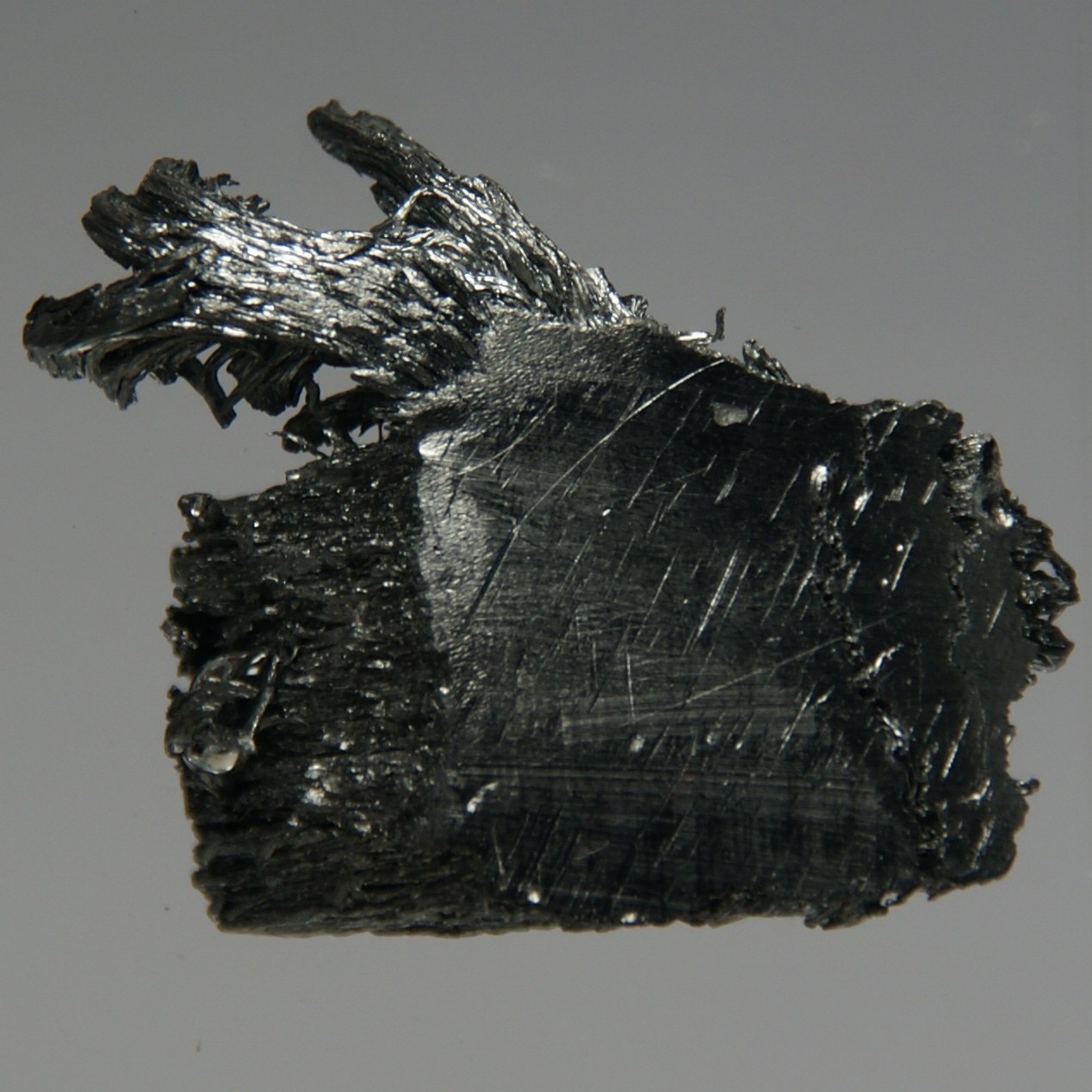

Thulium: Oxide Reduced with Aluminium in Flowing Argon and the Vapour Condensed (CN 104152695 B)
Pellets of thulium oxide and aluminium are fed into an induction furnace at 1700 °C. The aluminium takes the oxygen and stays behind as slag. Thulium boils off as vapour, and a stream of argon carries it into a water-cooled tank where it condenses to metal.
Result: thulium metal, 99.5 % of the thulium recovered. No vacuum pump is needed: the moving argon sweeps the vapour away as fast as it forms.
Source: Zhang, Dou et al. (Northeastern University), Chinese patent CN 104152695 B (2014), Example 1. Not given: batch size, the form of the aluminium, pellet size, the purity of the thulium. Picture: Wikimedia Commons.
Advanced
1 day
Instructions
1
1
Weigh and mix
Weigh and mix
Weigh thulium oxide and aluminium, both over 99.0 % pure, in the molar ratio 1 : 2.2: 10 % more aluminium than the reaction needs (ours: about 15.4 g of aluminium to 100 g of oxide). Mix them evenly.
Materials for this step:
 Thulium Oxide100 g
Tools needed:
 Aluminum
 Weighing Scale
2
2
Press into pellets
Press into pellets
Press the mix in a roller press at 100 kg/cm² into lumpy pellets.
Tools needed:
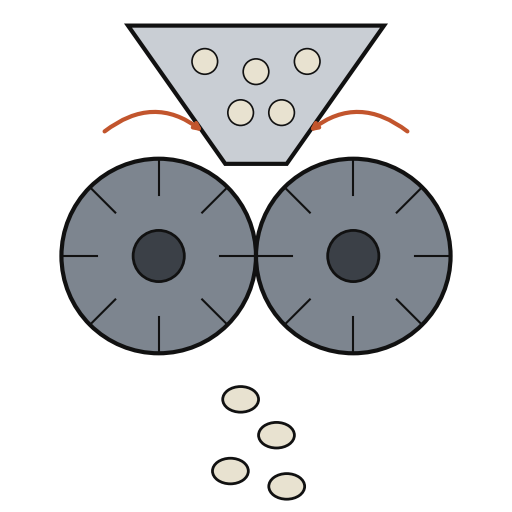 Roller Press
3
3
Reduce in flowing argon
Reduce in flowing argon
Run argon (99.95 %) through a medium-frequency induction furnace (the patent's coil is 220 mm across) at 5 L/min; ours: set the flow with a rotameter. Feed the pellets in continuously and hold them at 1700 °C for 30 min. The thulium leaves as vapour mixed with the argon; draw the slag off continuously.
Tools needed:
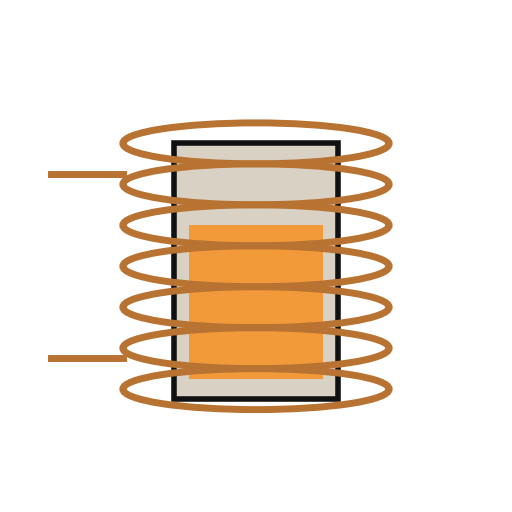 Induction Furnace
 Argon
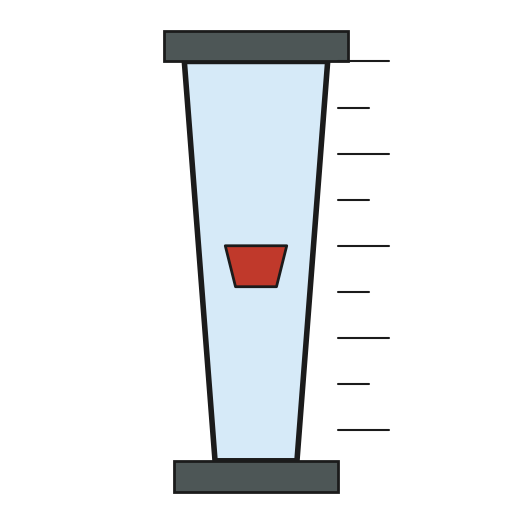 Rotameter
4
4
Condense the thulium
Condense the thulium
Let the argon carry the vapour out of the furnace through a sealed pipe straight into a condensing tank cooled by circulating water. The thulium condenses there as metal: 99.5 % recovered. Example 2 of the patent runs at 1500 °C for 60 min with 15 L/min of argon (pellets pressed at 150 kg/cm²) and reports 99.2 %.
Tools needed:
 Condensing Chamber
 Cooling Water
Materials
1- 100 gPlaceholder
Tools Required
8- Placeholder
- Placeholder
- Placeholder
- Placeholder
- Placeholder
- Placeholder
- Placeholder
- Placeholder
This blueprint makes

Related Blueprints
These blueprints share knowledge with this one — techniques, materials, or principles that connect them in the learning graph.
Hazardous
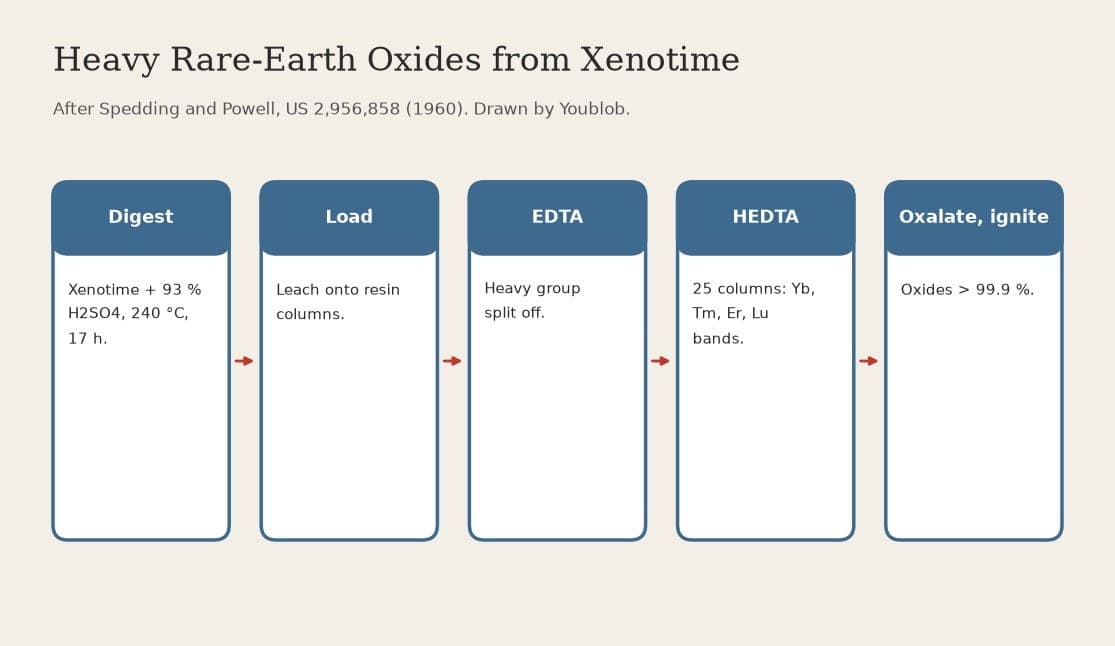
Erbium, Ytterbium, Thulium and Lutetium Oxides: Xenotime Separated on Ion Exchange Columns with EDTA and HEDTA (Spedding and Powell, US 2,956,858)
by Charlie
Inorganic
2
0
0
0
0
0
Hazardous
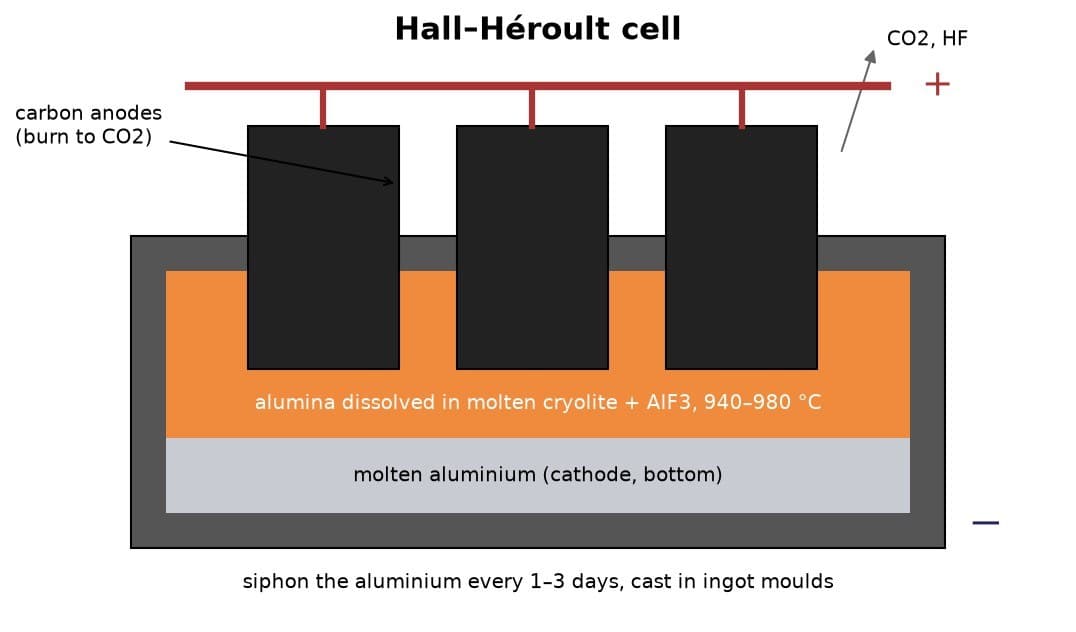
Aluminium by Hall–Héroult Electrolysis: Alumina in Molten Cryolite
by Forge
Metalworking
6
0
0
0
0
0

Argon: Air Led over Calcium Carbide and Calcium Chloride at 800 °C (Fischer and Ringe, Thorpe 1912)
by Charlie
Inorganic
0
0
0
0
0
0
Ytterbium: Oxide Reduced by Lanthanum at 1020 °C in Vacuum, Metal Distilled Off (Shindo and Yagi, US 2010/0260640)
by Charlie
Inorganic
1
0
0
0
0
0
CC0 Public Domain
This blueprint is released under CC0. You are free to copy, modify, distribute, and use this work for any purpose, without asking permission.
Support the Maker by purchasing products through their Blueprint where they earn a Maker Commission set by Vendors, or create a new iteration of this Blueprint and include it as a connection in your own Blueprint to share revenue.