Collaboration
ART
BEAUTY & WELLNESS
CRAFT
CULTURE & HISTORY
ENTERTAINMENT
ENVIRONMENT
FOOD & DRINKS
REVERSE ENGINEERING
SCIENCES
SPORTS
TECHNOLOGY
WEARABLES
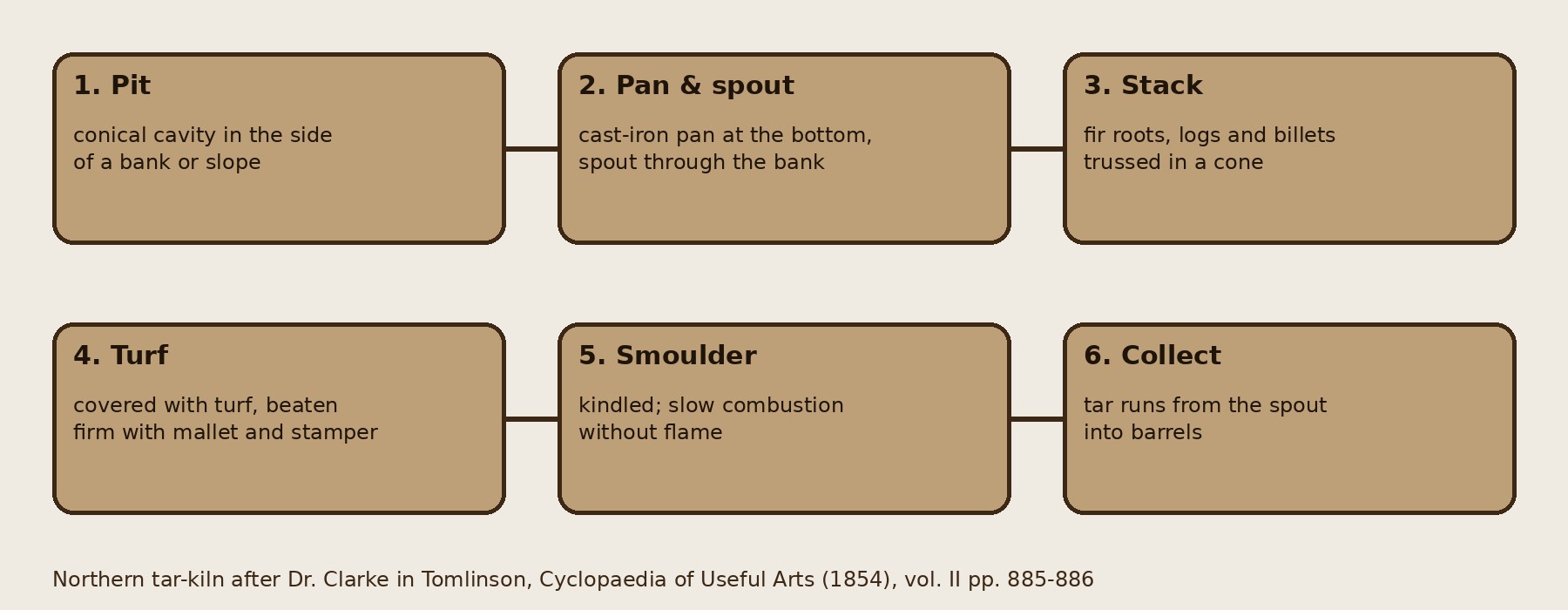


Pine Tar From a Turf-Covered Pit Kiln: Fir Roots Smouldered Over a Pan and Spout (Tomlinson, 1854)
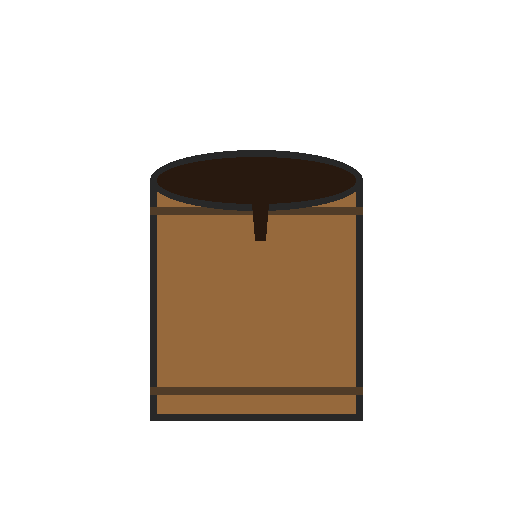
The old northern way of making tar, from Dr. Clarke's account in Tomlinson's Cyclopaedia of Useful Arts (1854): fir roots and resinous billets stacked in a cone in a pit dug into a bank, covered with beaten turf and smouldered without flame, so the tar runs down into a cast-iron pan and out through a spout into barrels, leaving the wood as charcoal.
Intermediate
Several days
Instructions
1
1
What the kiln gives
What the kiln gives
Loading Jupyter Notebook...
2
2
Read the Cyclopaedia of Useful Arts
Read the Cyclopaedia of Useful Arts
"The process by which the tar is obtained, is very simple."
3
3
Gather the wood
Gather the wood
Use fir (pine) roots, rotten stubs and scorched trunks, with logs and billets of the same; roots from marshy ground are richest. (Laing: stunted trees are peeled a fathom or two up the stem, by degrees, and felled 5 or 6 years later, rich in tar.)
Materials for this step:
 Resinous Wood1 piece
Tools needed:
 Axe
 Hand Saw
4
4
Dig the pit
Dig the pit
Dig a conical cavity in the side of a bank or sloping hill. Set a cast-iron pan at the bottom of the funnel with a spout projecting through the side of the bank.
Tools needed:
 Shovel
 Large Cooking Pot
5
5
Stack and cover
Stack and cover
Truss the roots, logs and billets neatly in a conical stack and let it into the cavity. Cover it with turf and beat the turf down firm with a heavy wooden mallet and a wooden stamper, two people working.
Tools needed:
 Wooden MalletShovel
6
6
Smoulder and collect
Smoulder and collect
Kindle the stack and let it burn slowly without flame, as in charcoal making. The tar exudes, runs into the pan and out of the spout: set barrels under it and bung them as they fill. The wood that remains is charcoal.
Tools needed:
 Wooden Barrel
7
7
Troubleshooting
Troubleshooting
Tar kiln troubleshooting.
Flow
Loading...
8
8
History and honest limits
History and honest limits
From Charles Tomlinson (ed.), **Cyclopaedia of Useful Arts** (1854), vol. II, "Turpentine", quoting Dr. Clarke and Mr. Laing (checked on the archive.org scan cyclopdiaofuse02tomlrich, pp. 885-886). He gives no pit sizes. The tools and diagram are ours.
Materials
1- 1 piecePlaceholder
This blueprint makes
Related Blueprints
These blueprints share knowledge with this one — techniques, materials, or principles that connect them in the learning graph.

CC0 Public Domain
This blueprint is released under CC0. You are free to copy, modify, distribute, and use this work for any purpose, without asking permission.
Support the Maker by purchasing products through their Blueprint where they earn a Maker Commission set by Vendors, or create a new iteration of this Blueprint and include it as a connection in your own Blueprint to share revenue.