Collaboration
ART
BEAUTY & WELLNESS
CRAFT
CULTURE & HISTORY
ENTERTAINMENT
ENVIRONMENT
FOOD & DRINKS
REVERSE ENGINEERING
SCIENCES
SPORTS
TECHNOLOGY
WEARABLES
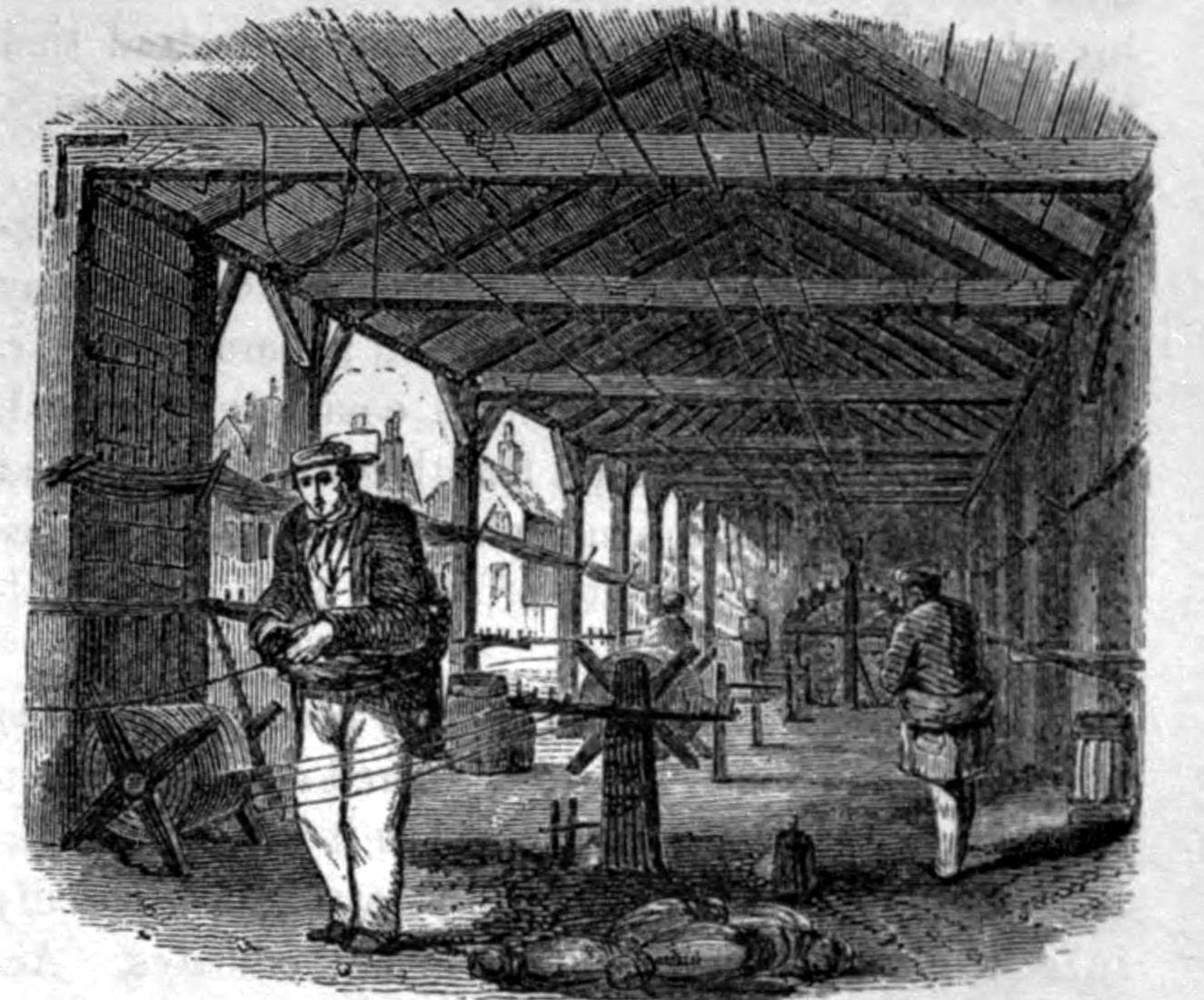


Hawser-Laid Hemp Rope in a Rope-Walk: Heckled, Hand-Spun Yarns, Optional Tarring, Laid With a Top (Tomlinson, 1854)
How 19th-century rope was made, from Tomlinson's Cyclopaedia of Useful Arts (1854): hemp heckled, spun by hand into 160-fathom yarns by spinners walking backward down a rope-walk from a wheel of whirling hooks, optionally tarred in hot tar and squeezed through a gage, then laid into three strands and closed into hawser-laid rope behind a grooved wooden top.
Advanced
Several days
Instructions
1
1
Rope-walk numbers
Rope-walk numbers
Loading Jupyter Notebook...
2
2
Read the Cyclopaedia of Useful Arts
Read the Cyclopaedia of Useful Arts
"The fibres are first spun into yarns, the yarns into strands, the strands into a rope."
3
3
Heckle the hemp
Heckle the hemp
Weigh out enough hemp for one yarn of 160 fathoms. Throw it loosely over the points of the heckle and draw it toward you, repeating until all the fibres are combed straight; a little oil on the points helps (he names whale-oil; fish oil here). Tie the combed fibres into a tow of about 3-1/2 lb.
Materials for this step:
 Hemp Fibre1 piece
 Fish Oil1 piece
Tools needed:
 Hackle Comb - Coarse
 Balance Scale
4
4
Spin the yarn
Spin the yarn
At the head of the walk turn the wheel of whirl-hooks. Wrap the tow round your body with the bight in front, draw out fibres, twist them and hook the bight on a whirl. Walk backward down the walk (about 2 miles an hour), holding the fibres in a piece of thick woollen cloth between the middle fingers, feeding an even, flat skein with the left hand, and throwing the yarn over the rafter hooks as you go. At the foot, reel the yarn in, keeping it tight. Yarns run from 1/12 to over 1/8 in thick.
Materials for this step:
 Burled Wool Cloth1 piece
Tools needed:
 Ropemaking Machine
 Wooden Stake
5
5
Tar the yarns (optional)
Tar the yarns (optional)
Warp 300 to 400 yarns straight and parallel into a haul about 100 yd long. Dip it in tar heated to about 212 F in a copper and drag it through a grip or gage that presses the tar in and wipes off the excess. The yarn should come out bright brown: too hot chars it, too cold leaves it black; a scum closing over the tar shows the right heat. Tarred rope resists wet but is weaker.
Materials for this step:
 Pine Tar1 piece
Tools needed:
 Large Cooking Pot
6
6
Lay the strands
Lay the strands
Count out the yarns for the rope and divide them into three on the bearers. Hang them on the hooks of the tackle-board at the head and the weighted sledge at the foot, stretch them tight, and heave the hooks round against the twist of the yarn until each strand is 'full hard', the sledge creeping up the walk as the yarns shorten.
Tools needed:
Ropemaking MachineWooden Stake7
7
Close the rope
Close the rope
Put the three strands on the middle hook and into the grooves of the top, with woolders and soft-rope tails. Force the top back to the sledge, turn the head hooks as before and the sledge hook the contrary way, easing the load so the top is driven forward and the strands close behind it into rope. Wrap the tails round the rope to steady the top, and mark the strands at each beam to keep the hardness even.
Tools needed:
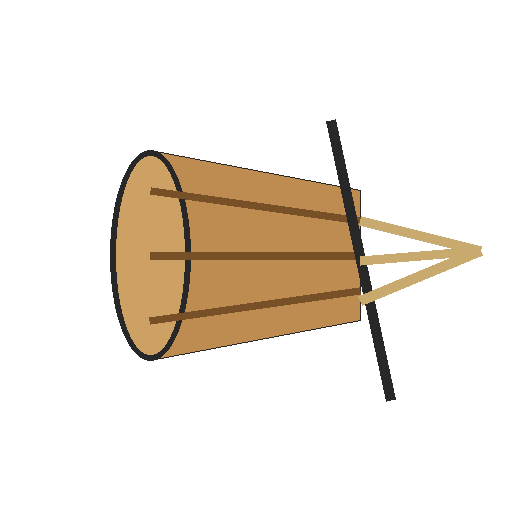 Rope Laying TopRopemaking Machine
8
8
Troubleshooting
Troubleshooting
Rope troubleshooting.
Flow
Loading...
9
9
History and honest limits
History and honest limits
From Charles Tomlinson (ed.), **Cyclopaedia of Useful Arts** (1854), vol. II, "Rope" (checked on the archive.org scan cyclopdiaofuse02tomlrich, pp. 564-568). He names whale-oil for the heckle; fish oil is our substitute and labelled so. The tools are ours.
Materials
4- 1 piecePlaceholder
- 1 piecePlaceholder
- 1 piecePlaceholder
- 1 piecePlaceholder
Tools Required
6- Placeholder
- Placeholder
- Placeholder
- Placeholder
- Placeholder
- Placeholder
This blueprint makes
Related Blueprints
These blueprints share knowledge with this one — techniques, materials, or principles that connect them in the learning graph.
CC0 Public Domain
This blueprint is released under CC0. You are free to copy, modify, distribute, and use this work for any purpose, without asking permission.
Support the Maker by purchasing products through their Blueprint where they earn a Maker Commission set by Vendors, or create a new iteration of this Blueprint and include it as a connection in your own Blueprint to share revenue.