ART
BEAUTY & WELLNESS
CRAFT
CULTURE & HISTORY
ENTERTAINMENT
ENVIRONMENT
FOOD & DRINKS
REVERSE ENGINEERING
SCIENCES
SPORTS
TECHNOLOGY
WEARABLES


Ventilating Paddle Rocking Churn: Hinged Paddles That Strike One Way and Slip the Other
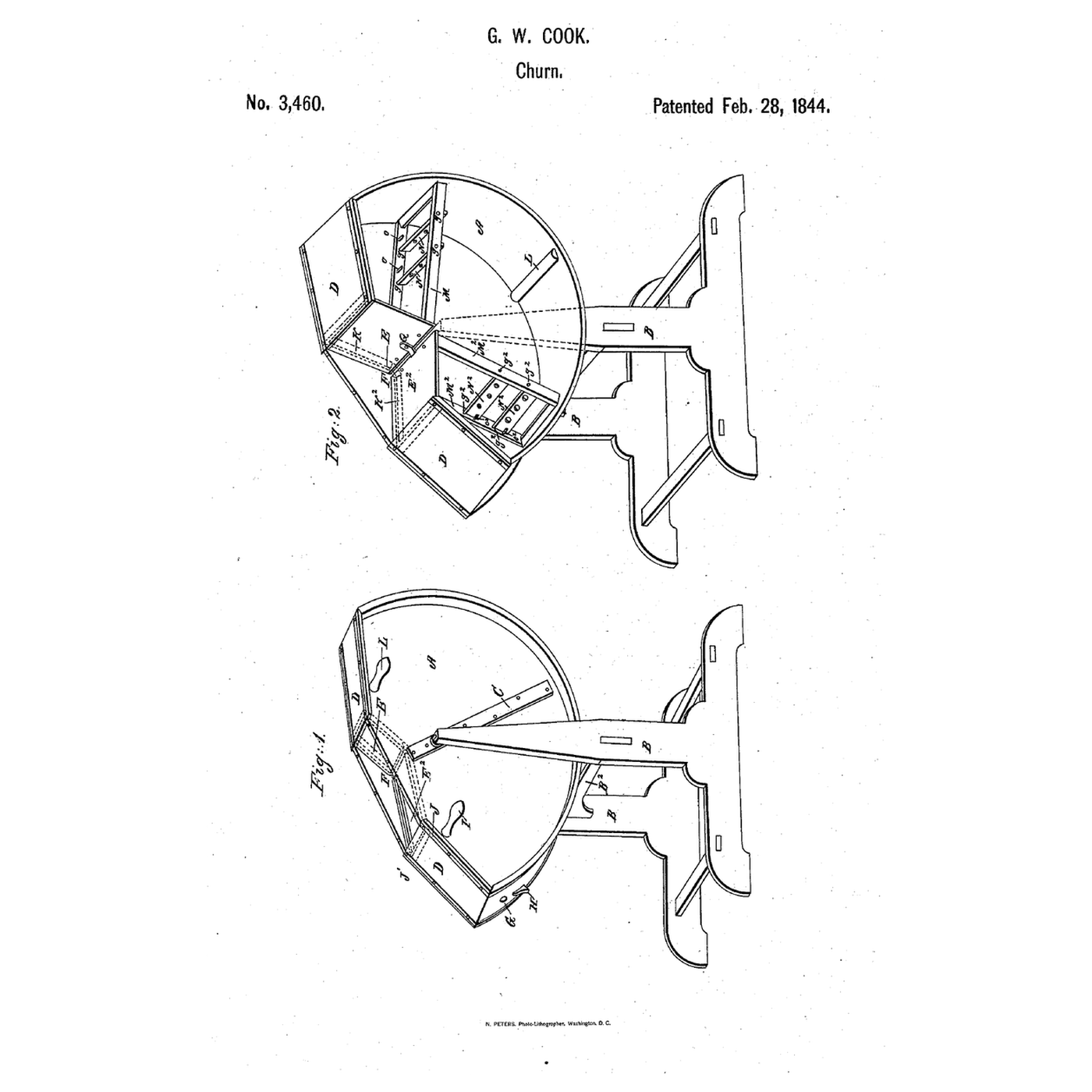
Cook set out to let "a current of fresh air" into the churn "to hasten the production of the butter and to improve its quality."
George W. Cook of Schenectady, New York, received US 3,460, dated 28 February 1844, for "Cook's Ventilating Churn": a semi-cylinder balanced on pivots so it rocks easily, its top closed by thin boards except a narrow opening in the middle. Inside, two frames at about 45° from the vertical, inclined opposite ways, carry perforated paddles hung on gudgeons. As the vessel is canted, one set swings square to its frame and strikes the cream while the other turns flat against its stops.
This rung works out how the paddles hang, then prints the ends, frames and paddles, bends a stainless semi-cylinder, and makes butter.
Advanced
About 6 hours, plus printing
Instructions
1
1
How the paddles hang
How the paddles hang
Loading Jupyter Notebook...
2
2
A rocking churn on pivots before it
A rocking churn on pivots before it
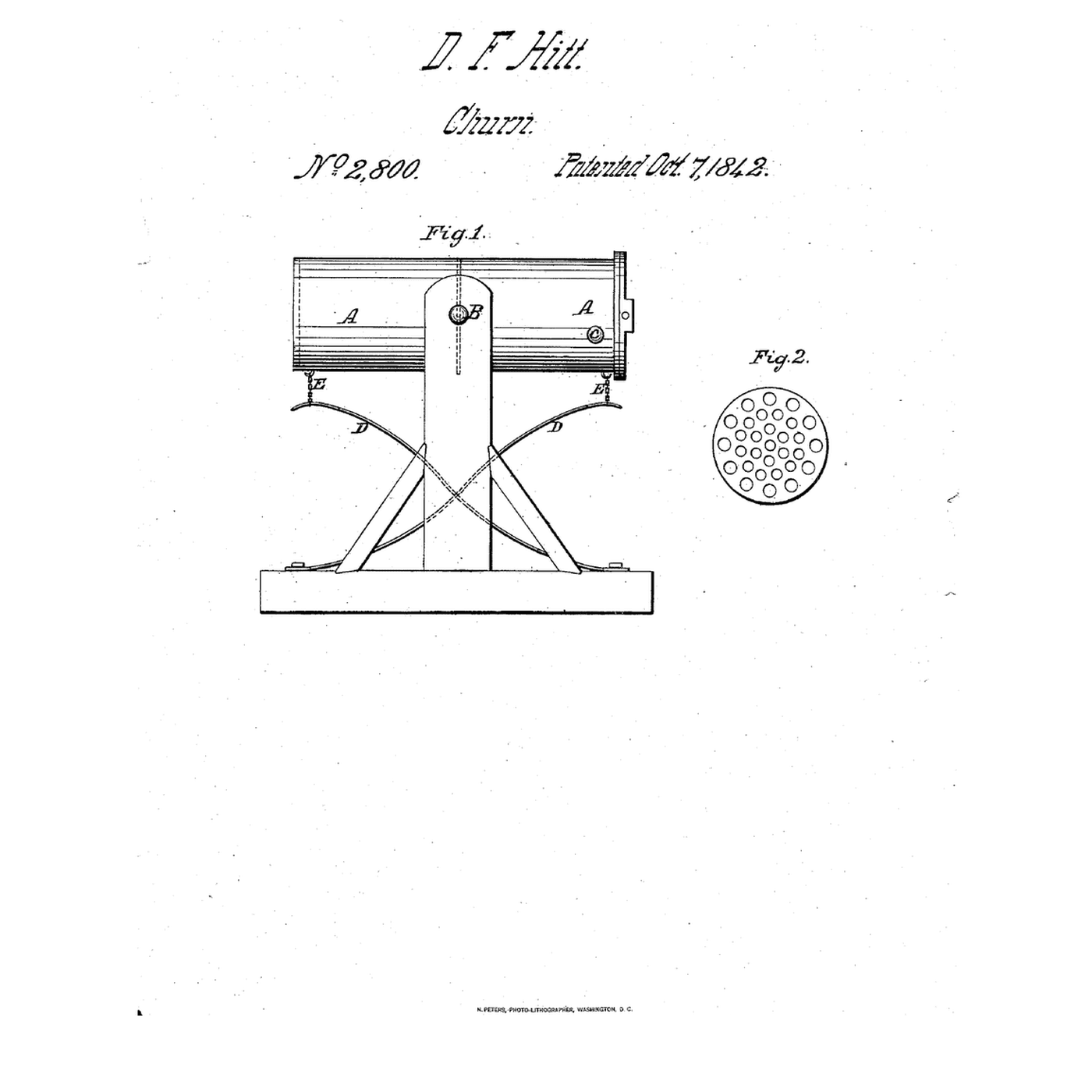
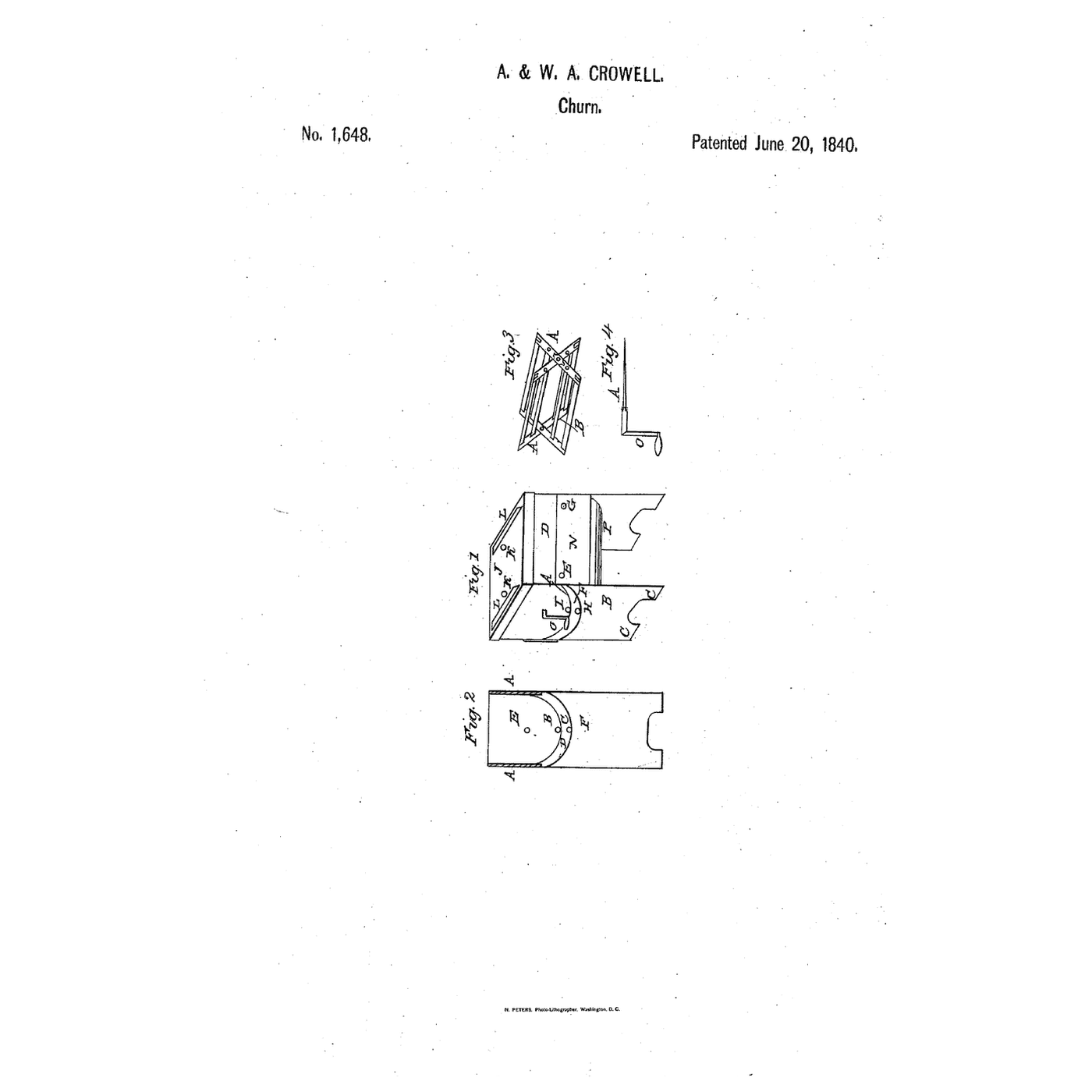
The embedded blueprint rocks a box on gudgeons with springs to return it. Cook balances his vessel on pivots and puts hinged paddles inside.
3
3
Read US 3,460
Read US 3,460
"When the vessel is canted, as represented in Fig. 2 the paddles N drop down or turn on their gudgeons assuming a position nearly at right angles to the sides of the frame of the paddles. At the same time the paddles N2 of the other frame turn until they are in a line parallel with the sides of the frame when they strike against pins or stops O2 inserted into the sides of the frame on the inside thereof."
4
4
Print the parts
Print the parts
Print two vessel ends flat (/uploads/blueprints/ventilating-paddle-rocking-churn-end.stl), each with its groove, pivot boss and the two ledges for the frames. Print two frames (/uploads/blueprints/ventilating-paddle-rocking-churn-frame.stl) and eight perforated paddles (/uploads/blueprints/ventilating-paddle-rocking-churn-paddle.stl). Print in PLA at 0.2 mm layers, 30 % infill, 4 walls; wash before first use.
Materials for this step:
 PLA Filament1 piece
Tools needed:
 FDM 3D Printer
5
5
Bend and close the vessel
Bend and close the vessel
Cut a 0.5 mm stainless sheet 160 mm wide and about 252 mm long, deburr it, and bend it round a 160 mm form into a half circle. Seat it in both ends' grooves in silicone. Cut two thin plywood boards to close the top, sloping 10–15° down toward the middle and leaving a narrow opening there, as his.
Materials for this step:
 Stainless Steel Sheet - 3041 piece
 Silicone Sealant1 piece
 Plywood Sheet1 piece
Tools needed:
 Tin Snips
 Deburring Tool
 Rubber Mallet
 Clamps
 Coping Saw
6
6
Hang the paddles and the vessel
Hang the paddles and the vessel
Hang four paddles in each frame on M3 screws through the frame's sides, so they swing freely and lie against the stops one way. Set the two frames on the ledges inside the vessel, inclined opposite ways. Build a pine stand with two posts and hang the vessel on an M8 bolt through each end's boss, so it is nicely balanced.
Materials for this step:
 Machine Screws1 piece
 Hex Nut1 piece
 Pine Board1 piece
 #8 x 1" Wood Screw1 piece
 Wood Glue1 piece
Tools needed:
 Hand Saw
 Cordless Drill
 Drill Bit Set
 Screwdriver Set
 Adjustable Spanner
7
7
The build in 3D
The build in 3D
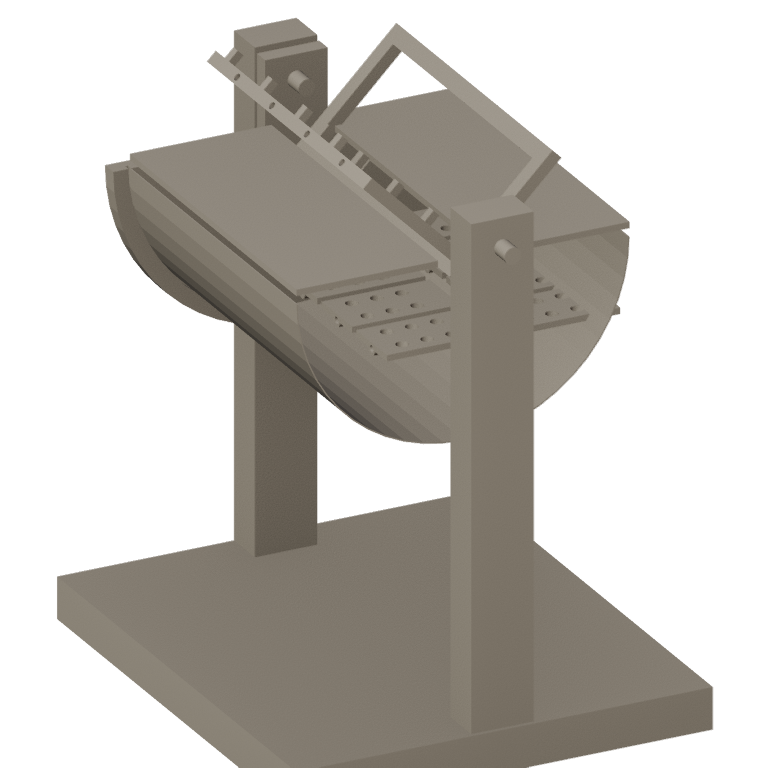
FreeCAD model of this build, not of the patent: the semi-cylinder hung on its pivots in a pine stand, one end off to show the two frames of hinged perforated paddles inclined opposite ways, and the top boards.
8
8
Rock and make butter
Rock and make butter
Let the heavy cream stand until it reaches about 15 °C, checked with the thermometer. Pour 500 ml through the middle opening. Rock the vessel steadily from side to side; time until the butter comes. Lift out the frames, then pour off the buttermilk, add cold water, churn a little and pour off again until it runs clear; work in a pinch of salt and weigh the butter.
Materials for this step:
 Heavy Cream500 ml
 Coarse Sea Salt1 piece
 Water1 piece
Tools needed:
 Leave-In Probe Thermometer
 Stopwatch
 Digital Kitchen Scale
 Stainless Steel Mixing Bowl (Large)
9
9
Paddles that stick, a vessel that tips
Paddles that stick, a vessel that tips
Ventilating paddle rocking churn troubleshooting.
Flow
Loading...
10
10
History and honest limits
History and honest limits
**George W. Cook** of Schenectady, New York, received US 3,460, dated 28 February 1844. Blocks on the vessel's convex side met a cross bar of the frame to stop it canting too far; handles in its side rocked it; iron straps strengthened it; a plugged aperture drew off the milk; a button held the two frames in place. He claimed combining with a rocking churn "floats or paddles arranged in and hinged to a frame."
**Honest limits.** Stainless sheet, plywood and printed parts stand in for his wooden vessel and frames. FDM prints hold food in their layer lines, so wash well and replace when worn. Your times and weights are the result.
Materials
12- 1 piecePlaceholder
- 1 piecePlaceholder
- 1 piecePlaceholder
- 1 piecePlaceholder
- 1 piecePlaceholder
- 1 piecePlaceholder
- 1 piecePlaceholder
- 1 piecePlaceholder
- 1 piecePlaceholder
- 500 mlPlaceholder
- 1 piecePlaceholder
- 1 piecePlaceholder
Tools Required
15- Placeholder
- Placeholder
- Placeholder
- Placeholder
- Placeholder
- Placeholder
- Placeholder
- 1 vendor sell this, none ship to you yetPlaceholder
- Placeholder
- Placeholder
- Placeholder
- Placeholder
- Placeholder
- Placeholder
- Placeholder
Design Files
1Related Blueprints
These blueprints share knowledge with this one — techniques, materials, or principles that connect them in the learning graph.


CC0 Public Domain
This blueprint is released under CC0. You are free to copy, modify, distribute, and use this work for any purpose, without asking permission.
Support the Maker by purchasing products through their Blueprint where they earn a Maker Commission set by Vendors, or create a new iteration of this Blueprint and include it as a connection in your own Blueprint to share revenue.