ART
BEAUTY & WELLNESS
CRAFT
CULTURE & HISTORY
ENTERTAINMENT
ENVIRONMENT
FOOD & DRINKS
REVERSE ENGINEERING
SCIENCES
SPORTS
TECHNOLOGY
WEARABLES
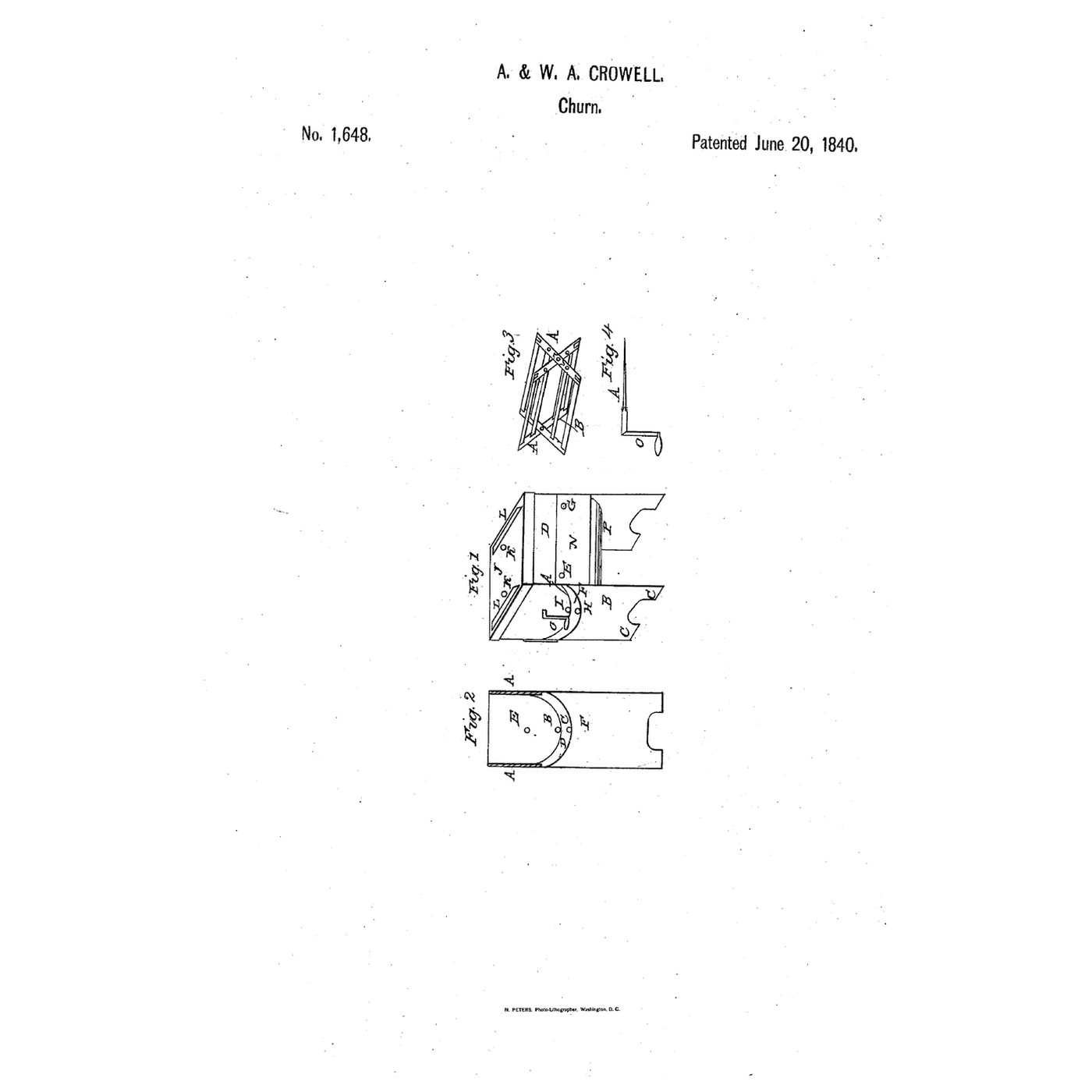


Water-Jacketed Churn: Hot or Cold Water Under a Metal Plate Tempers the Cream
Cream churns easily only at the right heat, and a churn has no way to set it.
William A. Crowell and Allen Crowell of Salisbury, Connecticut, received US 1,648, dated 20 June 1840, for a churn with "a chamber or space in the lower part or the bottom of the churn ... for containing hot or cold water or other liquids for the purpose of tempering the milk or cream in the churn to the proper degree of heat required for churning." A tin division plate bent into a half cylinder holds the cream above the chamber; a dash of two crosses and slats turns in it on a spindle.
This rung works out the water temperature to fill with, then prints the grooved end pieces and the dash crosses, bends a stainless sheet into the half cylinder, and makes butter.
Advanced
About 6 hours, plus printing
Instructions
1
1
Sixty degrees, and the water to fill with
Sixty degrees, and the water to fill with
Loading Jupyter Notebook...
2
2
Why the temperature matters
Why the temperature matters
The embedded blueprint makes butter from cream. The Crowells' chamber brings that cream to the right heat before and while it is churned.
3
3
Read US 1,648
Read US 1,648
"For using the churn herein described, the dash being placed in the churn, and the spindle screwed in, put in the milk or cream to be churned; if not in the right degree of heat apply the hot or cold water in the chamber or space, under the milk or cream until it becomes the right degree of heat required, being about sixty degrees."
4
4
Print the parts
Print the parts
Print two end pieces flat, grooved face up (/uploads/blueprints/water-jacketed-churn-end.stl), two dash crosses (/uploads/blueprints/water-jacketed-churn-cross.stl), the crank arm (/uploads/blueprints/water-jacketed-churn-crank-arm.stl) and the drain plug (/uploads/blueprints/water-jacketed-churn-drain-plug.stl). Print in PLA at 0.2 mm layers, 30 % infill, 4 walls; wash before first use.
Materials for this step:
 PLA Filament1 piece
Tools needed:
 FDM 3D Printer
5
5
Bend the division plate
Bend the division plate
Cut a 0.5 mm stainless sheet 160 mm wide and long enough for a 70 mm radius half circle with 60 mm straight sides, about 340 mm. Deburr it and bend it round a 140 mm form into a U. Stainless will not oxidise in the cream, as the patent required.
Materials for this step:
 Stainless Steel Sheet - 3041 piece
Tools needed:
 Tin Snips
 Deburring Tool
 Rubber Mallet
 Clamps
 Tape Measure
6
6
Assemble the box and chamber
Assemble the box and chamber
Seat the U in the curved grooves of both end pieces, and plywood sides and a bottom in their grooves, all bedded in silicone, leaving a closed chamber 25 mm deep under the U and 12 mm beside it. Let it cure, then fill the chamber with water and check for leaks. Glue the crosses on a 12 mm hardwood dowel spindle, glue eight 6 mm dowel slats into their holes, pass the spindle through the end pieces and glue the crank arm on. Press the plug into the drain.
Materials for this step:
 Plywood Sheet1 piece
 Silicone Sealant1 piece
 Hardwood Dowels1 piece
 Wood Glue1 piece
Tools needed:
 Hand Saw
 Coping Saw
 SandpaperClamps
7
7
The build in 3D
The build in 3D
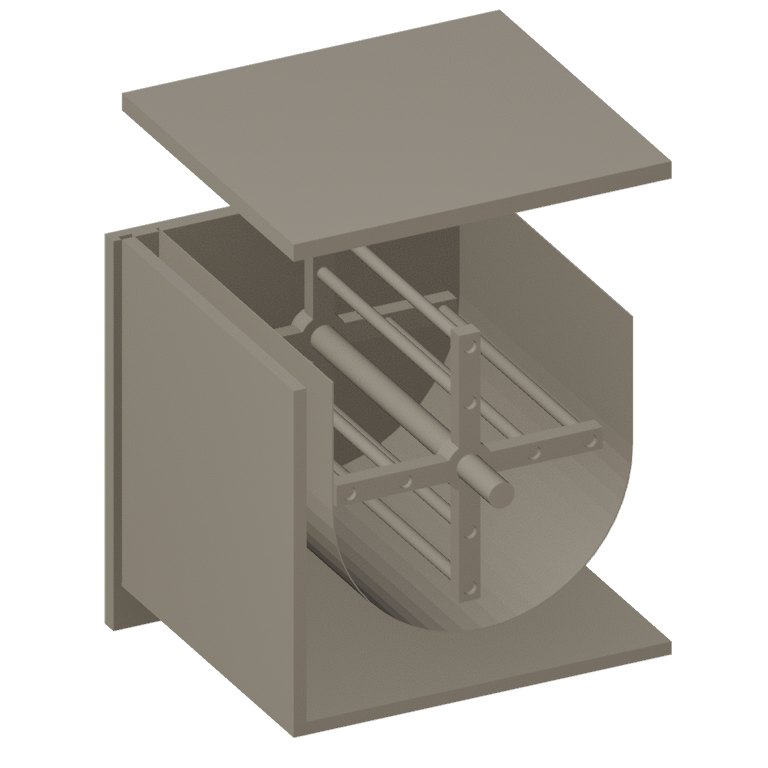
FreeCAD model of this build, not of the patent: one end piece and one side left off to show the stainless half cylinder with the water chamber below and beside it, the dash of two crosses and eight slats on its spindle, the far end piece with the crank, and the lid lifted off.
8
8
Temper, churn and make butter
Temper, churn and make butter
Pour in 500 ml of heavy cream and measure its temperature. Pour water into the chamber at the temperature the notebook gives, and wait until the cream reads about 15.6 °C. Turn the crank thirty to fifty times a minute, as they did, and time until the butter comes. To gather it, turn the dash half around and back a few times. Pour off the buttermilk, add cold water, churn a little and pour off again until it runs clear; work in a pinch of salt and weigh the butter.
Materials for this step:
 Heavy Cream500 ml
 Coarse Sea Salt1 piece
 Water1 piece
Tools needed:
 Leave-In Probe Thermometer
 Stopwatch
 Digital Kitchen Scale
 Stainless Steel Mixing Bowl (Large)
9
9
A chamber that leaks, cream that stays cold
A chamber that leaks, cream that stays cold
Water-jacketed churn troubleshooting.
Flow
Loading...
10
10
History and honest limits
History and honest limits
**William A. Crowell and Allen Crowell** of Salisbury, Litchfield County, Connecticut, received US 1,648, dated 20 June 1840. Their chamber was two inches wide; a tube at the top let the water in and one at the bottom drew it off; a thermometer could be fitted through the end piece with its card outside. The division plate was "to be made of tin or other metals which will not become oxidized by the action of the acid contained in the milk or cream." They claimed the combination of tin and wood, or other metal and wood, or all metal, in forming a chamber in the lower part of the churn with a metal division plate.
**Honest limits.** Stainless sheet, plywood and printed end pieces stand in for their tin and boards. The notebook ignores heat lost to the air and the box. FDM prints hold food in their layer lines, so wash well and replace when worn. Your temperatures, times and weights are the result.
Materials
9- 1 piecePlaceholder
- 1 piecePlaceholder
- 1 piecePlaceholder
- 1 piecePlaceholder
- 1 piecePlaceholder
- 1 piecePlaceholder
- 500 mlPlaceholder
- 1 piecePlaceholder
- 1 piecePlaceholder
Tools Required
13- Placeholder
- Placeholder
- Placeholder
- Placeholder
- Placeholder
- 1 vendor sell this, none ship to you yetPlaceholder
- Placeholder
- Placeholder
- Placeholder
- Placeholder
- Placeholder
- Placeholder
- Placeholder
Design Files
1Related Blueprints
These blueprints share knowledge with this one — techniques, materials, or principles that connect them in the learning graph.


CC0 Public Domain
This blueprint is released under CC0. You are free to copy, modify, distribute, and use this work for any purpose, without asking permission.
Support the Maker by purchasing products through their Blueprint where they earn a Maker Commission set by Vendors, or create a new iteration of this Blueprint and include it as a connection in your own Blueprint to share revenue.