ART
BEAUTY & WELLNESS
CRAFT
CULTURE & HISTORY
ENTERTAINMENT
ENVIRONMENT
FOOD & DRINKS
REVERSE ENGINEERING
SCIENCES
SPORTS
TECHNOLOGY
WEARABLES
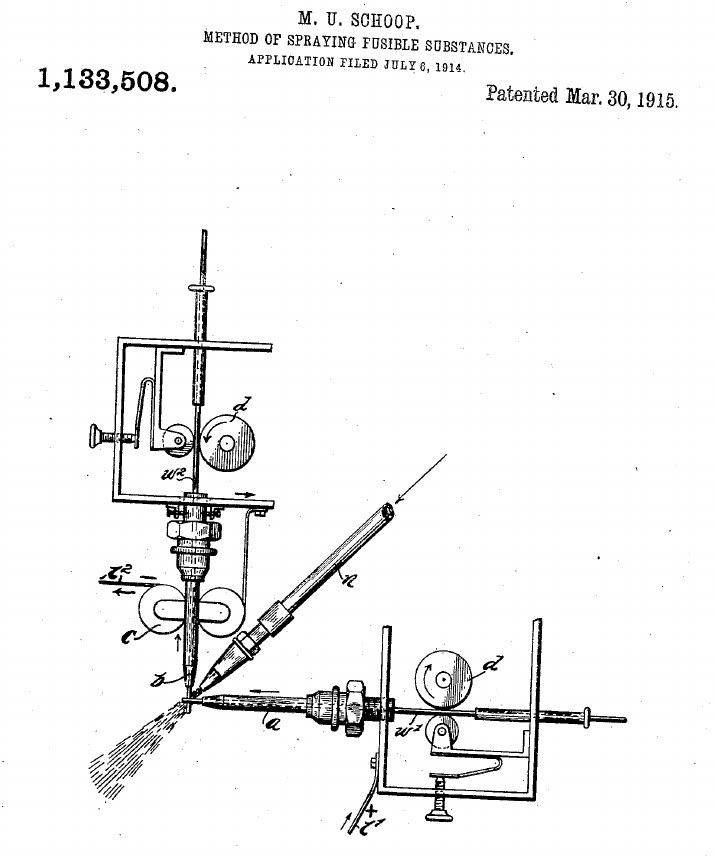


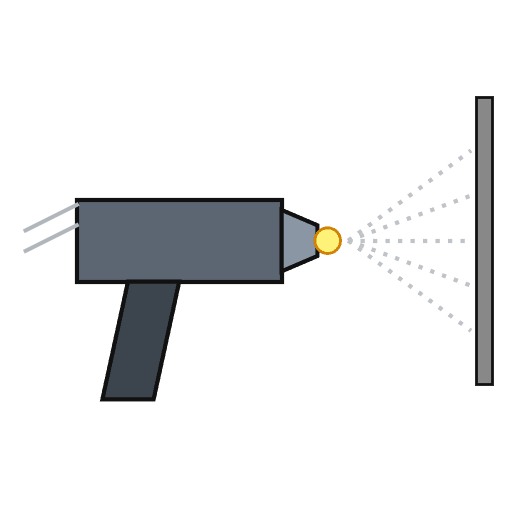
Wire-Arc Spray Gun: Two Crossed Wires, a Vibrating Arc and an Air Blast (Schoop, US 1,133,508, 1915)
The first wire-arc metal sprayer. Two metal wires are pushed through iron tubes until their tips cross. Current through the wires also runs an electromagnet that pulls one tube back, so a small arc springs between the tips and melts them; a jet of air blows the molten metal off as a fine spray and puts the arc out, the magnet lets go, the wires touch again, and the cycle repeats very fast.
Result: a continuous spray of molten metal for coating a surface.
Source: M. U. Schoop, US 1,133,508 (1915). Unknown: the wire metals and sizes, the coil, the air pressure. Picture: the patent drawing.
Advanced
Unknown
Instructions
1
1
Make the feed tubes and rolls
Make the feed tubes and rolls
Make two feed tubes ending in nozzles, preferably of iron. For each, mount a pair of feed rolls in a frame to push a wire through the tube. Set the tubes at about 90° to each other so the wires cross as they come out, the nozzles only a few millimetres apart. Mount one tube on an elastic support so it can move a little. Not given: sizes, the roll drive (the air blast may drive a small turbine for it).
Materials for this step:
 Iron Tube2 feed tubes
 Unknown Metal1 rolls, frames
 Leaf Spring1 elastic support
Tools needed:
 Metal Lathe
 Unknown Dimensions
2
2
Fit the electromagnet
Fit the electromagnet
Wind an electromagnet beside the springing tube, so the tube is its armature. Wire the coil into the same circuit as the two tubes and wires, positive to one tube and negative to the other. When current flows the magnet pulls the tube aside and draws its wire slightly back from the other. Ours: enamelled copper wire for the coil. Not given: the coil.
Materials for this step:
 Enamelled Copper Wire1 coilUnknown Metal1 magnet core
 Copper Wire1 circuit leads
Tools needed:
 Screwdriver Set
3
3
Fit the air blast
Fit the air blast
Aim a blast pipe at the point where the wires cross, either close to it or 20-30 mm away, whichever sprays best for the metal. Feed it with compressed air or another gas. Not given: the pressure.
Materials for this step:
 Air Nozzle1 piece
 Air Hose1 piece
Tools needed:
 Industrial Air Compressor
 Adjustable Spanner
4
4
Spray
Spray
Load a wire of the coating metal in each tube and feed them until they touch. Switch on the current, generally 40 to 75 volts depending on the metal and wire thickness, and the air. The magnet pulls the wires apart, an arc melts their tips, the air blows the melt away as spray and snuffs the arc, the magnet releases, and the cycle repeats very rapidly. The positive wire burns faster, so feed it faster or use a thicker wire; match the feed to the melting. Hold the work in the spray. Without the vibration the arc flickers and the wires may weld together.
Tools needed:
 DC Power SupplyIndustrial Air CompressorUnknown Metal
Materials
7- 2 feed tubesPlaceholder
- 1 magnet corePlaceholder
- 1 elastic supportPlaceholder
- 1 coilPlaceholder
- 1 circuit leadsPlaceholder
- 1 piecePlaceholder
- 1 piecePlaceholder
Tools Required
7- Placeholder
- Placeholder
- Placeholder
- Placeholder
- Placeholder
- Placeholder
- Placeholder
Connected Blueprint Materials
This blueprint makes
CC0 Public Domain
This blueprint is released under CC0. You are free to copy, modify, distribute, and use this work for any purpose, without asking permission.
Support the Maker by purchasing products through their Blueprint where they earn a Maker Commission set by Vendors, or create a new iteration of this Blueprint and include it as a connection in your own Blueprint to share revenue.