ART
BEAUTY & WELLNESS
CRAFT
CULTURE & HISTORY
ENTERTAINMENT
ENVIRONMENT
FOOD & DRINKS
REVERSE ENGINEERING
SCIENCES
SPORTS
TECHNOLOGY
WEARABLES
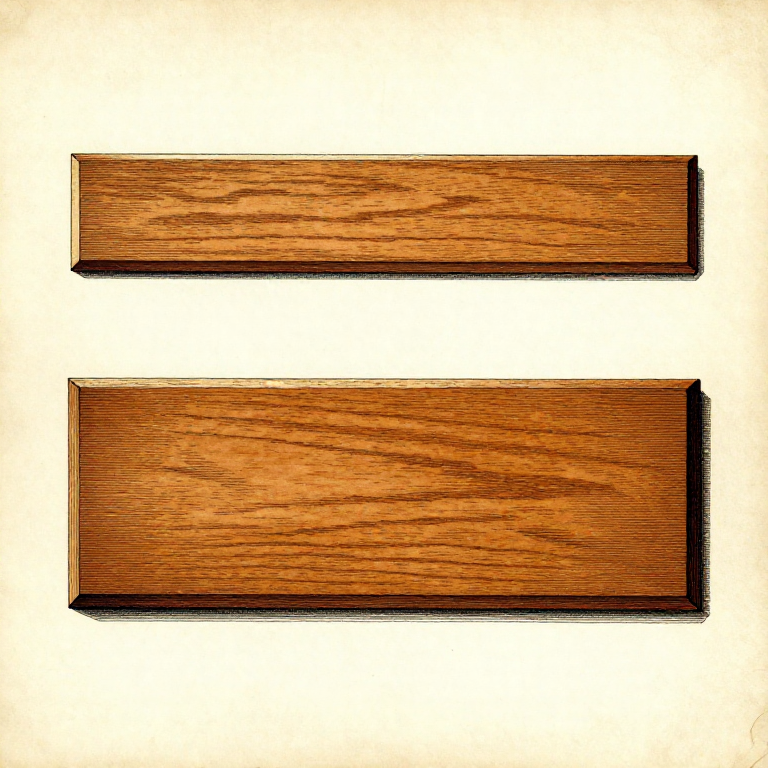


Wood Moves Across the Grain and Barely Along It — and It Never Stops
A board gets wider and narrower with the seasons and stays almost exactly the same length. That one asymmetry explains nearly every piece of furniture that has split itself apart.
The numbers are not small. A 300 mm oak board can move 6 mm or more across its width between a damp summer and a heated winter — and along its length, over the same 300 mm, it moves about a tenth of a millimetre.
Nothing stops it. Wood is hygroscopic for as long as it exists: finish slows the exchange but does not prevent it, and a 200-year-old table still moves every year. So the craft is not preventing movement but DESIGNING FOR it — which is what the rest of this batch is about.
Beginner
2 hours
Instructions
1
1
Why across and not along
Why across and not along
Wood is a bundle of long hollow cells running up the tree. Water sits in the walls of those cells, and when it leaves, the walls get thinner — so the bundle gets narrower without getting much shorter.
That is the whole mechanism. Shrinkage happens perpendicular to the cell walls, and the cells lie along the grain, so the movement lies across it.
It is not even across, though. Wood shrinks roughly TWICE as much around the growth rings (tangentially) as it does towards the centre of the tree (radially), and that inequality is exactly what makes a flatsawn board cup. The third rung of this batch is that difference in detail.
Materials for this step:
 Hardwood Board1 piece
Tools needed:
 Steel Ruler
 Digital Caliper 6-Inch
2
2
Work out how much YOUR board will move
Work out how much YOUR board will move
Loading Jupyter Notebook...
Materials for this step:
Hardwood Board1 pieceTools needed:
 Desktop Computer
 CalculatorDigital Caliper 6-Inch
3
3
Measure it yourself, over one season
Measure it yourself, over one season
Mark two fine knife lines across the width of an offcut, measure between them with a caliper, and write down the number with the date. Do it again every month for a year.
That one strip of offcut will teach you more about your own workshop than any published table, because it measures YOUR timber in YOUR building. Published coefficients are averages over many trees.
Measure the length the same way while you are at it. A year of readings that barely change is what turns "movement is across the grain" from something you were told into something you have seen.
Materials for this step:
Hardwood Board1 pieceTools needed:
Digital Caliper 6-Inch Marking Knife
 Hygrometer (humidity gauge)
4
4
Design for the movement, do not fight it
Design for the movement, do not fight it
You cannot restrain a wide board. The force wood generates as it shrinks is enormous — far more than any glue joint, screw or clamp will hold — so anything that tries to stop it simply loses.
What actually fails is always the weaker of the two: the board splits, or the joint tears open, or the screw pulls through. Which one fails is the only thing a rigid design gets to choose.
So design so the movement has somewhere to GO. A floating panel, a slotted screw hole, a tabletop fastened with buttons, narrower boards rather than one wide one. Every one of those is the same idea: let it move, and make sure nothing cares.
Materials for this step:
Hardwood Board1 pieceTools needed:
Steel RulerTools Required
6- Placeholder
- Placeholder
- Placeholder
- Placeholder
- Placeholder
- Placeholder
Related Blueprints
These blueprints share knowledge with this one — techniques, materials, or principles that connect them in the learning graph.
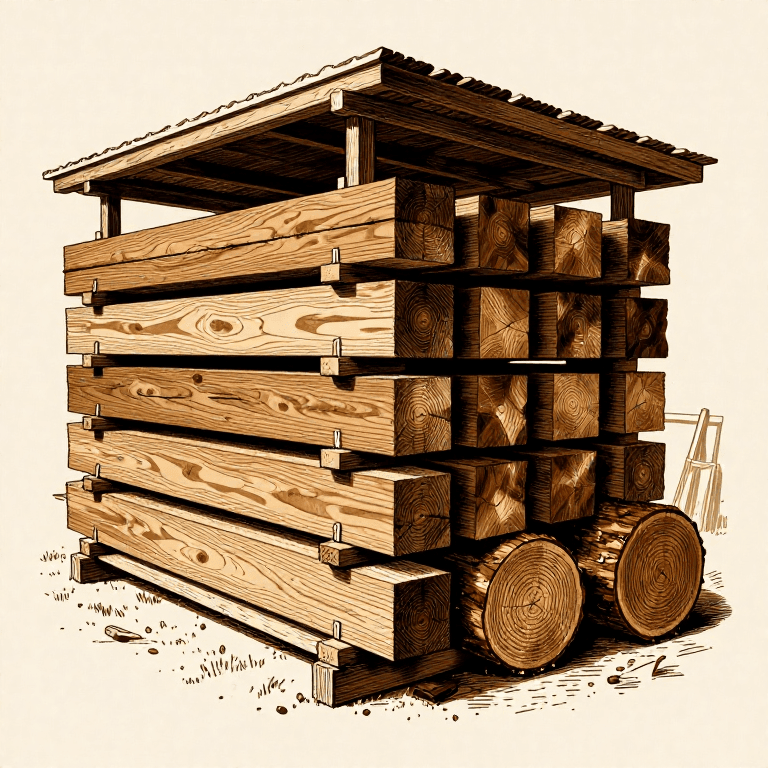
CC0 Public Domain
This blueprint is released under CC0. You are free to copy, modify, distribute, and use this work for any purpose, without asking permission.
Support the Maker by purchasing products through their Blueprint where they earn a Maker Commission set by Vendors, or create a new iteration of this Blueprint and include it as a connection in your own Blueprint to share revenue.