ART
BEAUTY & WELLNESS
CRAFT
CULTURE & HISTORY
ENTERTAINMENT
ENVIRONMENT
FOOD & DRINKS
REVERSE ENGINEERING
SCIENCES
SPORTS
TECHNOLOGY
WEARABLES
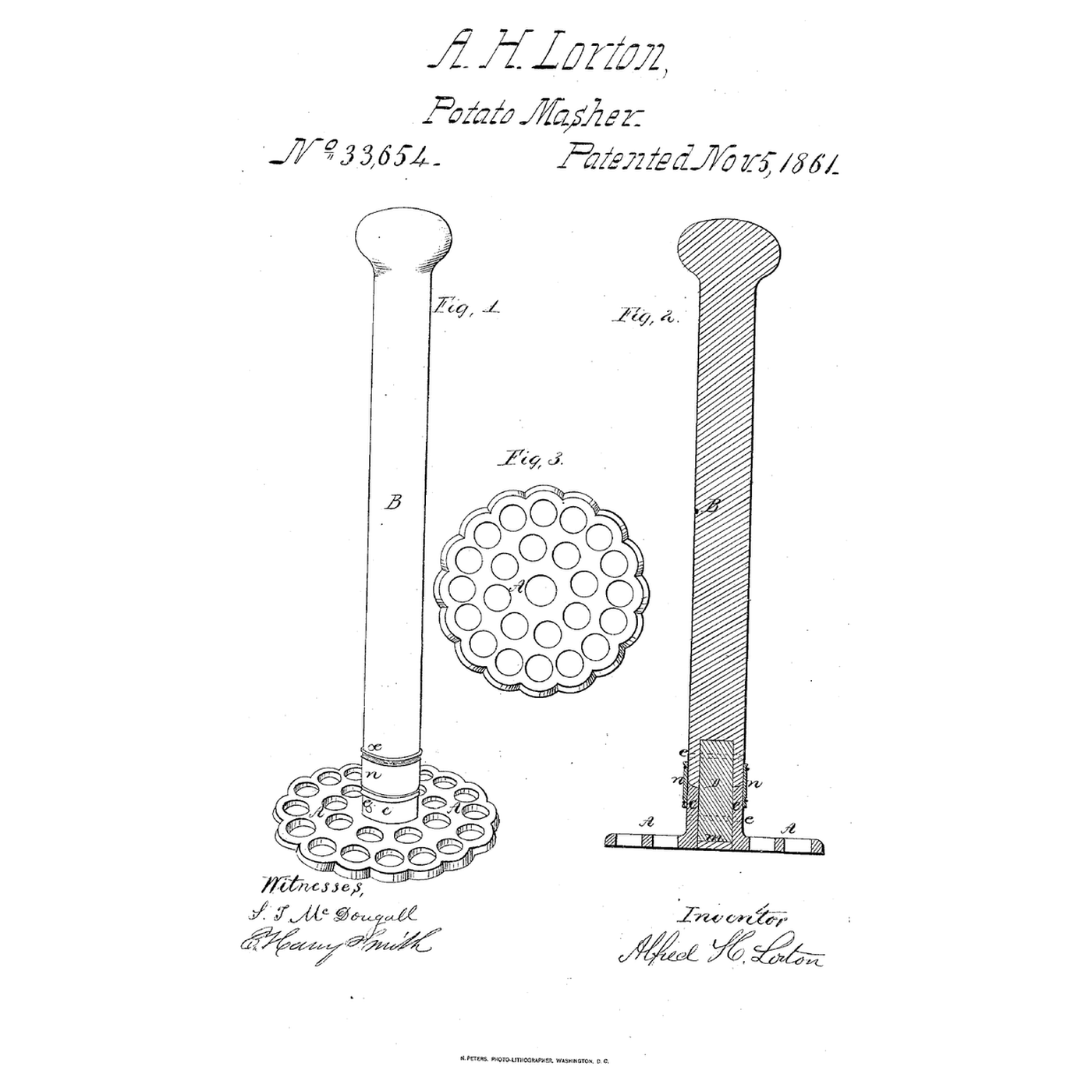


Yielding-Disk Potato Masher: A Perforated Disk That Rocks to the Mash
A rigid masher meets lumpy potatoes with its flat face tilted, and mashes only what it touches.
Alfred H. Lorton of New York received US 33,654, dated 5 November 1861, for a mashing utensil "comprised, practically, in a perforated disk provided with a suitable handle," best joined to the handle by an elastic or yielding medium — a core and sleeve of india-rubber — "so that the disk will be permitted to oscillate on the end of the handle in any direction, and thus accommodate itself to the inequalities of surface" of the mass.
This rung works out the disk's open area, then prints the disk and handle, joins them with a silicone core and sleeve, and mashes a pan of potatoes with the joint and without it.
Beginner
About 1 hour, plus printing
Instructions
1
1
Open area of the disk
Open area of the disk
Loading Jupyter Notebook...
2
2
Crushing by hand before it
Crushing by hand before it
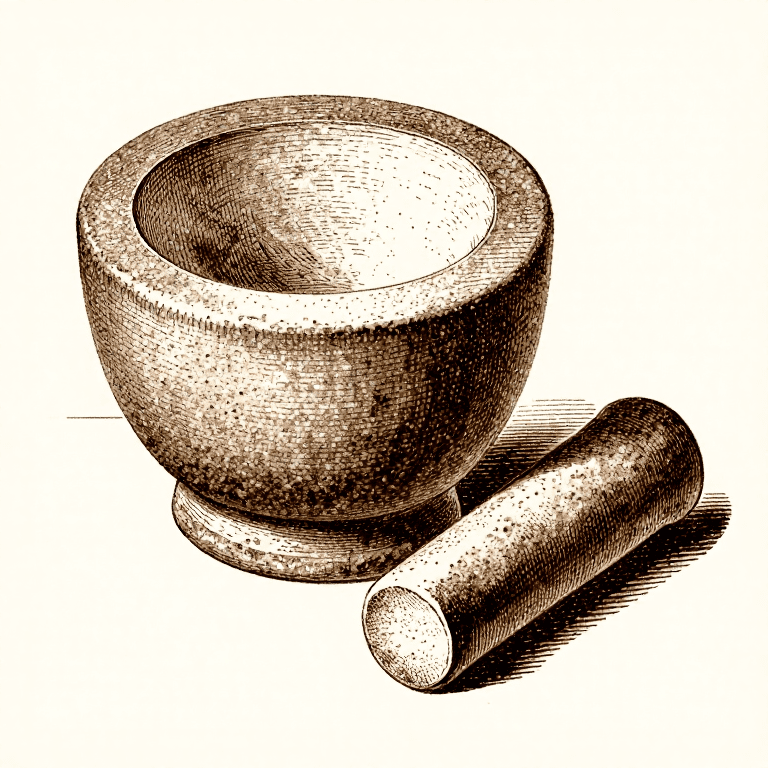
The embedded blueprint crushes with a solid pestle. Lorton perforates the face so the mash passes through, and lets it tilt.
3
3
Read US 33,654
Read US 33,654
"The perforations may be of any desired form; but I prefer to have them round, as the instrument is more readily cleared when the holes in the disk present no sharp corners."
"The instrument, though answering a very good purpose when made rigid, as last above mentioned, will not act so satisfactorily as when constructed so as to yield, as first above set forth."
4
4
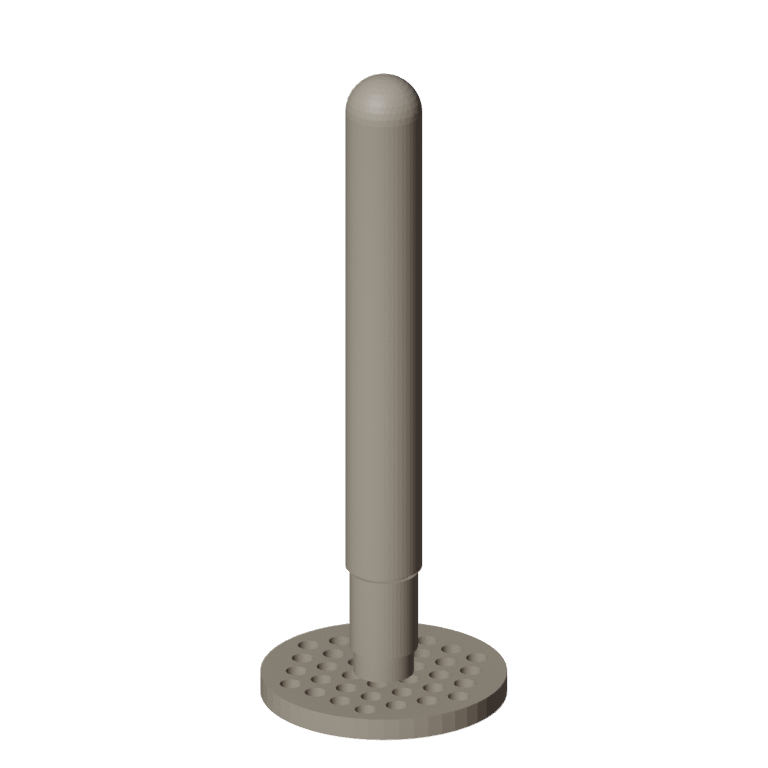
Print the disk and handle
Print the disk and handle
Print the perforated disk with its socket (/uploads/blueprints/yielding-disk-potato-masher-disk.stl) and the handle with its socket (/uploads/blueprints/yielding-disk-potato-masher-handle.stl). Print in PETG at 0.2 mm layers, 30 % infill, 4 walls; wash before first use.
Materials for this step:
 PETG Filament1 piece
Tools needed:
 FDM 3D Printer
5
5
Make the rubber core
Make the rubber core
Cut 34 mm of thick silicone tubing that fills both 15 mm sockets. Push it half into each socket and pin it through each with a 3 mm steel pin.
Materials for this step:
 Silicone Tubing1 piece
 Steel Dowel Pin1 piece
Tools needed:
 Craft Knife
 Digital Caliper 6-Inch
6
6
Fit the sleeve
Fit the sleeve
Slide a 30 mm sleeve of wider silicone tubing over both sockets and bind each end tightly with stainless wire.
Materials for this step:
Silicone Tubing1 piece Stainless Steel Wire1 piece
Tools needed:
 Flat-Nose PliersCraft Knife
7
7
The patent drawing
The patent drawing
US 33,654 drawing sheet, public domain (expired patent).
8
8
Cook the potatoes
Cook the potatoes
Boil 500 g of potatoes, peeled and quartered, in salted water for about 20 minutes until a knife slides in; drain.
Materials for this step:
 Potatoes1 piece
 Water1 piece
Tools needed:
 Saucepan
 Digital Kitchen Scale
9
9
Mash: yielding against rigid
Mash: yielding against rigid
Mash half the potatoes with the joint free and time it to no lumps. Wrap the joint stiff with tape, mash the other half, and compare.
Tools needed:
 Stainless Steel Mixing Bowl (Large)
 Stopwatch
10
10
A disk that clogs, flops or comes off
A disk that clogs, flops or comes off
Yielding-disk potato masher troubleshooting.
Flow
Loading...
11
11
History and honest limits
History and honest limits
**Alfred H. Lorton** of New York received US 33,654, dated 5 November 1861. In its simplest form the handle is driven into a socket on the disk; the yielding form uses a rubber core pinned into both sockets and a rubber sleeve wired round them, with a false bottom to protect the core. He named potatoes, turnips and other vegetables.
**Honest limits.** Printed PETG and silicone tubing stand in for his metal and india-rubber; FDM prints hold food in their layer lines, so wash well and replace when worn. Your times are the result.
Materials
6- 1 piecePlaceholder
- 2 piecesPlaceholder
- 1 piecePlaceholder
- 1 piecePlaceholder
- 1 piecePlaceholder
- 1 piecePlaceholder
Tools Required
8- Placeholder
- Placeholder
- Placeholder
- Placeholder
- Placeholder
- Placeholder
- Placeholder
- Placeholder
Related Blueprints
These blueprints share knowledge with this one — techniques, materials, or principles that connect them in the learning graph.



CC0 Public Domain
This blueprint is released under CC0. You are free to copy, modify, distribute, and use this work for any purpose, without asking permission.
Support the Maker by purchasing products through their Blueprint where they earn a Maker Commission set by Vendors, or create a new iteration of this Blueprint and include it as a connection in your own Blueprint to share revenue.