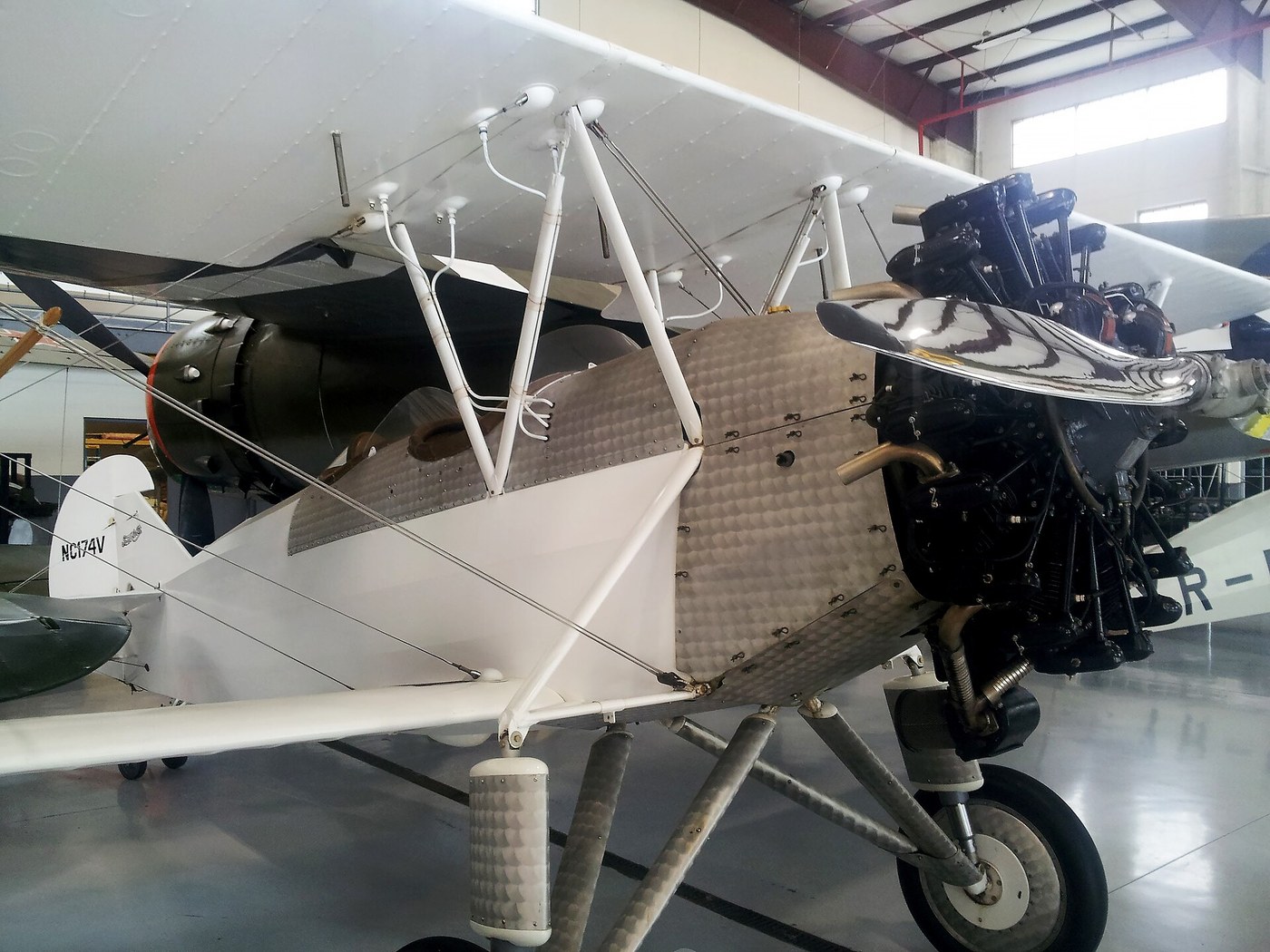


The Aileron and Wing Warping
Hướng dẫn
Establish that roll is the difficult axis
Establish that roll is the difficult axis
Find out why control needed inventing at all.
- Take a trimmed model glider and disturb it in pitch — nose up slightly — then release. Watch what it does.
- Disturb it in yaw and release.
- Now disturb it in roll, dropping one wing, and release.
Pitch and yaw recover on their own if the tail is doing its job; roll does not. A dropped wing tends to stay dropped, and worse, the machine then sideslips toward the low wing, which usually tightens the situation rather than relieving it. Nothing in the tail addresses roll, because the tail is small and close to the centreline — it has no leverage about the roll axis.
Add dihedral — angle the wings up in a shallow V — and try again. The model will now roll back toward level on its own, because in a sideslip the lower wing meets the airflow at a greater effective angle and lifts more. Dihedral gives you stability but not CONTROL: it returns you to level, it cannot make you turn.Vật liệu cho bước này:
 Tấm gỗ balsa2 tờ
 Thanh gỗ balsa1 bó
 Keo dán gỗ1 chai
Công cụ cần thiết:
 Dao thủ công kèm lưỡi thay
 Thước cặp điện tử 6 inch
 Thước đo góc
 Thước đo góc điện tử
 Điện thoại thông minh quay chậm
 Kính bảo hộ trong suốt
Build the wing-warping mechanism
Build the wing-warping mechanism
Twist the whole wing, the way the 1903 Flyer did.
- Build a wing with flexible trailing-edge structure — ribs firmly attached to the main spar but the trailing edge free to move vertically at the tips.
- Rig cables from each wingtip trailing edge to a common control, crossed so that pulling one down raises the other.
- Set the neutral position with both tips at equal incidence — check with an angle gauge, not by eye.
- Operate the control and measure the incidence change at each tip.
You are changing the wing’s angle of attack asymmetrically: more incidence on one side means more lift there, and the aircraft rolls. The Wrights got the idea, by their own account, from twisting an empty inner-tube box in the bicycle shop.
Feel how much force the control needs, and note that the whole wing structure has to be deliberately compliant for it to work. That compliance is the problem: a structure soft enough to warp on demand is soft enough to warp under aerodynamic load, and as speeds and wing loadings rose in the following decade this became a genuine hazard. Warping was effectively gone from new designs by about 1915.Vật liệu cho bước này:
Tấm gỗ balsa2 tờThanh gỗ balsa1 bó Dây đàn piano1 coil
 Cần lái bề mặt1 bộ
 Càng chữ U có chốt1 bộ
Công cụ cần thiết:
Dao thủ công kèm lưỡi thayThước cặp điện tử 6 inchThước đo gócThước đo góc điện tử Bộ giũaKính bảo hộ trong suốt
Build ailerons on an identical wing
Build ailerons on an identical wing
Same job, different mechanism, and the difference is entirely structural.
- Build a second wing to the same plan, but rigid — braced trailing edge, no deliberate compliance.
- Cut a hinged panel into the outboard trailing edge of each side, roughly a quarter of the semi-span.
- Link them so that one goes up as the other goes down.
- Measure the deflection angles and confirm they are symmetric.
The aileron changes the effective camber of the outer wing rather than the incidence of the whole wing, and it does so without asking the structure to bend. That is the entire advantage — the wing can now be made as stiff as you like, which is what allowed wings to get thinner, faster and eventually all-metal.
Reverse-engineering note: ailerons sit OUTBOARD because roll authority is a moment, so leverage matters, and the tips have the longest arm. They stop short of the very tip both because the structure is shallow there and because the tip vortex makes the last few percent of span aerodynamically poor anyway.Vật liệu cho bước này:
Tấm gỗ balsa2 tờThanh gỗ balsa1 bó Băng bản lề (mặt điều khiển)1 cuộnCần lái bề mặt1 bộCàng chữ U có chốt1 bộKeo dán gỗ1 chai
Công cụ cần thiết:
Dao thủ công kèm lưỡi thayThước cặp điện tử 6 inchThước đo gócThước đo góc điện tửBộ giũaKính bảo hộ trong suốtFly both and find adverse yaw
Fly both and find adverse yaw
Both mechanisms share a flaw, and finding it is the point of this step.
- Fly each wing in turn on the same fuselage, in calm air, filming from behind.
- Apply roll input and watch the NOSE, not the wings.
- Note which way the nose swings at the moment roll begins.
The nose swings the WRONG way — away from the intended turn — at the start of the roll. The wing being asked to lift more is also, unavoidably, producing more drag; the wing lifting less produces less. That drag difference is a yawing moment opposing the turn, and it is called adverse yaw.
This is why an aeroplane needs a rudder to turn properly, and why pilots are taught to lead a turn with coordinated rudder rather than roll alone. It is not a training quirk — it is a direct consequence of lift and drag being produced by the same surface.
Two real fixes exist and both are visible on aircraft today. Differential ailerons move the up-going one further than the down-going one, so the drag is more evenly matched. Frise ailerons project the leading edge of the up-going aileron into the airflow beneath the wing, deliberately adding drag on that side. Look along the wing of almost any light aircraft and you can see which it uses.Vật liệu cho bước này:
 Giấy kẻ ô ly1 pad
Công cụ cần thiết:
Điện thoại thông minh quay chậm Máy đo gió cầm tayThước đo gócThước đo góc điện tửKính bảo hộ trong suốt
Compare the structures, not just the handling
Compare the structures, not just the handling
The two mechanisms fly similarly. They do not survive similarly.
- Load each wing at the tip with a steadily increasing weight and measure the twist with an angle gauge.
- Record the angle of twist against load for both.
- Now estimate how that twist would change the local angle of attack in flight.
The warping wing twists far more under load, and the twist adds to whatever the pilot commanded. At low speed and light loading this is merely imprecise. As speed rises, aerodynamic loads rise with the square of speed, and a wing that twists under load can enter a feedback loop where twist increases load, which increases twist. That is aeroelastic divergence and it destroys wings.
So the aileron did not win because it rolled better. It won because it decoupled the control from the structure, letting engineers make wings stiff — and stiffness was the prerequisite for everything that followed, from the cantilever monoplane to the all-metal stressed skin.
Worth stating plainly, because it is a recurring pattern: the superseded design was not stupid, it had a hard limit built into its principle. Warping is fine on a slow, lightly-loaded, heavily-braced biplane, which is exactly the aircraft the Wrights had. It fails on the aircraft that came next.Vật liệu cho bước này:
 Bộ quả cân chuẩn1 bộGiấy kẻ ô ly1 pad
Công cụ cần thiết:
Thước đo góc điện tử Cân điện tửThước cặp điện tử 6 inch
 Vam chữ CThước đo gócKính bảo hộ trong suốt
Vật liệu
9- 2 tờTạm thời
- 1 bóTạm thời
- 1 chaiTạm thời
- 1 coilTạm thời
- 1 bộTạm thời
- Tạm thời
- Tạm thời
- 1 padTạm thời
- 1 bộTạm thời
Công cụ yêu cầu
10- Tạm thời
- Tạm thời
- Tạm thời
- Tạm thời
- Tạm thời
- Tạm thời
- Tạm thời
- Tạm thời
- Tạm thời
- Tạm thời
Blueprint liên quan
Các blueprint này chia sẻ kiến thức — kỹ thuật, vật liệu hoặc nguyên tắc
CC0 Phạm vi công cộng
Bản thiết kế này được phát hành theo CC0. Bạn tự do sao chép, sửa đổi, phân phối và sử dụng cho bất kỳ mục đích nào mà không cần xin phép.
Hỗ trợ nhà sáng tạo bằng cách mua sản phẩm qua bản thiết kế, nơi họ nhận Hoa hồng nhà sáng tạo do nhà bán hàng đặt, hoặc tạo phiên bản mới và kết nối trong bản thiết kế riêng để chia sẻ doanh thu.