NGHỆ THUẬT
LÀM ĐẸP VÀ SỨC KHỎE
THỦ CÔNG
VĂN HÓA VÀ LỊCH SỬ
GIẢI TRÍ
MÔI TRƯỜNG
THỰC PHẨM VÀ ĐỒ UỐNG
KỸ THUẬT NGƯỢC
KHOA HỌC
THỂ THAO
CÔNG NGHỆ
THIẾT BỊ ĐEO

Balls or Rods: The Media Decide the Product, Not Just the Fineness
Two grinding mills can be the same drum, turning at the same speed, holding the same weight of steel, and produce products that are not remotely alike.
The reason is contact geometry. A ball touches its neighbour at a point, and whatever happens to be at that point gets broken — coarse, fine, or already fine enough. A rod touches along a line down the whole length of the mill, and a line cannot come down past the largest lump beneath it. So a rod charge breaks the coarse and steps over the fine.
That is a selection rule, and it decides the shape of the product distribution rather than just its average. This rung derives what size media can grip what size particle — it turns out to be the jaw crusher's nip angle again, in a different costume — and then generates what the two selection rules do to the same starting bed.
Nâng cao
About 3 hours
Hướng dẫn
1
1
Watch a rod pick the big one
Watch a rod pick the big one
Spread a single layer of mixed stone on a flat plate — a good spread of sizes, nothing sorted. Lay a length of steel bar across it and press down evenly with both hands.
Watch which stones crack. It will be the big ones, and only the big ones, because the bar is resting on them and cannot reach anything else.
Now do it again with a ball bearing or a round pebble, pressed down at a point. Whatever is under the point breaks, and whether that is a large stone or a small one is entirely a matter of where you put your hand.
That is the whole rung, done in two minutes with a bar and a ball. Everything that follows is putting numbers on it.
Do the bar version twice: once on a single layer and once on a heap two or three deep. On the heap the selection gets weaker, because the bar is now resting on a lumpy surface rather than on individual stones. Rod mills are run with a thin charge for exactly that reason.
Vật liệu cho bước này:
 Đá cốt liệu1 nắm
 Thép thanh thô1 cái
 Vòng bi1 cái
Công cụ cần thiết:
 Tấm thép mềm
 Thước cặp điện tử 6 inch
 Găng tay da bảo hộ
 Kính bảo hộ trong suốt
2
2
The nip condition, again
The nip condition, again
Đang tải sổ tay Jupyter…
3
3
Charge a mill properly: fill, grade and top up
Charge a mill properly: fill, grade and top up
Three numbers describe a media charge and all three matter.
**Fill.** The fraction of the mill's volume the charge occupies, usually a third or a little more. Too little and the charge has room to fall further than the toe, which hammers the liner instead of the material. Too much and there is no free space for the charge to cataract into, so it rolls instead, and the mill quietly turns into a cascading machine that grinds slowly and makes fines.
**Grading.** A new charge is never one size. It is a distribution, because the mill needs the big media for the feed and the small media for the surface — the same argument as the tube mill's compartments, solved a different way.
**Top-up.** Media wear away, and as they wear they get smaller, so a mill that is topped up only with the largest size drifts toward a coarse charge over months. Top up with a graded mix, and weigh what goes in. The commonest slow failure in a grinding circuit is a charge that has been maintained by eye.
Measure the fill with the mill stopped: the charge's chord against the shell, taken with a tape, converts straight to a filled fraction. Record it every time. A drifting fill is visible in a log and invisible in a glance.
Vật liệu cho bước này:
 Bi nghiền (bi thép)1 charge
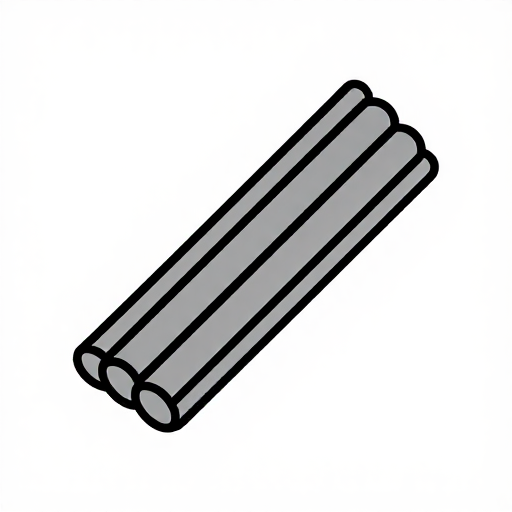 Thanh nghiền (thanh thép)1 charge
Công cụ cần thiết:
 Cân điện tử
 Thước dây cuộnThước cặp điện tử 6 inch
 XôGăng tay da bảo hộKính bảo hộ trong suốt
4
4
Point contact against line contact, generated
Point contact against line contact, generated
Đang tải sổ tay Jupyter…
5
5
Close the circuit, or grind what is already finished
Close the circuit, or grind what is already finished
An open-circuit mill has to hold everything until the *worst* particle is fine enough, which means the average particle is ground far past the point of usefulness. That over-grinding is wasted power and unwanted fines, and it is entirely avoidable.
A **closed circuit** puts a screen or a classifier on the mill's discharge and returns the coarse fraction to the feed. Each particle now leaves as soon as it is small enough. The coarse that comes back is the **circulating load**, and on a well-run circuit it is often larger than the fresh feed — two or three times, sometimes more — which surprises people the first time they see the figure.
That number is not a sign of something wrong. A high circulating load means material is being removed promptly, which is exactly the point. What it costs is a bigger mill feed conveyor, a bigger classifier and more pumping, so there is an optimum rather than a maximum.
The screening rung is what the classifier is doing, and its partition curve is why the circulating load can never be sharp: every pass returns some material that was already fine enough and passes some that was not.
Vật liệu cho bước này:
 Lưới sàng đan bằng dây thép1 cái
 Sàng phân loại1 cái
Công cụ cần thiết:
Cân điện tử Sàng thô
 Rây lưới mịn
 Rây 60 mesh
 Rây 120 mắtXô
 Khẩu trang chống bụiKính bảo hộ trong suốt
6
6
History and context
History and context
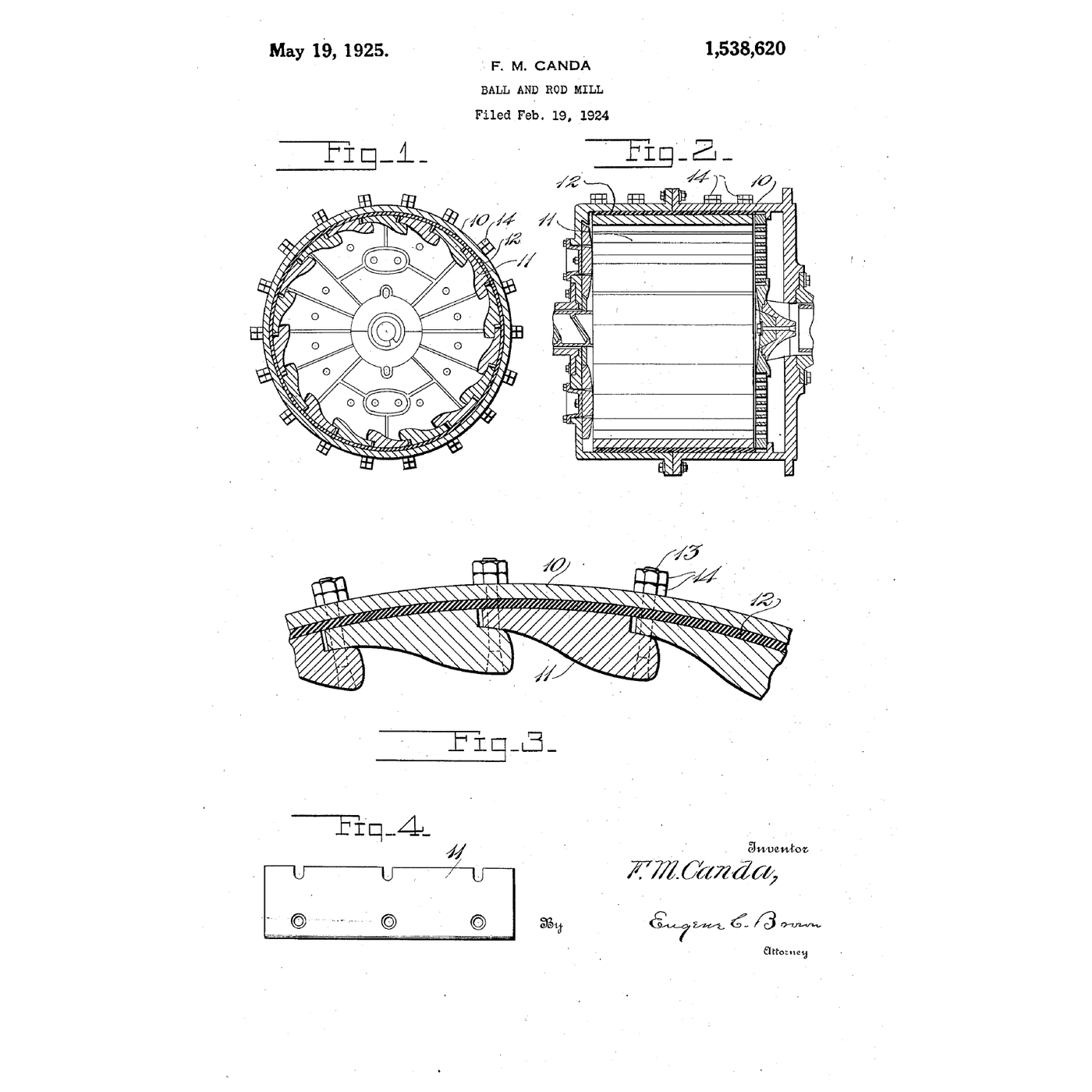
**US 1,538,620, 'Ball and Rod Mill', Ferdinand Mora Canda of Chrome, New Jersey, application filed 19 February 1924, granted 19 May 1925.** The claims are about the mill's lining — 'a metal shell or casing, a circumferential series of brittle hard steel plates bolted to the shell, and a resilient shock absorbing medium interposed between the plates and the shell' — and the title covers both media in one breath, because the body of the machine does not care what is in it.
That detail of the claim is worth noticing. By 1924 the mill itself was not the invention any more; what was being fought over was how to line it so the liners survived, which is the mark of a mature machine.
Rod mills became the standard first stage of grinding in metalliferous plants for half a century, precisely because of the selection rule in step 4: gravity separation and flotation both work badly on slimes, and a rod mill delivered a narrow product without making them. They faded when autogenous and semi-autogenous mills took over the coarse grinding duty, not because the physics changed.
**Honest limits.** A rod mill cannot be made long relative to its diameter — beyond about six to one the rods tangle, and a tangled charge is a day of work with a crane and a lot of swearing. Rods wear unevenly and have to be culled as well as topped up. A rod mill will not grind fine: the selection rule that protects the fines from being over-ground is the same rule that stops you reaching a fine product at all, so almost every rod mill in history had a ball mill downstream of it. And both are media mills, so both consume steel continuously — in a large plant the media bill can exceed the power bill.
Vật liệu
7- 1 nắmTạm thời
- 1 cáiTạm thời
- 1 cáiTạm thời
- 1 chargeTạm thời
- 1 chargeTạm thời
- Tạm thời
- 1 cáiTạm thời
Công cụ yêu cầu
12- Tạm thời
- Tạm thời
- Tạm thời
- Tạm thời
- Tạm thời
- 1 vendor sell this, none ship to you yetTạm thời
- Tạm thời
- Tạm thời
- Tạm thời
- Tạm thời
- Tạm thời
- Tạm thời
Blueprint liên quan
Các blueprint này chia sẻ kiến thức — kỹ thuật, vật liệu hoặc nguyên tắc
Grinding in a Tumbling Mill: Critical Speed, and Why the Media Are Graded
bởi Emma
Cơ học
7
0
0
0
0
0

Sorting by Size: Why a Screen Never Makes a Clean Cut
bởi Emma
Cơ học
13
0
0
0
0
0
Breaking Stone by Compression: The Nip Angle Decides Everything
bởi Martin
Gia công kim loại
13
0
0
0
0
0

Ore Dressing
bởi Mary
Gia công kim loại
31
0
0
0
0
0
Panning for Alluvial Gold — Gravity Separation in Stream Sediment
bởi Mary
Gia công kim loại
79
0
0
0
0
0
CC0 Phạm vi công cộng
Bản thiết kế này được phát hành theo CC0. Bạn tự do sao chép, sửa đổi, phân phối và sử dụng cho bất kỳ mục đích nào mà không cần xin phép.
Hỗ trợ nhà sáng tạo bằng cách mua sản phẩm qua bản thiết kế, nơi họ nhận Hoa hồng nhà sáng tạo do nhà bán hàng đặt, hoặc tạo phiên bản mới và kết nối trong bản thiết kế riêng để chia sẻ doanh thu.