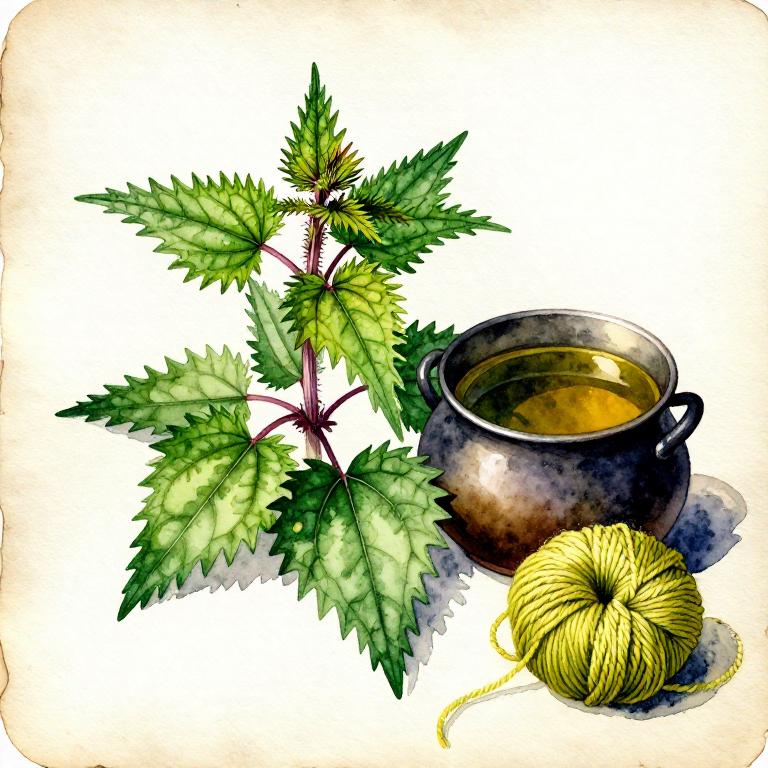


Dyeing Yellow-Green with Nettle — The Universal Wild Dye Plant
Stinging nettle (Urtica dioica) is one of the most abundant and accessible wild dye plants in the temperate world. Found across Europe, Asia, and North America, nettles grow aggressively in nutrient-rich soil near human settlements — garden edges, field margins, waste ground, riverbanks. The leaves contain chlorophyll and flavonoid pigments that produce a soft yellow-green on alum-mordanted wool. Nettle has been used as a dye since the Neolithic period, and its ubiquity has made it a starting point for plant dyers across nearly every culture that encountered it.
Beyond dyeing, nettle has a parallel history as a fibre plant. The stems contain bast fibres similar to flax and hemp — nettle cloth was produced in Bronze Age Scandinavia and continued to be made in parts of Europe into the 19th century. German military uniforms in World War I reportedly incorporated nettle fibre when cotton supplies were cut off. For the dyer, however, it is the leaves that matter — specifically, leaves harvested before the plant flowers, when chlorophyll content is highest.
The colour from nettle is a gentle, muted yellow-green — not as vivid as dyer's chamomile yellow or as green as iron-modified tansy. It is a subtle, natural-looking tone that blends well in colour palettes. With iron modification, the yellow-green shifts to a deeper olive. The lightfastness is moderate — similar to most leaf-based dyes. Nettle is an ideal beginner's dye plant because the raw material is free, abundant, and the process requires nothing more than a pot, water, and alum.
Hướng dẫn
Harvest and weigh the nettle leaves
Harvest and weigh the nettle leaves
Use 200-300% WOF of fresh nettle leaves, or 100% WOF dried. For 100 g of wool, gather 200-300 g of fresh leaves or 100 g dried. Harvest before the plant flowers for highest dye content — once nettles bolt and flower, the leaves lose pigment. Wear thick gloves when picking — the stinging hairs on fresh nettles inject formic acid and histamine on contact. The sting disappears completely during drying or simmering. Strip leaves from stems; the stems contain little dye.
Vật liệu cho bước này:
 Lá tầm ma (khô)100 g
Công cụ cần thiết:
 Cân nhà bếp điện tử
 Găng tay cao su
Soak the leaves in warm water for one hour
Soak the leaves in warm water for one hour
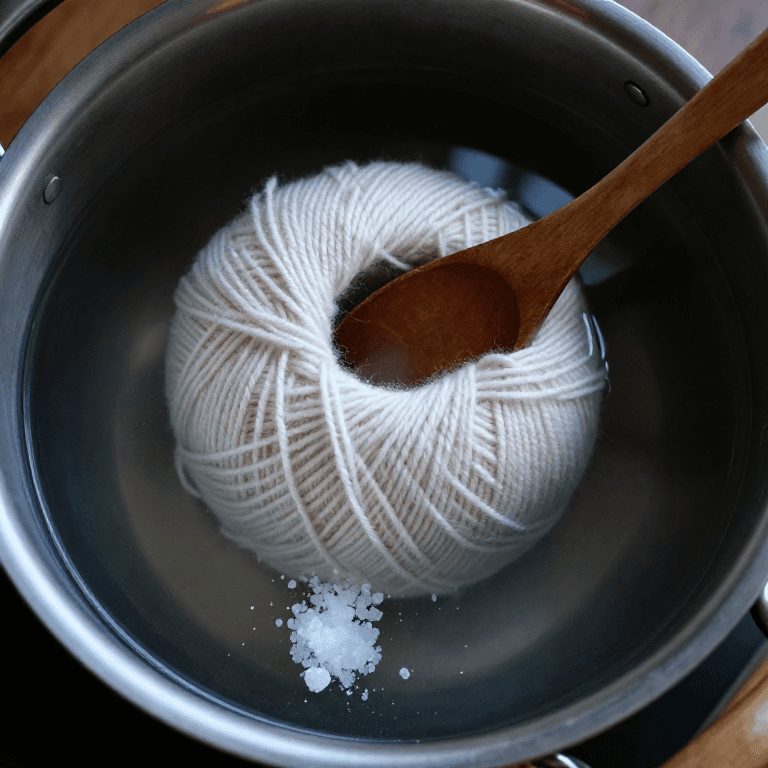
Place the nettle leaves in a dye pot with 4 litres of warm water and soak for at least one hour. The water will turn a greenish-gold as the chlorophyll and flavonoids dissolve. Fresh leaves release colour faster than dried. The stinging hairs are deactivated by water — after soaking, the leaves are safe to handle without gloves.
Công cụ cần thiết:
 Nồi cao
Simmer at 80°C for 30 minutes
Simmer at 80°C for 30 minutes
Bring the pot to a gentle simmer (75-80°C) and hold for 30 minutes. Do not boil — excessive heat breaks down chlorophyll and shifts the colour from green-yellow toward muddy brown. Stir occasionally. The liquid will deepen to a warm greenish-gold. The leaves will darken and lose their green colour as pigment transfers to the water.
Công cụ cần thiết:
 Nhiệt kế nấu ăn
 Thìa khuấy bằng gỗ
Strain out the leaves
Strain out the leaves
Strain the dye liquor through a fine mesh strainer into a clean pot. Press the leaves to extract all remaining liquid. Nettle leaves become soft and pulpy during simmering — strain thoroughly to avoid leaf fragments sticking to the wool. The strained liquor should be a clear, warm greenish-gold.
Công cụ cần thiết:
 Rây lưới mịn
Dye alum-mordanted wool at 75-80°C for 45 minutes
Dye alum-mordanted wool at 75-80°C for 45 minutes
Pre-wet the alum-mordanted wool in lukewarm water for 15 minutes, squeeze gently, and lower it into the nettle dye bath at room temperature. Slowly raise to 75-80°C over 15 minutes, then hold for 45 minutes. Turn gently every 10 minutes. The wool will develop a soft, muted yellow-green. The colour is gentle rather than vivid — this is characteristic of nettle and part of its charm.
Vật liệu cho bước này:
 Con sợi len100 g
 Phèn chua (phèn kali)10 g
Cool, rinse, and dry
Cool, rinse, and dry
Turn off the heat and let the wool cool in the dye bath overnight. Remove, squeeze gently, and rinse in lukewarm water until the runoff is clear. The final colour is a soft yellow-green — natural-looking and understated. Lightfastness is moderate. The green tone will gradually fade toward warmer yellow with prolonged sunlight exposure as the chlorophyll component degrades faster than the flavonoids. Dry in shade.
Vật liệu
3- 100 gTạm thời
- 100 gTạm thời
- Tạm thời
Công cụ yêu cầu
6- Tạm thời
- Tạm thời
- Tạm thời
- Tạm thời
- Tạm thời
- Tạm thời
Vật liệu bản thiết kế liên kết
Blueprint liên quan
Các blueprint này chia sẻ kiến thức — kỹ thuật, vật liệu hoặc nguyên tắc
CC0 Phạm vi công cộng
Bản thiết kế này được phát hành theo CC0. Bạn tự do sao chép, sửa đổi, phân phối và sử dụng cho bất kỳ mục đích nào mà không cần xin phép.
Hỗ trợ nhà sáng tạo bằng cách mua sản phẩm qua bản thiết kế, nơi họ nhận Hoa hồng nhà sáng tạo do nhà bán hàng đặt, hoặc tạo phiên bản mới và kết nối trong bản thiết kế riêng để chia sẻ doanh thu.