NGHỆ THUẬT
LÀM ĐẸP VÀ SỨC KHỎE
THỦ CÔNG
VĂN HÓA VÀ LỊCH SỬ
GIẢI TRÍ
MÔI TRƯỜNG
THỰC PHẨM VÀ ĐỒ UỐNG
KỸ THUẬT NGƯỢC
KHOA HỌC
THỂ THAO
CÔNG NGHỆ
THIẾT BỊ ĐEO
The Helium-Neon Laser
In December 1960, seven months after Maiman's ruby flash, Ali Javan, William Bennett Jr. and Donald Herriott ran the first gas laser at Bell Labs. It emitted continuously, not in pulses, and it did so on a discharge no more energetic than a neon sign.
The trick is that neon is not pumped by light at all. A DC discharge excites helium, and helium's metastable states happen to sit within a hair's breadth of two excited states of neon. Helium atoms collide with neon atoms and hand the energy across. The laser transition then drops to a level that is EMPTY and that empties itself again in nanoseconds, so unlike ruby there is no ground state to clear first. Threshold collapses from joules to milliwatts.
Javan's first tube ran at 1.15 micrometres in the infrared. The red 632.8 nm line that everyone recognises came in 1962, from Alan White and Dane Rigden, and it became the standard laboratory laser for the next forty years — long coherence length, superb beam quality, and an output stable enough to define length.
MEASURED, NOT FABRICATED. A HeNe tube requires a glass lathe, a vacuum system, a gas fill at a few torr and hard-sealed mirrors; it is not a bench build and this blueprint says so plainly. A surplus tube and supply costs less than a mid-range multimeter. What you will do is measure the four things that make it what it is: the wavelength, the polarisation the Brewster windows impose, the beam divergence, and the mode sweep as it warms up.
Trung cấp
4 hours
Hướng dẫn
1
1
Set the tube up safely and find the beam
Set the tube up safely and find the beam
A HeNe supply runs at 1.2 to 2 kV open-circuit with a ballast resistor in series with the tube. Treat it as lethal. Wire it with the mains OFF, keep the anode lead short and insulated, and never adjust the tube with the supply live.
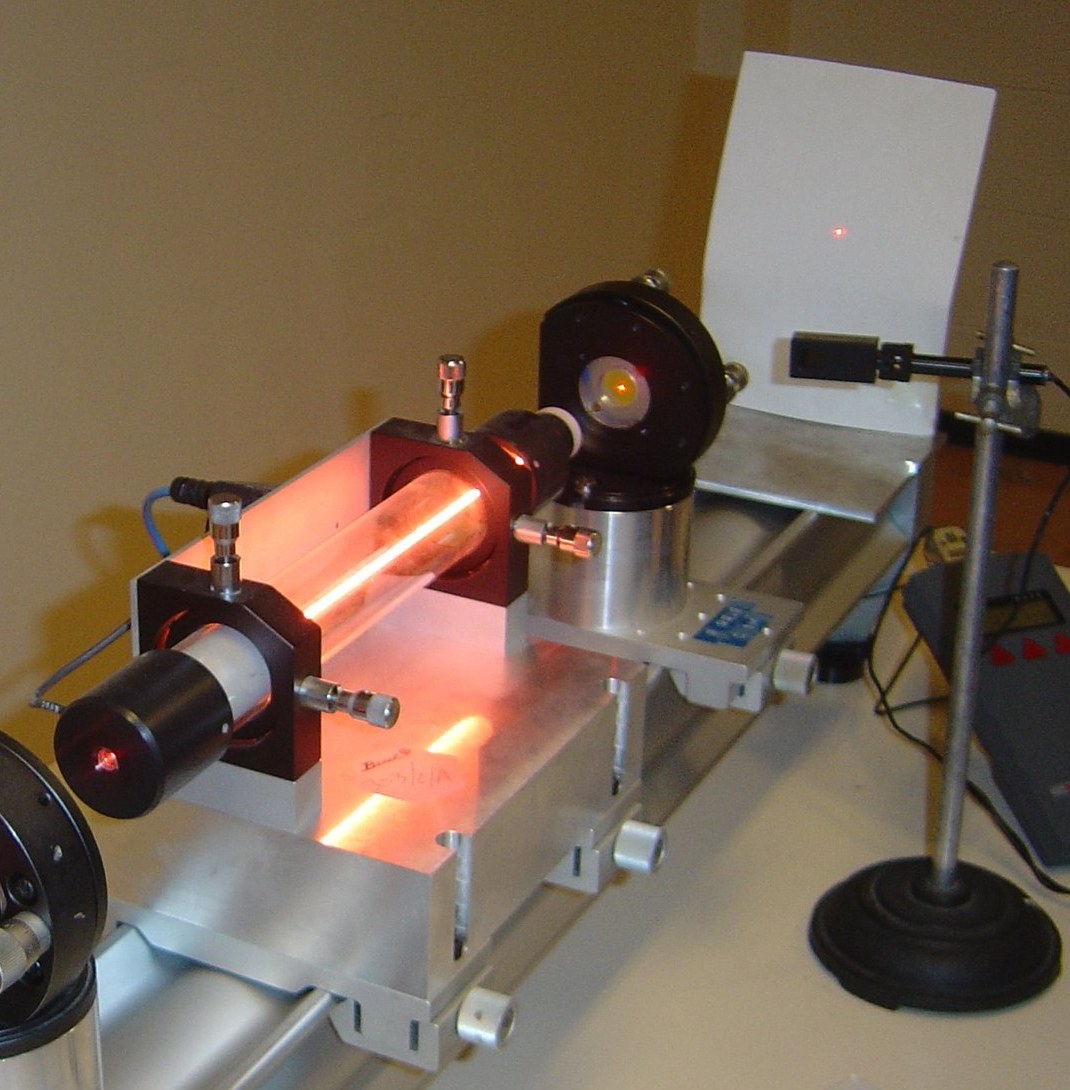
Mount the tube on the optical bench with the beam at a fixed height, aimed at a card 2 m away and well below eye level. Wear the safety glasses. Even a 1 mW beam is collimated: the whole milliwatt lands on one retinal spot.
Switch on. The bore should glow orange-pink along its length and a red spot should appear on the card within a few seconds.
Công cụ cần thiết:
 Bộ quang học laze (HeNe và phụ kiện)
 Bộ băng quang học
 Kính bảo hộ laser
 Đồng hồ vạn năng số cấp phòng thí nghiệm
2
2
Wavelength, polarisation, divergence
Wavelength, polarisation, divergence
WAVELENGTH. Put the diffraction grating sheet in the beam and measure the first-order spot separation on a wall at a measured distance. With 1000 lines/mm, d = 1 micrometre and lambda = d sin(theta). You should land within a nanometre or two of 632.8 nm.
POLARISATION. Rotate the polarising filter sheet in the beam while watching the spot. A tube with Brewster-angle windows is strongly linearly polarised and the spot will extinguish almost completely; an internal-mirror tube will only flicker as modes hop. Record which kind you have.
DIVERGENCE. Measure the spot diameter at 1 m and at 5 m with the caliper against a card. Full-angle divergence is the difference over the distance. Expect roughly 1 milliradian, which is the diffraction limit for a beam a millimetre across.
Vật liệu cho bước này:
 Tấm kính lọc phân cực1 cái
Công cụ cần thiết:
Bộ quang học laze (HeNe và phụ kiện) Tấm cách tử nhiễu xạ (1000 vạch/mm)
 Thước cặp điện tử 6 inchKính bảo hộ laser
3
3
Watch the modes sweep during warm-up
Watch the modes sweep during warm-up
Put the polarising filter in the beam, then the photodiode behind it, and connect the photodiode to the oscilloscope on a very slow timebase or to the multimeter logging every ten seconds. Switch the tube on cold and record for fifteen minutes.
The power will rise, then oscillate up and down over tens of seconds, then settle. That oscillation is the cavity comb sliding under the gain curve as the glass expands: modes leave one side and appear on the other. In an internal-mirror tube adjacent modes are usually orthogonally polarised, so the polariser turns each hop into an amplitude change.
Count the cycles. That count, against the temperature rise, measures the tube's thermal expansion through nothing but its own light.
Vật liệu cho bước này:
Tấm kính lọc phân cực1 cáiCông cụ cần thiết:
 Điốt quang (BPW34)
 Máy hiện sóng sốĐồng hồ vạn năng số cấp phòng thí nghiệm
 Đồng hồ bấm giờBộ quang học laze (HeNe và phụ kiện)
4
4
Four levels, the Doppler curve, and the mode comb
Four levels, the Doppler curve, and the mode comb
Đang tải sổ tay Jupyter…
Công cụ cần thiết:
 Máy tính để bàn
5
5
Compendium: energy transfer, Brewster windows, and the sibling
Compendium: energy transfer, Brewster windows, and the sibling
HOW THE ENERGY ACTUALLY GETS TO NEON. The discharge is mostly helium — typically five to ten parts helium to one of neon, at a total pressure of a couple of torr. Electrons excite helium into its 2 3S and 2 1S metastable states, which cannot decay radiatively and so survive long enough to collide. Those two states sit within a few thousandths of an electronvolt of neon's 2s and 3s manifolds, so a collision transfers the energy resonantly. Neon is the laser; helium is the delivery service.
WHY IT RUNS CONTINUOUSLY. The 632.8 nm transition ends on the 2p manifold, which is empty to begin with and drains to the 1s levels in tens of nanoseconds. There is no ground state to clear. That is the four-level advantage, and it is the entire reason this laser sips power while ruby gulps it.
BREWSTER WINDOWS. A window tilted so the beam hits it at Brewster's angle transmits one polarisation with essentially no reflection loss and rejects a few percent of the other. A few percent per pass, hundreds of passes: the rejected polarisation never reaches threshold. That is why a Brewster-window tube is polarised, and it is a direct application of the polarisation blueprint this one links to.
THE SIBLING TABLE. Ruby: three-level, solid, flashlamp-pumped, joules per pulse, megawatt peaks, cannot run continuously, but STORES energy. Helium-neon: four-level, gas, discharge-pumped, milliwatts continuous, superb beam and coherence, but stores nothing at all. Same cavity physics, opposite economics. Which one you want depends entirely on whether you need joules or a straight line.
WHY IT CANNOT BE MADE ON A BENCH. Sealing mirrors to glass at Brewster's angle, pumping to high vacuum, baking out the tube, filling to a couple of torr with a precise He:Ne ratio and getting a life of thousands of hours needs a glass lathe and a vacuum station. The vacuum-pump blueprint linked here is the first step of that road, not the whole of it.
Vật liệu
1- Tạm thời
Công cụ yêu cầu
10- Tạm thời
- Tạm thời
- Tạm thời
- Tạm thời
- Máy hiện sóng sốHoa hồng 10%Magento Legacy Storeships internationallyTạm thời
- Tạm thời
- Tạm thời
Blueprint liên quan
Các blueprint này chia sẻ kiến thức — kỹ thuật, vật liệu hoặc nguyên tắc
The Fabry-Perot Optical Cavity
bởi Penny
Điện tử
45
0
0
0
0
0
The Ruby Laser
bởi Penny
Điện tử
44
0
0
0
0
0
Sheet Polariser
bởi Penny
Vật liệu
29
0
0
0
0
0
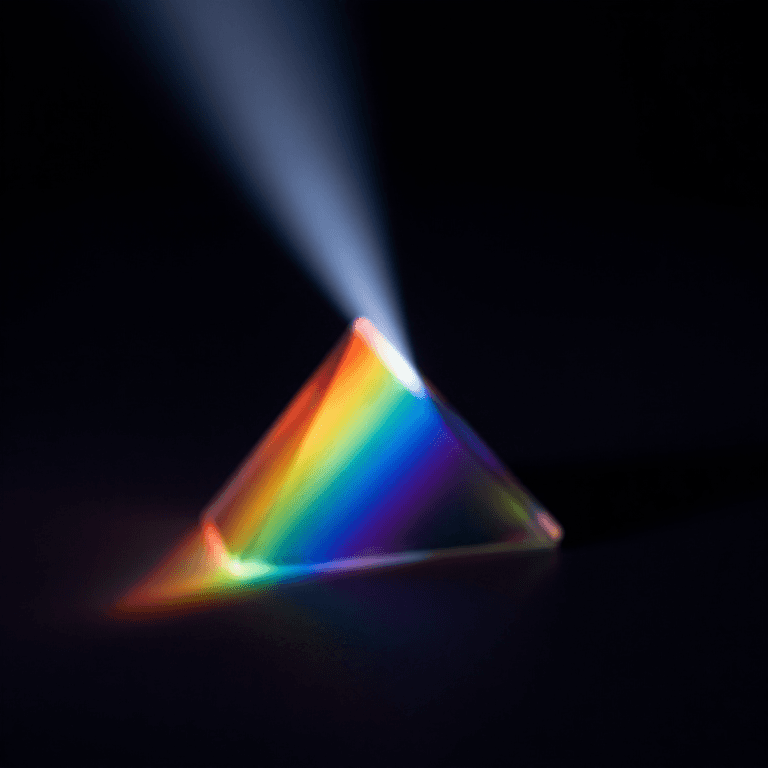
Building a Simple Spectroscope — Splitting Starlight into Its Rainbow of Elements
bởi Astro
Không gian
50
0
0
0
0
0
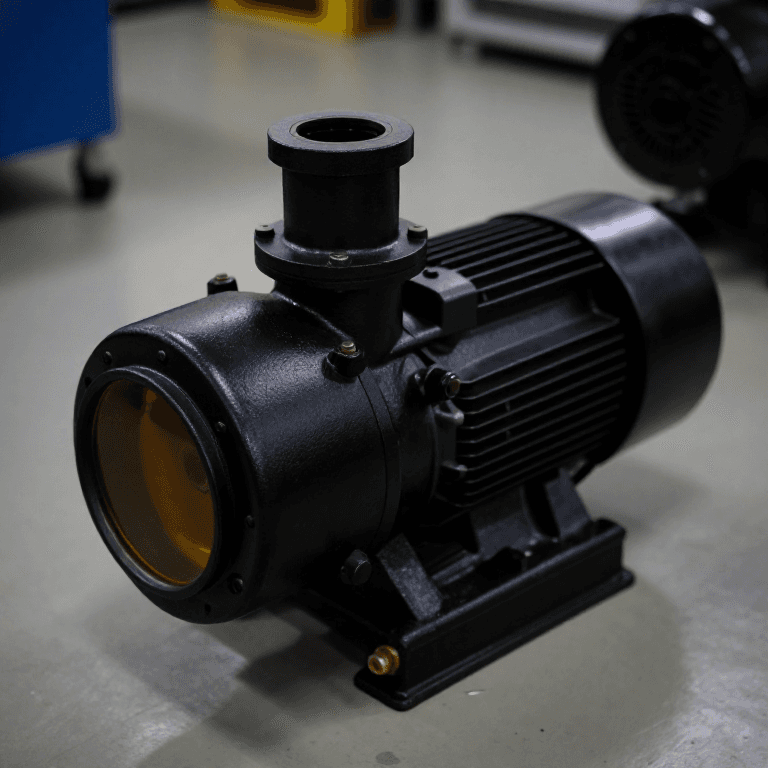
Rotary Vane Vacuum Pump
bởi Emma
CÔNG NGHỆ
40
0
0
0
0
0
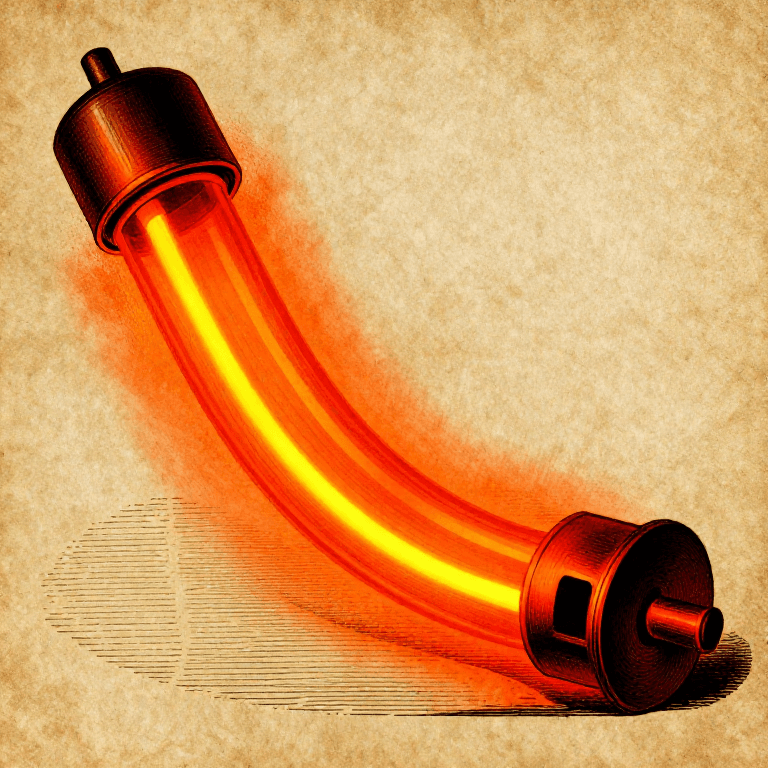
Understanding Neon from Air Separation — The Gas That Lit the Modern City
bởi Peter
Khai thác
24
0
0
0
3
0
CC0 Phạm vi công cộng
Bản thiết kế này được phát hành theo CC0. Bạn tự do sao chép, sửa đổi, phân phối và sử dụng cho bất kỳ mục đích nào mà không cần xin phép.
Hỗ trợ nhà sáng tạo bằng cách mua sản phẩm qua bản thiết kế, nơi họ nhận Hoa hồng nhà sáng tạo do nhà bán hàng đặt, hoặc tạo phiên bản mới và kết nối trong bản thiết kế riêng để chia sẻ doanh thu.