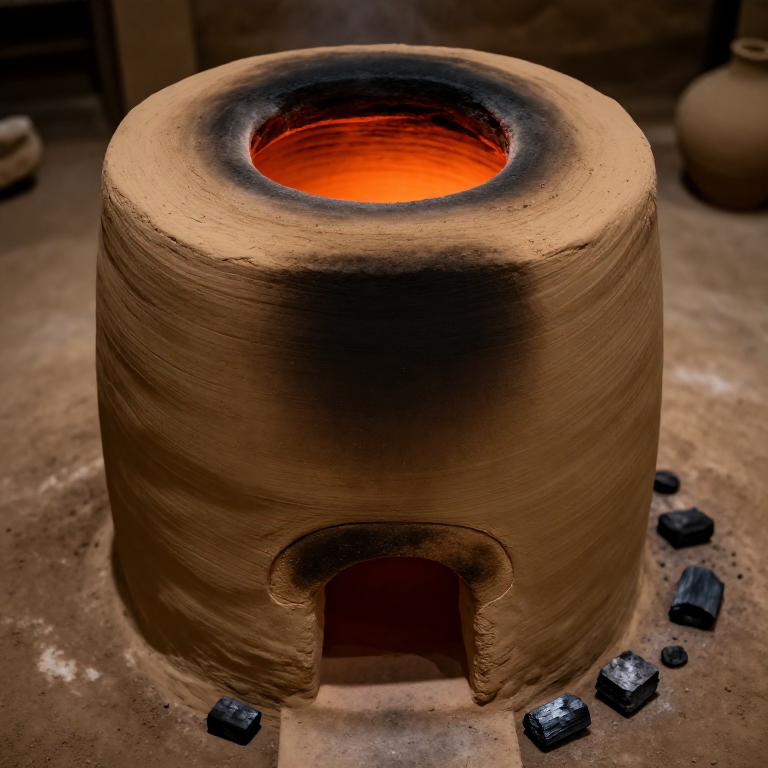


Building a Clay Kiln — The First Furnace
Hướng dẫn
Prerequisite: Making Charcoal
Prerequisite: Making Charcoal
You need charcoal for kiln curing and temperature testing. Complete this blueprint first:
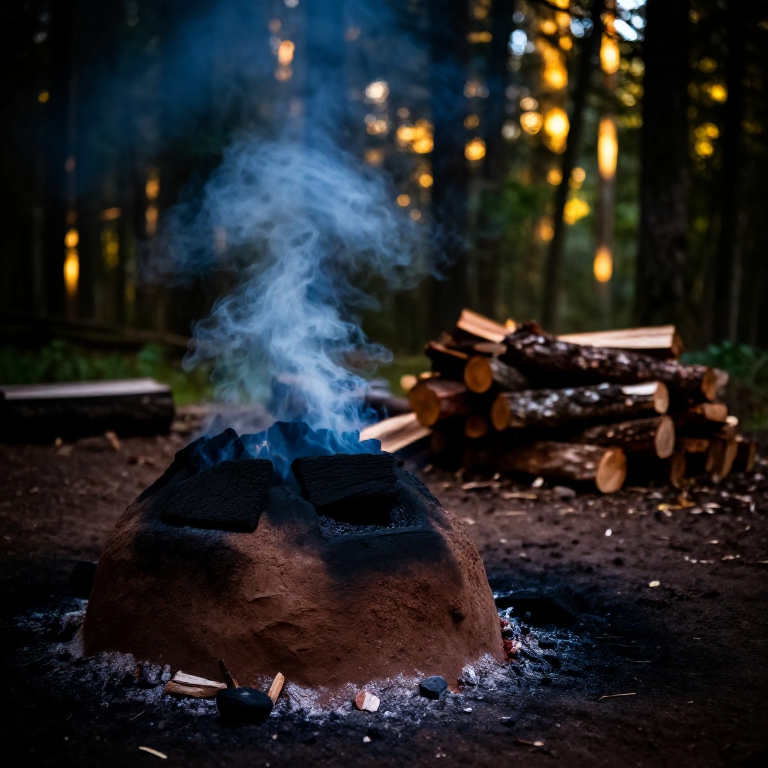
Bản thiết kế tiên quyết
Making Charcoal — The First Chemical Process
Vật liệu cho bước này:
 Bột than hoạt tính10 kg
Công cụ cần thiết:
 Dụng cụ đào (đá, gạc hoặc gậy)
 Đá phẳng (bay / dụng cụ tạo hình)
 Que tạo lỗ gió
 Bễ thổi
Kiln Design — The Updraft Principle
Kiln Design — The Updraft Principle
How a Kiln Works
A kiln is an insulated chamber with controlled airflow. The key principles:
- Insulation: Thick clay walls retain heat instead of radiating it into the air
- Updraft: Hot air rises. Cold air enters at the bottom (tuyère), hot exhaust exits at the top
- Forced air: Bellows or blowpipe through the tuyère increases oxygen supply, raising temperature
Design Specifications
We're building a simple updraft kiln — the oldest furnace design, dating to ~6000 BCE:
- Internal diameter: 30-40cm (enough for a crucible)
- Wall thickness: 8-12cm (thicker = better insulation)
- Height: 50-60cm
- Tuyère hole: 3-5cm diameter, positioned 5cm above the floor, angled slightly downward
- Top opening: 15-20cm diameter (partially sealed during operation)
Vật liệu cho bước này:
 Đất sét30 kg
Building the Kiln
Building the Kiln
Preparing the Clay Body
- Mix clay and sand in a 3:1 ratio (by volume). Too much clay = cracks. Too much sand = crumbles.
- Add chopped straw (~5% by volume). Knead thoroughly until uniform.
- The mix should hold its shape when squeezed but not stick excessively to your hands.
- Let the mix rest overnight (improves workability).
Construction Method: Coil Building
- Foundation: Create a flat clay disc, 50cm diameter, 5cm thick. This is the kiln floor.
- First course: Roll clay into coils (5cm diameter). Layer the first ring on the edge of the floor disc, 30cm inside diameter.
- Build up: Add coils one at a time, smoothing each into the one below. Overlap joints for strength.
- Tuyère: At the 3rd course (~5cm above floor), insert a stick horizontally to form the air inlet hole. Remove after clay firms up.
- Taper inward: From 30cm at the bottom, narrow gradually to 15-20cm at the top over 50cm height.
- Smooth interior: The inside surface should be as smooth as possible — rough surfaces waste heat.
Drying
Critical: Let the kiln dry slowly over 3-5 days in shade. Rapid drying causes cracks. If cracks appear, patch with wet clay.
Vật liệu cho bước này:
 Cát thô (xây dựng/gốm)10 kg
 Chất độn hữu cơ2 kgĐất sét sành thô30 kg
 Gạch chịu lửa20 pc
First Firing — Curing the Kiln
First Firing — Curing the Kiln
The Curing Process
A new clay kiln must be cured with progressively hotter fires. Jumping straight to full temperature will crack it.
- Day 1 — Warm fire: Small wood fire inside. Target ~200°C. Maintain for 2 hours. This drives out remaining moisture.
- Day 2 — Medium fire: Larger wood fire. Target ~500°C. Maintain for 2 hours. The straw burns out, creating insulating air pockets.
- Day 3 — Full fire: Switch to charcoal. Use bellows through the tuyère. Target 900-1000°C. The clay vitrifies (partially melts and hardens). The kiln is now a permanent structure.
Temperature Indicators (No Thermometer Needed)
| Temperature | Visual Indicator |
|---|---|
| ~400°C | Dull red glow barely visible in darkness |
| ~600°C | Dark cherry red, visible in shade |
| ~800°C | Cherry red, clearly visible |
| ~1000°C | Bright orange |
| ~1100°C | Yellow-orange (copper smelting range) |
Your Kiln is Ready
After curing, your kiln can reach 1100°C+ with charcoal and bellows. This unlocks:
- Pottery firing (900°C)
- Copper smelting from ore (1085°C)
- Bronze casting (~950°C)
- And eventually, with modifications, iron smelting (~1250°C)
Vật liệu cho bước này:
Bột than hoạt tính10 kgChất độn hữu cơ2 kgĐất sét sành thô30 kgVật liệu
6- 30 kgTạm thời
- Tạm thời
- 2 kgTạm thời
- 20 cáiTạm thời
- 10 kgTạm thời
- 10 kgTạm thời
Công cụ yêu cầu
4- Tạm thời
- Tạm thời
- Tạm thời
Vật liệu bản thiết kế liên kết



CC0 Phạm vi công cộng
Bản thiết kế này được phát hành theo CC0. Bạn tự do sao chép, sửa đổi, phân phối và sử dụng cho bất kỳ mục đích nào mà không cần xin phép.
Hỗ trợ nhà sáng tạo bằng cách mua sản phẩm qua bản thiết kế, nơi họ nhận Hoa hồng nhà sáng tạo do nhà bán hàng đặt, hoặc tạo phiên bản mới và kết nối trong bản thiết kế riêng để chia sẻ doanh thu.