NGHỆ THUẬT
LÀM ĐẸP VÀ SỨC KHỎE
THỦ CÔNG
VĂN HÓA VÀ LỊCH SỬ
GIẢI TRÍ
MÔI TRƯỜNG
THỰC PHẨM VÀ ĐỒ UỐNG
KỸ THUẬT NGƯỢC
KHOA HỌC
THỂ THAO
CÔNG NGHỆ
THIẾT BỊ ĐEO
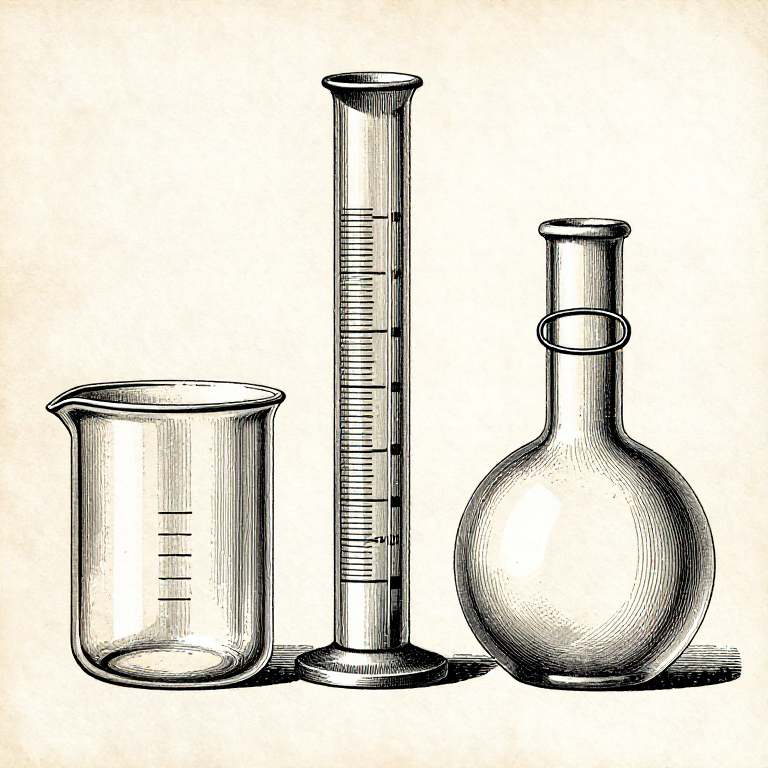


Making Up a Solution: Which Glassware Actually Measures, and Which Only Looks Like It
The graduations printed on a beaker are decoration. They are there so you can see roughly how full it is, and they are commonly 5% out — which is a hundred times worse than the flask standing next to it.
Glassware divides into two families and the difference is enormous. VOLUMETRIC glassware — volumetric flasks, bulb pipettes, burettes — is made and tested to deliver one stated volume accurately. Everything else is a container with marks on it.
Which you reach for is a decision about what the solution is FOR. Rinsing something out needs a beaker; a solution whose concentration will appear in a result needs a volumetric flask, and using the wrong one quietly poisons every number downstream.
Cơ bản
2 hours
Hướng dẫn
1
1
Weigh the solid, and dissolve it somewhere else first
Weigh the solid, and dissolve it somewhere else first
Weigh the solid on a precision balance, into a weighing container rather than onto the pan, and write the ACTUAL mass down — not the mass you intended. The difference between 5.00 g and 5.03 g is the difference between a calculated concentration and a guessed one.
Dissolve it in a BEAKER with a smaller volume of solvent than the final target, not in the volumetric flask. Solids dissolve slowly, need stirring, and sometimes need warming, and a volumetric flask has a narrow neck that makes all three awkward.
Make sure it is completely dissolved before going any further. Undissolved solid transferred into the flask is solid that is not in your solution, and the concentration you calculate will be higher than the one you have.
Vật liệu cho bước này:
 Natri clorua (muối)1 cái
 Nước cất1 lít
Công cụ cần thiết:
 Cân chính xác
 Cốc thủy tinh (becher)
 Xẻng lật
 Đũa khuấy
2
2
Transfer, rinse, and rinse again
Transfer, rinse, and rinse again
Pour the dissolved solution into the volumetric flask through a funnel, then rinse the beaker with a little solvent and pour that in too. Then do it again. Rinse the stirring rod and the funnel into the flask as well.
Whatever stays behind in the beaker is solute missing from your solution. A beaker that looks empty holds a film worth a percent or more of a small quantity, and three small rinses recover nearly all of it.
A wash bottle makes this easy and precise: a thin jet reaches the walls and the rod without adding much volume. The rinsings go into the flask, never into the sink — they are part of the measurement.
Vật liệu cho bước này:
Nước cất1 lítCông cụ cần thiết:
 Bình định mức
 Phễu thuỷ tinh có cuống
 Bình tiaCốc thủy tinh (becher)
3
3
Make up to the mark — and what the mark means
Make up to the mark — and what the mark means
Đang tải sổ tay Jupyter…
Vật liệu cho bước này:
Nước cất1 lítCông cụ cần thiết:
Bình định mức Ống đongCân chính xác
 Máy tính để bàn
4
4
Invert to mix, then label
Invert to mix, then label
Stopper the flask and invert it completely, twenty times or so, letting the bubble travel the full length each time. Swirling does not mix a volumetric flask: the dense solution sits in the bulb and the neck stays nearly pure solvent.
This matters more than it sounds. An unmixed flask sampled from the neck gives a concentration far below the real one, and it is a mistake that produces beautifully reproducible wrong answers — the systematic error the measurement batch warns about.
Then label it: substance, concentration, solvent, date, initials. And do not STORE solutions in volumetric flasks; transfer to a proper bottle. A volumetric flask is a measuring instrument, and leaving solution to dry in the neck around the graduation is how one stops being accurate.
Vật liệu cho bước này:
 Nhãn dán1 cái
Công cụ cần thiết:
Bình định mức Bút dạ không xoá
Blueprint liên quan
Các blueprint này chia sẻ kiến thức — kỹ thuật, vật liệu hoặc nguyên tắc


CC0 Phạm vi công cộng
Bản thiết kế này được phát hành theo CC0. Bạn tự do sao chép, sửa đổi, phân phối và sử dụng cho bất kỳ mục đích nào mà không cần xin phép.
Hỗ trợ nhà sáng tạo bằng cách mua sản phẩm qua bản thiết kế, nơi họ nhận Hoa hồng nhà sáng tạo do nhà bán hàng đặt, hoặc tạo phiên bản mới và kết nối trong bản thiết kế riêng để chia sẻ doanh thu.