
Pepper's Ghost
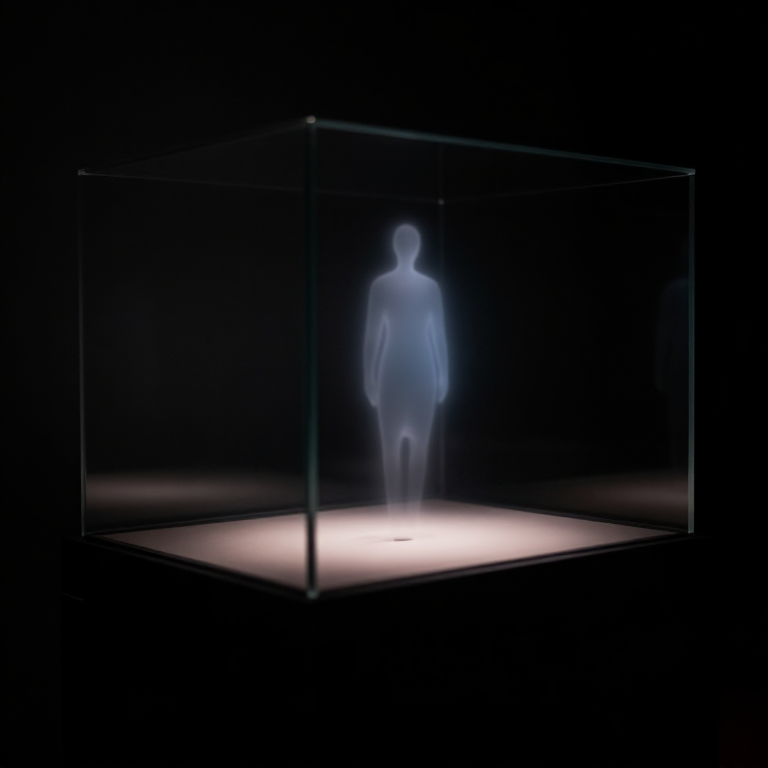
A transparent figure walks onto a stage, is run through with a sword, and vanishes. London audiences in 1862 found it genuinely frightening, and the effect has never stopped working — it is the trick behind theme-park ghosts, teleprompters, head-up displays in cars, and every "hologram" of a dead musician you have ever seen advertised. None of those are holograms. They are all this.
The mechanism is one sheet of glass at 45°. Glass reflects a few per cent of the light hitting it and transmits the rest, so a viewer looking through it sees the real scene beyond and a reflection of something hidden off to the side, superimposed. Light the hidden object and it appears; dim it and it dissolves.
Everything difficult about this build is light control, not optics.
Hướng dẫn
Use acrylic rather than glass
Use acrylic rather than glass
Clear acrylic sheet reflects almost as well and will not shatter. If you do use glass, tape the edges and never cut it without eye protection.
Vật liệu cho bước này:
 Tấm acrylic1 tờ
Build a box with an open front and an open top
Build a box with an open front and an open top
Make a rectangular box roughly 300 mm on a side, open at the front where the viewer looks in and open at the top. The top opening is where the hidden object will sit.
Line the whole interior matte black
Line the whole interior matte black
Paint or paper every internal surface dead matte black. This single step decides whether the effect looks magical or looks like a reflection in a box. Any bright surface reflects into the acrylic as a ghost of its own.
Cut the acrylic to span the box diagonally
Cut the acrylic to span the box diagonally
Cut a sheet wide enough to fit the box interior and long enough to run from the front bottom edge to the back top edge. Peel the protective film only when it is time to install.
Công cụ cần thiết:
 Dao rọc thủ công
Mount the sheet at exactly 45°
Mount the sheet at exactly 45°
Fix it running from the bottom front edge up to the top rear, held in slots or on small blocks. 45° puts the reflected image at the same apparent position as the real scene; a few degrees off and the ghost sits visibly askew.
Keep the sheet flat and unstressed
Keep the sheet flat and unstressed
Support it without clamping it hard. A bowed sheet acts as a weak curved mirror and distorts the ghost — usually seen as a face that stretches when the viewer moves.
Place the real scene behind the sheet
Place the real scene behind the sheet
Set the object the audience is meant to see — a chair, a model room — in the back of the box, beyond the acrylic. This is what they look at directly.
Place the ghost object above, out of sight
Place the ghost object above, out of sight
Put the object to be ghosted on the top opening, face down toward the sheet, hidden from the viewer by the box edge. Nothing about it should be directly visible from the front.
Compensate for the mirror flip
Compensate for the mirror flip
The reflection reverses left and right. Any text or asymmetric object must be placed mirrored to read correctly — the classic mistake, and immediately obvious once someone photographs it.
Match the two optical path lengths
Match the two optical path lengths
Measure from the sheet to the ghost object, and from the sheet to where the ghost should appear in the scene. Make these equal, or the ghost will float at the wrong depth and refuse to look solid.
Công cụ cần thiết:
 Thước kẻ
Light only the ghost object
Light only the ghost object
Put a small bright LED on the hidden object and shield it so none of its light spills into the main scene or reaches the viewer's eye directly.
Vật liệu cho bước này:
 Bộ LED nhiều màu1 gói
Light the main scene separately and dimly
Light the main scene separately and dimly
Give the rear scene its own light, kept dimmer than the ghost's. The relative brightness of the two is the only control over how solid the ghost looks.
Fade the ghost in and out on the dimmer
Fade the ghost in and out on the dimmer
Bring the ghost light up and the figure materialises; take it down and it dissolves into nothing. The sheet never moves. This is exactly how the 1862 stage effect made spirits appear and vanish.
Kill every reflection you did not intend
Kill every reflection you did not intend
Look in from the viewing position in a dark room and hunt for stray bright edges, the LED itself, or your own face. Black-flock or tape each one out. This is most of the build time.
Compendium — why this is not a hologram
Compendium — why this is not a hologram
What the glass is actually doing. At every boundary between air and a transparent material, some light reflects and the rest passes through. For ordinary glass or acrylic at modest angles that reflection is only about four per cent per surface — weak, which is exactly what makes the effect useful. The viewer sees the bright rear scene through the sheet at ninety-odd per cent strength, and a four-per-cent reflection of the hidden object laid over it. A dim reflection of a brightly lit object can match a well-lit scene, and the result is a figure you can see straight through.
The 1862 debut, and an honest credit. John Henry Pepper demonstrated it at the Royal Polytechnic Institution in London in 1862 and it became a sensation, but the technique was patented by the civil engineer Henry Dircks, who had devised it as "Dircksian Phantasmagoria". Dircks's version required a theatre to be rebuilt around it; Pepper's contribution was to modify it so it could be installed in an existing stage, which is why it spread — and why it carries his name rather than Dircks's. They shared the patent, and Pepper reportedly tried and failed to get Dircks's name attached to it in popular use.
Why calling it a hologram is wrong. A hologram records the phase of a light wave on a medium and reconstructs a genuinely three-dimensional wavefront: move your head and you see round the object. Pepper's ghost is a flat reflected image of a flat or real object, and it has one correct viewing position — move far enough and the illusion breaks. The widely publicised "holograms" of deceased performers at concerts and of politicians on news broadcasts are, without exception, this 160-year-old reflection trick, usually with a projection screen above and a tensioned foil in place of glass.
Where you have used one today. A teleprompter is a Pepper's ghost: the presenter reads text reflected off angled glass while the camera shoots straight through it. A car's head-up display is the same arrangement using the windscreen. Both work for exactly the reason your box does — partial reflection, matched path lengths and careful control of what is lit.
Vật liệu
2- 1 tờTạm thời
- 1 góiTạm thời
Vật liệu bản thiết kế liên kết
Blueprint liên quan
Các blueprint này chia sẻ kiến thức — kỹ thuật, vật liệu hoặc nguyên tắc
CC0 Phạm vi công cộng
Bản thiết kế này được phát hành theo CC0. Bạn tự do sao chép, sửa đổi, phân phối và sử dụng cho bất kỳ mục đích nào mà không cần xin phép.
Hỗ trợ nhà sáng tạo bằng cách mua sản phẩm qua bản thiết kế, nơi họ nhận Hoa hồng nhà sáng tạo do nhà bán hàng đặt, hoặc tạo phiên bản mới và kết nối trong bản thiết kế riêng để chia sẻ doanh thu.