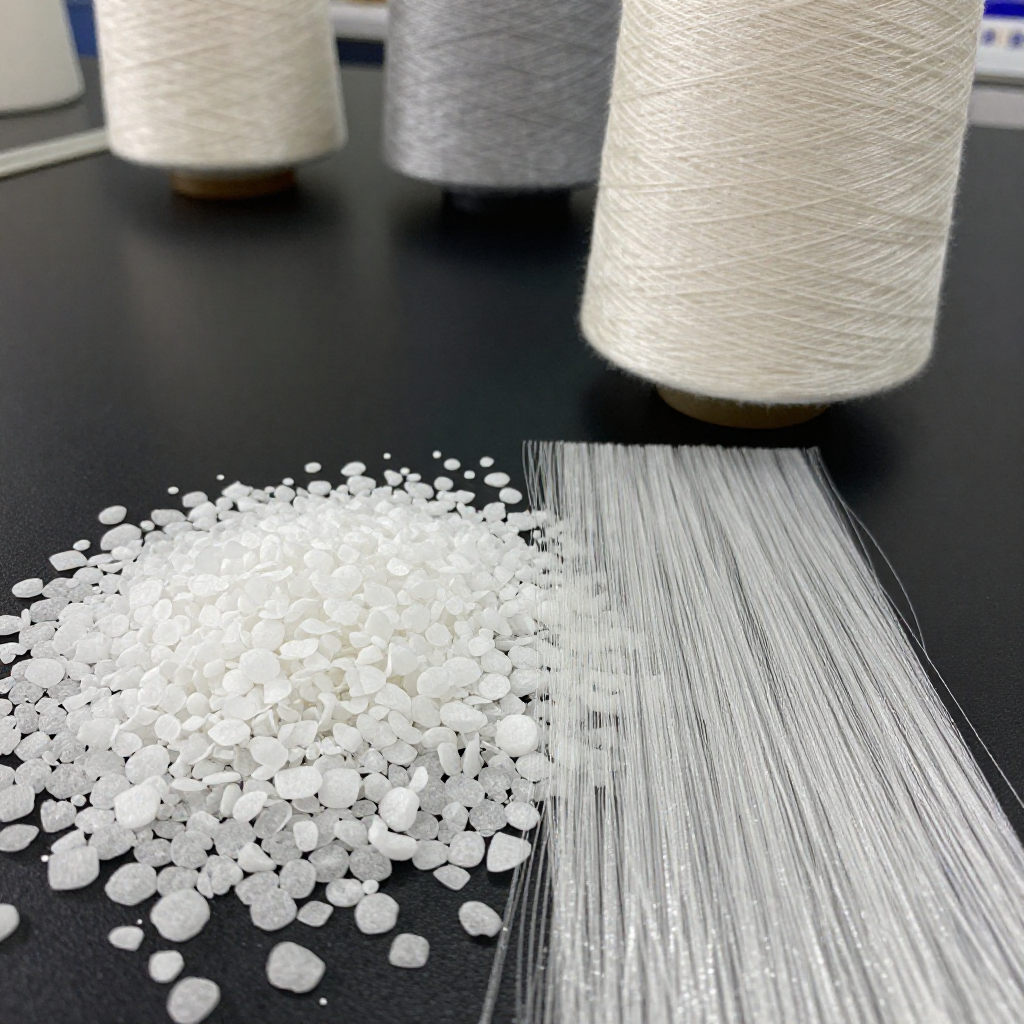


Polyester (PET) — The Fiber That Clothed the World
On March 22, 1941, John Rex Whinfield and James Tennant Dickson, working at the Calico Printers' Association laboratory in Accrington, Lancashire, synthesized polyethylene terephthalate (PET) — the polyester fiber that would become the most produced textile fiber in human history. By 2024, polyester accounts for over 54% of all fiber production worldwide: roughly 60 million tonnes per year, more than cotton, wool, silk, and all other fibers combined.
PET is made from two petrochemical monomers: terephthalic acid (or its ester, dimethyl terephthalate) and ethylene glycol. These react via condensation polymerization to form long chains linked by ester bonds (-COO-), hence 'polyester.' The resulting polymer is melt-spun into fibers, just like nylon — but polyester has properties nylon lacks. It resists stretching (high modulus), holds its shape through washing (dimensional stability), resists wrinkling (elastic recovery), and dries quickly (low moisture absorption at only 0.4%).
Whinfield and Dickson's work built directly on Wallace Carothers' polymer research at DuPont. Carothers had actually synthesized polyesters in the early 1930s but abandoned them as inferior to polyamides (nylon) because his polyesters had low melting points. Whinfield realized that using an aromatic acid (terephthalic acid, with its rigid benzene ring) instead of Carothers' aliphatic acids would raise the melting point above 250°C — high enough for textile use. DuPont licensed the patents and commercialized the fiber as Dacron in 1953; ICI launched it as Terylene in Britain. The wash-and-wear revolution of the 1960s and the global fast-fashion industry both depend on Whinfield's insight.
Nội dung nguy hiểm
Blueprint này chứa các quy trình nguy hiểm. Đăng nhập và bật nội dung nguy hiểm trong cài đặt tài khoản của bạn để xem hướng dẫn từng bước.
Blueprint liên quan
Các blueprint này chia sẻ kiến thức — kỹ thuật, vật liệu hoặc nguyên tắc
CC0 Phạm vi công cộng
Bản thiết kế này được phát hành theo CC0. Bạn tự do sao chép, sửa đổi, phân phối và sử dụng cho bất kỳ mục đích nào mà không cần xin phép.
Hỗ trợ nhà sáng tạo bằng cách mua sản phẩm qua bản thiết kế, nơi họ nhận Hoa hồng nhà sáng tạo do nhà bán hàng đặt, hoặc tạo phiên bản mới và kết nối trong bản thiết kế riêng để chia sẻ doanh thu.