NGHỆ THUẬT
LÀM ĐẸP VÀ SỨC KHỎE
THỦ CÔNG
VĂN HÓA VÀ LỊCH SỬ
GIẢI TRÍ
MÔI TRƯỜNG
THỰC PHẨM VÀ ĐỒ UỐNG
KỸ THUẬT NGƯỢC
KHOA HỌC
THỂ THAO
CÔNG NGHỆ
THIẾT BỊ ĐEO
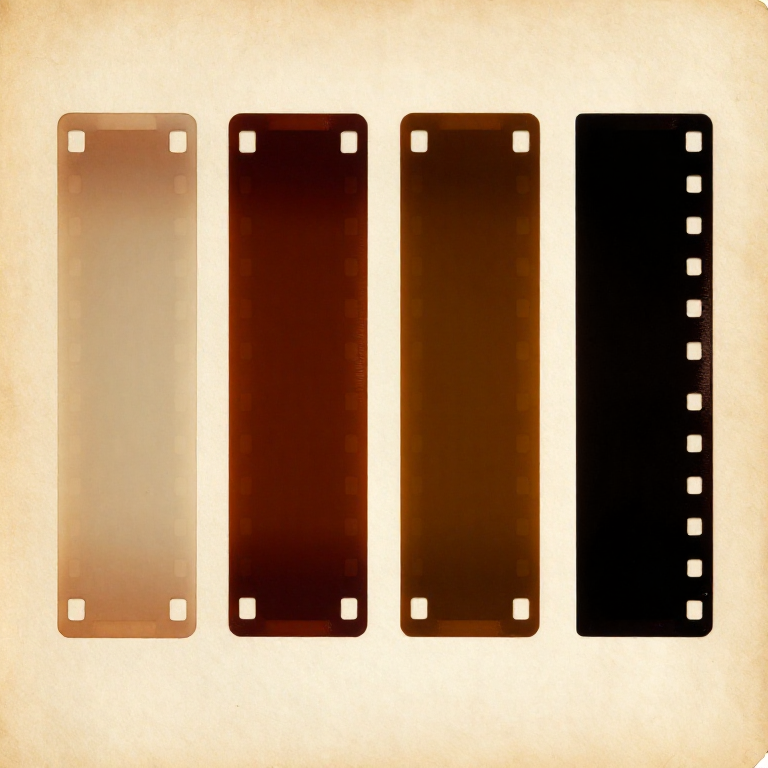


Reading a Negative: Thin or Dense, Flat or Contrasty
A negative carries a complete record of what was done to it, and it separates cleanly into two questions.
**Is it thin or dense?** That is exposure. **Is it flat or contrasty?** That is development. The two are independent, which is what makes the diagnosis possible at all.
Everything else — scratches, fog, marks, blank frames — has its own signature, and most of them are unmistakable once they have been seen and named. This rung is that vocabulary, and it is the fastest way to stop repeating a mistake.
Trung cấp
2 hours
Hướng dẫn
1
1
The two questions, and how to ask them
The two questions, and how to ask them
**Look at the shadows for exposure.** The darkest parts of the subject are the thinnest parts of the negative, and they are where under-exposure shows first.
*Clear film in the shadows with no detail at all* — under-exposed. Nothing can recover it, because nothing was recorded.
*Shadows carrying faint but real detail* — correct.
*Shadows already quite dense* — over-exposed. Still printable, with more grain and less sharpness.
**Look at the highlights for development.** They are the densest parts, and they are where development shows.
*Highlights so dense you cannot see through them* — over-developed, too much contrast. Print on a softer grade.
*Highlights barely darker than the mid tones* — under-developed, flat. Print on a harder grade.
**The newsprint test.** A well-exposed, well-developed 35 mm negative should let you just about read newsprint through its densest area. It is a crude test and it is remarkably good.
**Look at the clear film outside the frame too.** It should be nearly transparent with a slight base tint; if it is visibly grey, the film was fogged.
Vật liệu cho bước này:
 Phim chụp ảnh1 cái
Công cụ cần thiết:
 Kính lúp thợ kim hoàn
2
2
The four combinations
The four combinations
Because exposure and development are independent, there are four cases and each has a different fix.
**Thin and flat** — under-exposed and under-developed. The worst case: there is nothing there to print. More exposure AND more development.
**Thin and contrasty** — under-exposed and over-developed. Empty shadows with blocked highlights. This is what pushing does, and it is why pushing is a compromise rather than a free speed increase. More exposure, less development.
**Dense and flat** — over-exposed and under-developed. Printable, grainy, dull. Less exposure, more development.
**Dense and contrasty** — over-exposed and over-developed. Blocked highlights over usable shadows. Less of both.
**The one to aim for** is a negative that just barely has detail in the important shadows and highlights you can see through. It will look disappointingly thin and low in contrast held up to a window, and it will print beautifully — a negative that looks impressive is usually over-developed.
Write the diagnosis on the sleeve with the roll's log. Two rolls with the same diagnosis is a systematic error; one is an accident.
Vật liệu cho bước này:
Phim chụp ảnh2 cáiCông cụ cần thiết:
Kính lúp thợ kim hoàn3
3
Marks, and what each one means
Marks, and what each one means
**Completely clear film, no frames, no edge markings at all** — the film never went through the camera, or was never developed. Check whether the edge printing is there: if it is, the camera never exposed it; if it is not, the developer did not work.
**Completely black film** — fogged to daylight, usually opened before fixing.
**Clear crescents** — the film was kinked, which cracks the emulsion. Handling damage, usually while loading the reel.
**Streaks running down from dense areas** — bromide drag from too little agitation.
**A clear blotch with a hard edge** — two turns of film touched in the reel, so no developer reached that spot.
**Small round clear spots** — air bubbles that stuck to the emulsion. Tap the tank after each agitation.
**Milky overall haze** — under-fixed. Re-fix it in fresh fixer and wash again; this one is genuinely recoverable.
**Fine crazing over the whole frame** — reticulation, from a large temperature difference between baths.
**A red or purple cast to the base** — the anti-halation layer did not wash out. More washing.
**Dense streaks from the sprocket holes inwards** — too much agitation, surging developer through the holes.
Vật liệu cho bước này:
Phim chụp ảnh2 cáiCông cụ cần thiết:
Kính lúp thợ kim hoàn4
4
The contact sheet, which is the real reading tool
The contact sheet, which is the real reading tool
A **contact sheet** is the whole roll printed at once, in contact with the paper, at one exposure. It is the fastest way to read a roll and the only way to compare frames honestly.
**Make it at a standard exposure** — the one that just barely renders the clear film between the frames as full black. That is a fixed reference: at that setting, a frame that prints too dark is a thin negative and a frame that prints too light is a dense one, and the whole roll can be read at a glance.
Finding that exposure is a test strip on a scrap of clear developed film, done once for a given paper and enlarger height and then written on the wall.
**Keep it with the negatives.** A sleeve of negatives with its contact sheet is a usable archive; a sleeve without one is a box that never gets opened.
**Mark it up.** Ring the frames worth printing, note the crop, note the areas that will need holding back. That marked sheet is the plan for a printing session, and it turns an afternoon of guessing into an afternoon of printing.
This is also where a roll's log finally pays: frame by frame, the settings against the result, in one view.
Vật liệu cho bước này:
 Giấy ảnh (đa độ tương phản)1 cáiPhim chụp ảnh1 cái
Công cụ cần thiết:
 Máy phóng ảnh buồng tối (khổ trung)
 Đèn an toàn buồng tối (hổ phách, LED)
 Bộ kẹp buồng tối
Công cụ yêu cầu
4- Tạm thời
- Tạm thời
Blueprint liên quan
Các blueprint này chia sẻ kiến thức — kỹ thuật, vật liệu hoặc nguyên tắc

CC0 Phạm vi công cộng
Bản thiết kế này được phát hành theo CC0. Bạn tự do sao chép, sửa đổi, phân phối và sử dụng cho bất kỳ mục đích nào mà không cần xin phép.
Hỗ trợ nhà sáng tạo bằng cách mua sản phẩm qua bản thiết kế, nơi họ nhận Hoa hồng nhà sáng tạo do nhà bán hàng đặt, hoặc tạo phiên bản mới và kết nối trong bản thiết kế riêng để chia sẻ doanh thu.