NGHỆ THUẬT
LÀM ĐẸP VÀ SỨC KHỎE
THỦ CÔNG
VĂN HÓA VÀ LỊCH SỬ
GIẢI TRÍ
MÔI TRƯỜNG
THỰC PHẨM VÀ ĐỒ UỐNG
KỸ THUẬT NGƯỢC
KHOA HỌC
THỂ THAO
CÔNG NGHỆ
THIẾT BỊ ĐEO
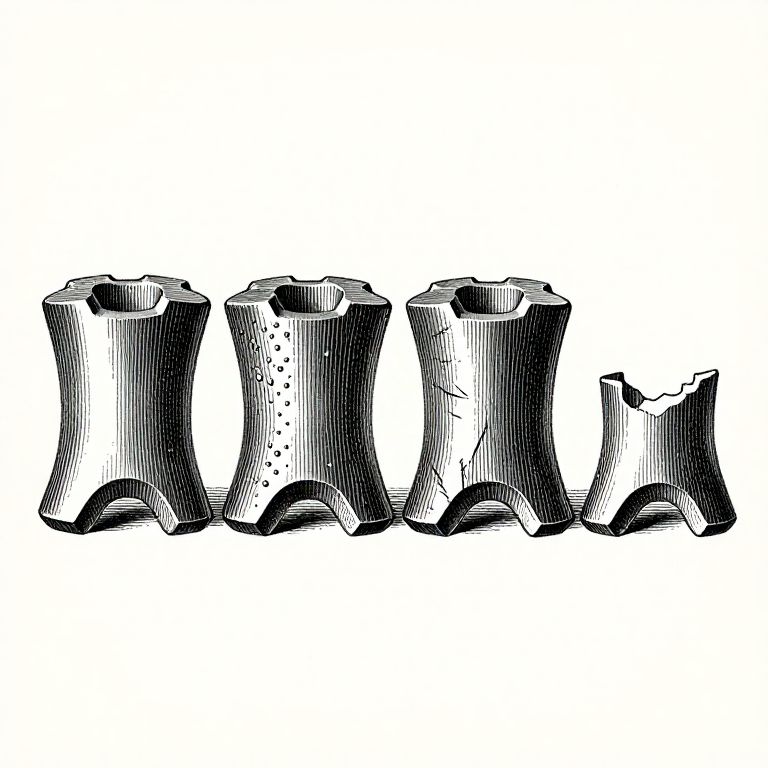


Reading a Worn Tooth: What the Damage Is Telling You
A gear that has run is a written record. The damage on the flank is not just wear — it is patterned, and the pattern names its cause: where on the tooth it sits, whether it is on one tooth or all of them, whether the surface is polished, pitted, torn or bruised.
The reason to read it rather than simply replace the gear is that most gear failures are not the gear's fault. Pitting in the dedendum means the contact stress is too high; scuffing across the tips means the oil film collapsed; damage on three teeth spaced evenly round the wheel means a driver gear with three faults, not a wheel with three. Fit a new gear without reading the old one and the new one fails the same way.
This rung is the vocabulary, what each mode means, and how to decide between leave it, watch it, and stop.
Trung cấp
3 hours
Hướng dẫn
1
1
Normal wear, and where the tooth touches
Normal wear, and where the tooth touches
Before the damage, the geometry — because every wear mode sits somewhere specific and the position is half the diagnosis.
**The pitch line is where the contact rolls without sliding.** Above it and below it the flanks slide against each other, in opposite directions, and the sliding is fastest at the tip and at the root. So an oil film is easiest to maintain at the tips and roots, where the sliding speed helps it form, and hardest at the pitch line, where there is no sliding to drag oil in.
**That is why a band of damage at the pitch line means one thing and damage at the tips means another.** Pitch line damage is contact stress with a thin film; tip and root damage is sliding and heat.
**Running in** is normal and desirable: the first hours under moderate load polish the machining marks off the high spots, the contact pattern spreads, and the surface becomes brighter than it was. A gear that has run in correctly has a uniform matte-to-bright flank over 70–80% of the face, with the original cutter marks still visible at the edges of the pattern.
**Normal wear** thereafter is slow, even loss of metal over the whole active flank. It is acceptable until the tooth thickness is reduced enough to matter — a common shop limit is 10% of the tooth thickness for power gearing, less for anything that positions.
**Measure it rather than judging it.** A gear tooth caliper or a measurement over pins, compared with the record taken when the gear was new, turns "it looks worn" into a number and a rate. The rate is the useful part.
Vật liệu cho bước này:
 Bộ bánh răng trụ (thép, 20 răng)1 cái
Công cụ cần thiết:
 Kính lúp thợ kim hoàn
 Thước cặp
2
2
Surface fatigue: pitting, micropitting and spalling
Surface fatigue: pitting, micropitting and spalling
**Pitting** is small cavities where metal has fatigued out of the surface. It is a contact stress problem, not a lubrication one.
*Initial or corrective pitting* appears in the first weeks, in a band just below the pitch line, on the high spots of an imperfect contact pattern. It stops once those spots have worn down and the load has spread. Small, isolated, not growing — watch it.
*Destructive pitting* spreads: the pits grow, join, and the flank breaks up. The load is simply too high for the material, or the contact is concentrated on part of the face by misalignment. It does not stop. Replace, and fix the cause.
**Micropitting or frosting** is a grey, matte patch that looks like fine etching and is pitting at a scale of micrometres. It means the oil film is thinner than the surface roughness — too thin an oil, too low a speed, or too rough a surface. It is the commonest damage on case-hardened gears and the answer is usually a higher viscosity oil, a smoother finish, or both.
**Spalling** is pitting's big brother: flakes rather than pits, from fatigue cracks that started below the surface. On a case-hardened gear it means the case is too thin for the load and the subsurface stress peak is sitting under it, in the soft core. The gear is finished and so is the specification.
**Where it sits decides which it is.** A band below the pitch line is classic contact fatigue. A patch at one end of the face is misalignment doing the same thing locally. Pits on a few teeth only is a pitch error or a single damaged tooth on the mate.
Vật liệu cho bước này:
Bộ bánh răng trụ (thép, 20 răng)1 cáiCông cụ cần thiết:
Kính lúp thợ kim hoàn3
3
Lubrication and load damage: scuffing, wear and plastic flow
Lubrication and load damage: scuffing, wear and plastic flow
**Scuffing (scoring)** is radial tearing, usually near the tips and roots where the sliding is fastest, often with a bright, torn, welded look. The oil film collapsed, the surfaces touched metal to metal and micro-welded, and the motion tore the welds apart. Causes: too thin an oil, too hot, too high a load, or a new pair run in too hard. Fix the oil and the load before fitting a new gear.
**Abrasive wear** is fine, even scratching along the direction of sliding. It is dirt: casting sand left in the box, wear debris that was never filtered out, or a breather with no filter. Clean the box, change the oil, and find where the dirt comes in.
**Plastic flow** is metal pushed rather than lost — a burr or fin rolled over at the tip, or a ridge along the pitch line. It means the material has yielded, which is overload on a gear that is too soft. It is common on through-hardened gears under shock.
**Rippling** is a regular wave pattern across the flank, like sand ripples. Vibration and high contact stress together. Look at what is driving the torsional vibration before blaming the gear.
**Corrosion and staining** is a chemical attack: water in the oil, or an additive package attacking a bronze wheel. On a worm wheel a green tinge is the bronze corroding, and the oil is the wrong one.
**Interference marks at the root** — a polished or dug band at the very bottom of the tooth space — mean the tip of the mating tooth is hitting the root. The centres are too close, or one gear is not the module it is believed to be.
Vật liệu cho bước này:
Bộ bánh răng trụ (thép, 20 răng)1 cái Bộ trục vít và bánh vít (thép và đồng thanh)1 cái
Công cụ cần thiết:
Kính lúp thợ kim hoàn Bộ căn lá
4
4
Broken teeth, and the decision
Broken teeth, and the decision
**A fatigue break** starts as a crack at the root fillet on the loaded side, spreads slowly, and leaves a fracture face with beach marks and a small final rough zone. It means the bending stress is too high for the number of cycles — the tooth was going to break eventually. Root fillet condition matters enormously here: a sharp cutter mark or a grinding notch at the fillet halves the life.
**An overload break** is a single coarse fracture with no beach marks. Something jammed, or a foreign object went through the mesh. Find it — it is still in the box.
**One tooth broken, the rest perfect** is almost always a defect in that tooth or a single event. **Several teeth broken at regular intervals** is a fault on the mating gear, repeating; count the interval and it will match the mate's tooth count.
**The decision.**
*Leave it* — running-in polish, light even wear, isolated initial pitting that is not growing. Record it and set a date.
*Watch it* — anything that is changing. Photograph the same three teeth against a ruler, measure the tooth thickness or the backlash, and repeat on a schedule. The rate of change decides, not the appearance.
*Stop now* — any crack at a root fillet, spalling, destructive pitting that is spreading, or scuffing that is still active. A broken tooth in a running box destroys the mate and the bearings within minutes.
**And always fix the cause before fitting the new gear.** The new one will wear the same way, only later, and you will have paid twice to learn the same thing.
Vật liệu cho bước này:
Bộ bánh răng trụ (thép, 20 răng)2 cáiCông cụ cần thiết:
Kính lúp thợ kim hoànThước cặp Đồng hồ so
Vật liệu
2- Tạm thời
- Tạm thời
Blueprint liên quan
Các blueprint này chia sẻ kiến thức — kỹ thuật, vật liệu hoặc nguyên tắc


CC0 Phạm vi công cộng
Bản thiết kế này được phát hành theo CC0. Bạn tự do sao chép, sửa đổi, phân phối và sử dụng cho bất kỳ mục đích nào mà không cần xin phép.
Hỗ trợ nhà sáng tạo bằng cách mua sản phẩm qua bản thiết kế, nơi họ nhận Hoa hồng nhà sáng tạo do nhà bán hàng đặt, hoặc tạo phiên bản mới và kết nối trong bản thiết kế riêng để chia sẻ doanh thu.