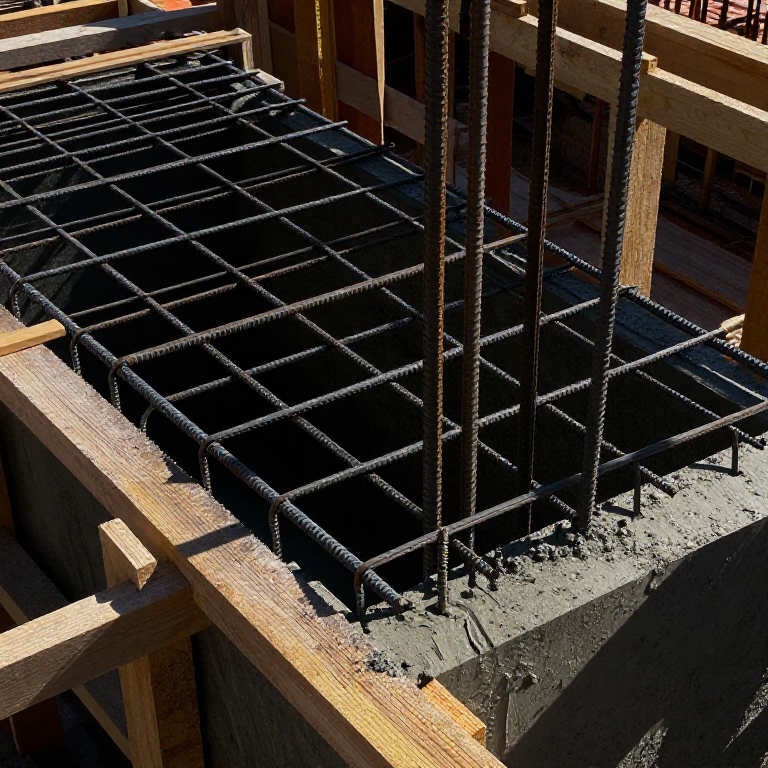


Casting Reinforced Concrete — Marrying Steel and Stone into the Modern Structure
Concrete is wonderful stuff in compression — squeeze it and it holds — but pull on it and it cracks like a biscuit. Steel is the opposite: superb in tension, useless if you try to build a wall of it. In the late 1800s builders like Joseph Monier and François Hennebique realised that embedding steel inside concrete combines the best of both, and reinforced concrete became the material that built the modern world.
The idea works because of three lucky properties. Concrete and steel expand and contract at almost exactly the same rate, so temperature changes do not tear them apart. Wet concrete is strongly alkaline, which coats the steel in a protective film that stops it rusting. And the two grip each other firmly, so a load shared between them is truly shared. Put steel where the structure is stretched and concrete where it is squeezed, and you get a member strong in every direction.
From this came bridges, dams, tunnels, and the skeletons of skyscrapers — shapes impossible in stone or iron alone. The skill is in knowing where the steel must go and in surrounding it completely with sound, well-cured concrete.
Hướng dẫn
Understand the partnership
Understand the partnership
Know where the steel goes
Know where the steel goes
Build the formwork
Build the formwork
Vật liệu cho bước này:
 Tấm ván gỗ10 cái
Công cụ cần thiết:
 Búa
BúaCut and bend the rebar
Cut and bend the rebar
Vật liệu cho bước này:
 Thép cây gân thép mềm #415 mét
Công cụ cần thiết:
 Máy uốn thép thanh
Place and tie the cage
Place and tie the cage
Vật liệu cho bước này:
 Dây thép buộc1 cuộn
Mix the concrete
Mix the concrete
Vật liệu cho bước này:
 Xi măng poóc lăng50 kg
 Cát mịn100 kg
 Sỏi200 kg
Công cụ cần thiết:
 Máy trộn bê tông
Pour around the steel
Pour around the steel
Vật liệu cho bước này:
 Nước30 lít
Compact out the air
Compact out the air
Công cụ cần thiết:
 Que đầm
Cure it slowly
Cure it slowly
Strip the formwork
Strip the formwork
Công cụ cần thiết:
 Xà beng dẹt
Understand why it lasts
Understand why it lasts
See what it built
See what it built
Vật liệu
7- 10 cáiTạm thời
- 15 métTạm thời
- 1 cuộnTạm thời
- 50 kgTạm thời
- 100 kgTạm thời
- 200 kgTạm thời
- 30 lítTạm thời
Công cụ yêu cầu
5- Tạm thời
- Tạm thời
- Tạm thời
- Tạm thời
- Tạm thời
Vật liệu bản thiết kế liên kết



Bản thiết kế này làm ra
Blueprint liên quan
Các blueprint này chia sẻ kiến thức — kỹ thuật, vật liệu hoặc nguyên tắc

CC0 Phạm vi công cộng
Bản thiết kế này được phát hành theo CC0. Bạn tự do sao chép, sửa đổi, phân phối và sử dụng cho bất kỳ mục đích nào mà không cần xin phép.
Hỗ trợ nhà sáng tạo bằng cách mua sản phẩm qua bản thiết kế, nơi họ nhận Hoa hồng nhà sáng tạo do nhà bán hàng đặt, hoặc tạo phiên bản mới và kết nối trong bản thiết kế riêng để chia sẻ doanh thu.