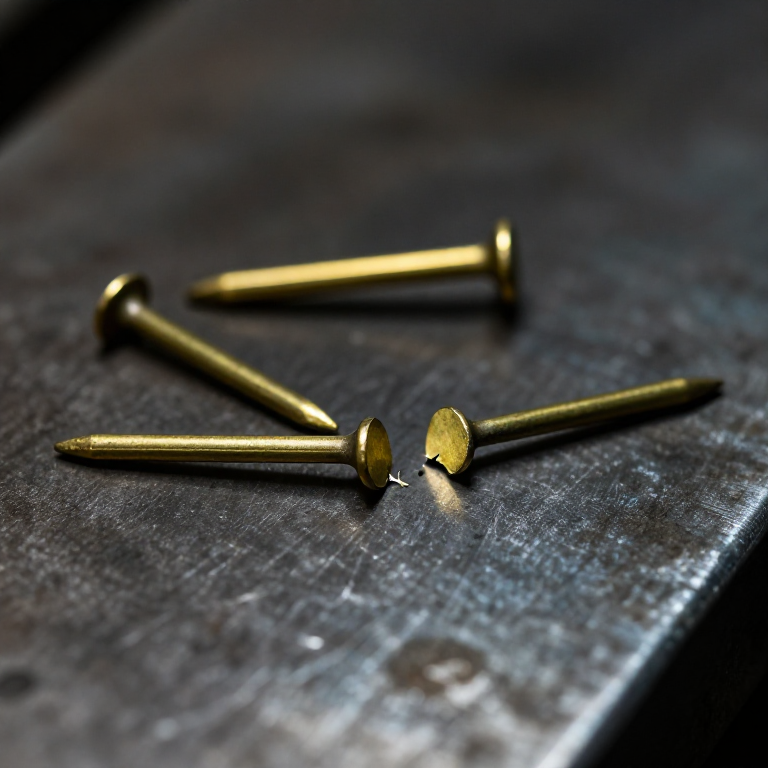


Shear Pin Coupling
Hướng dẫn
Compute the pin size before making anything
Compute the pin size before making anything
This is the one protective device you can calculate rather than calibrate.
- Choose the torque you want it to break at, and the pin radius from the shaft centre — say 25 mm.
- Force on the pin = torque ÷ radius.
- The pin is in DOUBLE shear, so each of its two shear planes carries half that force.
- Required area per plane = force per plane ÷ the material's shear strength.
- Convert area to a diameter, and write down the number.
Double shear is the detail people miss. A pin passing through a hub and a shaft is cut across at two places, so it carries twice what a single-shear pin of the same diameter would. Forget it and your pin breaks at half the torque you intended.
Brass and aluminium are the usual choices because their shear strengths are modest and reasonably consistent, and because they fail cleanly rather than deforming and hanging on. Mild steel makes a poor shear pin — it yields and stretches first, so the break torque is vague.Vật liệu cho bước này:
 Giấy kẻ ô ly1 pad
Công cụ cần thiết:
 Thước cặp điện tử 6 inch
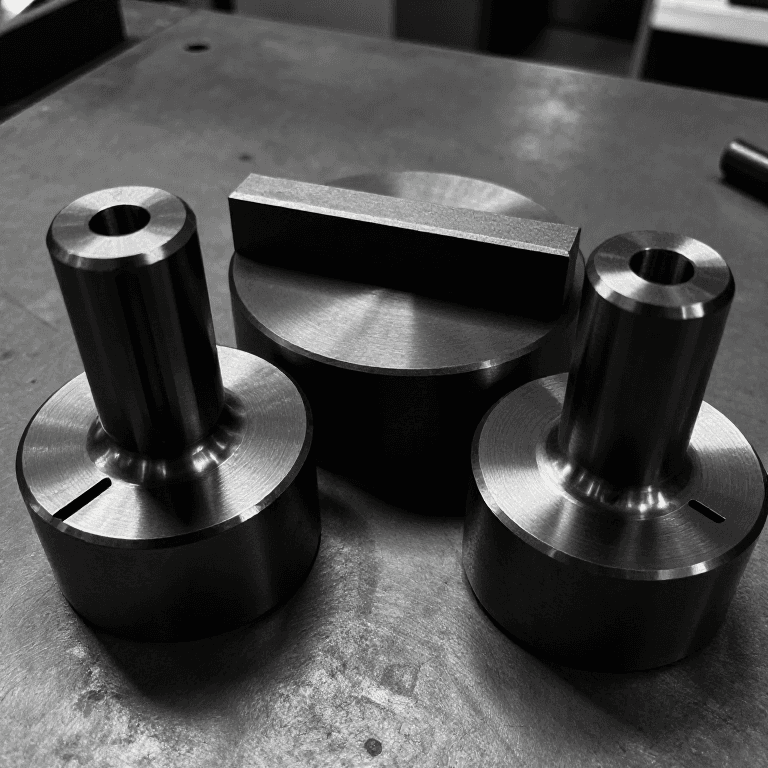
Make the two hubs and drill them together
Make the two hubs and drill them together
The pin hole must line up perfectly, so drill both parts as one.
- Cut two hubs from 25 mm aluminium round bar, each 30 mm long, bored 8.0 mm.
- Make one a spigot that fits inside the other, so they are concentric but free to rotate relative to each other.
- Assemble them and clamp.
- Drill the pin hole THROUGH BOTH at once, radially, at 4.0 mm.
- Deburr both holes carefully.
Drilling together is what makes the pin a shear element rather than a bending one. Misaligned holes force the pin to bend as it takes up the offset, and a bent pin fails at an unpredictable torque — usually much lower than calculated, which destroys the whole point of a calculable device.
Deburring matters more than usual here: a burr in the hole is a stress raiser that starts the fracture early, and this is a component whose failure point is meant to be exact.Vật liệu cho bước này:
 Thanh nhôm tròn1 cái
Công cụ cần thiết:
 Khung cưa sắt kèm lưỡi
 Ê tô bàn nguội
 Máy khoan pin
 Bộ mũi khoan
 Bộ giũaThước cặp điện tử 6 inch
 Đục dấu tâm
Make a set of pins in two materials
Make a set of pins in two materials
Several of each, identical, because you are going to destroy them.
- Cut six pins from 4 mm brass round bar and six from 4 mm aluminium.
- Face both ends of each square and deburr.
- Measure every pin with the caliper and discard any that differ.
- Label the two sets clearly and keep them separate.
Modern build spec (derived). Brass has roughly twice the shear strength of soft aluminium, so the same 4 mm pin gives two clearly different protection levels from one coupling — which is a neat way to change the setting without changing any dimension.
Keep the sets separate and labelled. A brass pin fitted where an aluminium one was intended doubles the protection torque, and there is no way to tell by looking once it is in the hole. This is a real failure mode in the field, not a hypothetical one.Vật liệu cho bước này:
 Thanh đồng thau tròn1 cáiThanh nhôm tròn1 cái
Công cụ cần thiết:
Khung cưa sắt kèm lưỡiBộ giũaThước cặp điện tử 6 inchÊ tô bàn nguộiBreak them, and compare with your calculation
Break them, and compare with your calculation
Prediction against measurement — the whole reason to build this.
- Clamp one hub, fit an aluminium pin, and load the other hub through a lever arm of known length.
- Increase the load until the pin shears. Record the force and compute the torque.
- Repeat with two more aluminium pins and average.
- Repeat the whole set with brass pins.
- Compare both averages against your step 1 calculation.
Công cụ cần thiết:
Ê tô bàn nguộiThước cặp điện tử 6 inch Bộ lục giác
The stronger-pin temptation, and history
The stronger-pin temptation, and history
The classic failure is human, not mechanical. A machine keeps shearing pins, so somebody fits a stronger one — a steel bolt instead of a brass pin. The shearing stops, and the next overload breaks a gearbox, a shaft or a casting instead. The shear pin did not fail; it was overruled. This is why good practice keeps correct pins with the machine, and why some designs make it physically awkward to fit the wrong thing.
Where shear pins are standard: snow blower augers, agricultural implements, boat propellers, and light machinery generally. In each case the overload is a sudden shock — a rock, a frozen lump, a submerged log — which is exactly the case a friction limiter handles badly, because the inertia spike passes through before the plates can slip.
Against the torque limiter, plainly: the limiter is resettable, adjustable and forgiving, but its trip torque drifts with wear and contamination and it cannot stop a sharp shock. The shear pin is exact, computable, immune to drift, and useless until somebody replaces it. Choose by asking how often the overload happens and how bad an unnoticed drift would be.
The wider idea: both are deliberate weak links, and the electrical fuse is the same thought in another domain — a cheap, calculable, sacrificial element that fails so that expensive things do not. Recognising when to design one in is a mark of an engineer who has thought about what happens when the machine meets the real world.
Vật liệu
3- 1 padTạm thời
- 1 cáiTạm thời
- 1 cáiTạm thời
Blueprint liên quan
Các blueprint này chia sẻ kiến thức — kỹ thuật, vật liệu hoặc nguyên tắc

CC0 Phạm vi công cộng
Bản thiết kế này được phát hành theo CC0. Bạn tự do sao chép, sửa đổi, phân phối và sử dụng cho bất kỳ mục đích nào mà không cần xin phép.
Hỗ trợ nhà sáng tạo bằng cách mua sản phẩm qua bản thiết kế, nơi họ nhận Hoa hồng nhà sáng tạo do nhà bán hàng đặt, hoặc tạo phiên bản mới và kết nối trong bản thiết kế riêng để chia sẻ doanh thu.