NGHỆ THUẬT
LÀM ĐẸP VÀ SỨC KHỎE
THỦ CÔNG
VĂN HÓA VÀ LỊCH SỬ
GIẢI TRÍ
MÔI TRƯỜNG
THỰC PHẨM VÀ ĐỒ UỐNG
KỸ THUẬT NGƯỢC
KHOA HỌC
THỂ THAO
CÔNG NGHỆ
THIẾT BỊ ĐEO
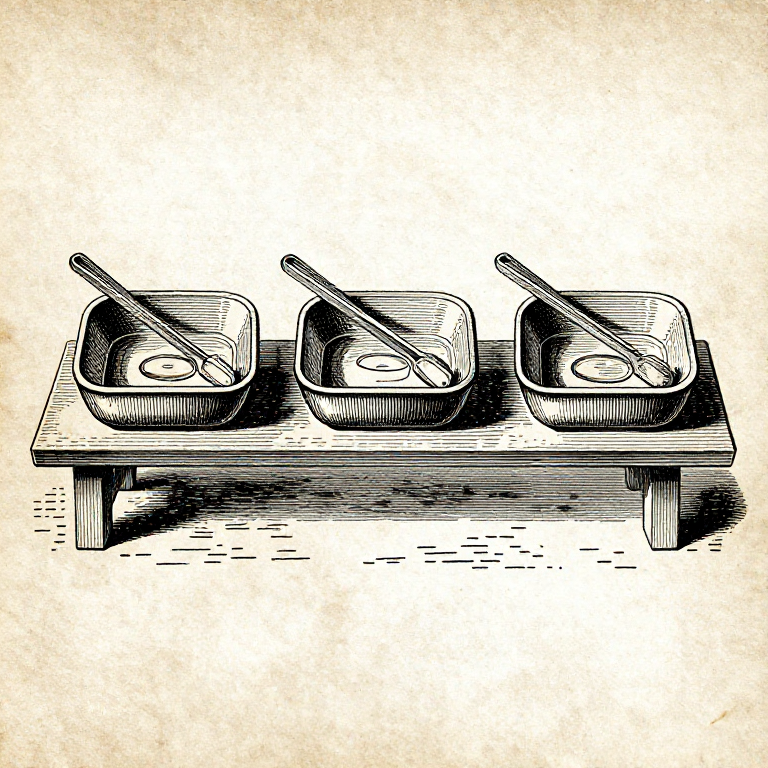


Stop, Fix, Wash: The Three Baths That Decide Whether It Lasts
Development makes the image. The three baths after it decide whether the image still exists in fifty years.
**Stop** halts development at a defined moment. **Fix** dissolves away the silver that was never exposed, which is what makes the film safe to look at in daylight. **Wash** removes the fixer, and it is the step most often cut short — an under-washed negative looks perfect and stains brown over a decade.
None of the three is optional, and none of them is interesting to do, which is exactly why they are the steps that get rushed.
Trung cấp
3 hours
Hướng dẫn
1
1
Stop: why plain water is not quite enough
Stop: why plain water is not quite enough
Development does not end when the developer is poured out. Developer soaked into the emulsion keeps working until it is neutralised or diluted away, and that is several seconds of uncontrolled extra development.
**A stop bath is dilute acetic or citric acid.** Developers work in alkali, so an acid bath stops them instantly and completely. Thirty seconds with agitation.
**A water rinse is the alternative** and it is genuinely used — two or three changes of water, half a minute. It dilutes rather than neutralises, so it is slower to act, and for a film with a long development time the difference is negligible. For a short development or for paper, an acid stop is better.
**It also protects the fixer.** Carrying alkaline developer straight into an acid fixer neutralises the fixer a little each time, so a stop bath makes the fixer last considerably longer. That is the practical reason most people use one.
**Indicator stop bath** changes colour when it is exhausted, which removes the only question about it.
Same temperature as the developer, within a couple of degrees. A large temperature jump between baths can crack the emulsion into a fine crazing called reticulation — occasionally used deliberately, usually a disaster.
Vật liệu cho bước này:
 Bộ hóa chất phim (thuốc hiện, thuốc dừng, thuốc hãm đen trắng)1 cái
Công cụ cần thiết:
 Thùng tráng phim (thép không gỉ, 2 lõi)
 Nhiệt kế phòng thí nghiệm
 Ống đong chia vạch
 Găng tay chống hóa chất
2
2
Fix: removing the silver that never got the chance
Fix: removing the silver that never got the chance
A film emulsion is silver halide crystals in gelatin. Exposure and development turn the exposed ones into black metallic silver. The unexposed ones are still light-sensitive, and if they are left there the whole film darkens the moment it sees daylight.
**The fixer dissolves them.** Sodium or ammonium thiosulphate forms a soluble complex with silver halide and carries it out of the emulsion.
**The clearing test sets the time.** Drop a scrap of undeveloped film into fresh fixer and time how long it takes to go from milky to clear. **Fix for twice that time.** That is the only reliable way to know, because it adapts automatically to how tired the fixer is.
**A fixer that takes more than about twice as long to clear as it did when fresh is finished.** Continuing to use it is how negatives end up with a permanent milky haze.
**Over-fixing is possible** — prolonged fixing slowly attacks the image silver itself, and it also makes the fixer harder to wash out of paper. Twice the clearing time, not ten minutes for luck.
**The used fixer holds dissolved silver** and should not go down the drain. It is also the one bath worth saving, because that silver can be recovered.
Vật liệu cho bước này:
Bộ hóa chất phim (thuốc hiện, thuốc dừng, thuốc hãm đen trắng)1 cái Phim chụp ảnh1 cái
Công cụ cần thiết:
Thùng tráng phim (thép không gỉ, 2 lõi)Ống đong chia vạchGăng tay chống hóa chất3
3
Wash: the step that decides the next fifty years
Wash: the step that decides the next fifty years
Fixer left in the emulsion slowly attacks the silver image. The negative looks perfect when it dries and develops brown stains and fading over years — which is why this is the step whose consequences nobody sees until it is far too late.
**Running water for twenty to thirty minutes** is the traditional answer for film, and it works and wastes a great deal of water.
**The Ilford sequence is better and faster**: fill the tank, invert five times, dump; fill, invert ten times, dump; fill, invert twenty times, dump. Three changes, a couple of minutes, and a measured result — each change dilutes what is left by a large factor, and three of them is enough.
**A hypo clearing agent** cuts washing time substantially and is genuinely worth it for fibre-based paper, which holds fixer in the paper base itself rather than just in the emulsion.
**Paper needs far more washing than film.** Resin-coated paper washes in a few minutes; fibre-based paper needs an hour, or a clearing agent and twenty minutes. An archivally washed fibre print is the most durable photographic object there is, and an unwashed one is among the least.
**Test it** if it matters: a residual hypo test kit puts a drop on the margin and reads the stain against a scale. It is the only way to know.
Vật liệu cho bước này:
 Giấy ảnh (đa độ tương phản)1 cái
Công cụ cần thiết:
Thùng tráng phim (thép không gỉ, 2 lõi)Nhiệt kế phòng thí nghiệm4
4
Drying without marks
Drying without marks
Nearly every mark on an otherwise good negative happens in the last five minutes.
**A wetting agent in the final rinse.** A few drops in the last change of water lowers the surface tension so the water sheets off instead of beading. Beads dry into hard mineral spots that are visible in every print made afterwards.
**Hang it and leave it.** Weighted at the bottom so it hangs straight, in still air, somewhere dust-free. A bathroom after a hot shower is the traditional answer, because the steam has settled the dust.
**Do not wipe it.** A squeegee or fingers on a wet emulsion scratch it, and the gelatin is at its softest and most vulnerable while wet. If the wetting agent is doing its job, nothing needs wiping.
**Do not force-dry with heat.** Fast drying makes the film curl hard and can leave drying marks where one part dries much sooner than another.
**Cut and sleeve when completely dry**, which takes a couple of hours. Film that is still slightly damp will stick to the sleeve, and that damage is permanent.
Handle by the edges for the rest of its life. A fingerprint on an emulsion etches into it over months.
Vật liệu cho bước này:
Phim chụp ảnh1 cáiCông cụ cần thiết:
 Tủ sấy phim (không bụi)
 Kính lúp thợ kim hoàn
Vật liệu
3- 1 cáiTạm thời
- Tạm thời
Công cụ yêu cầu
6- Tạm thời
- Tạm thời
- Tạm thời
- Tạm thời
- Tạm thời
Blueprint liên quan
Các blueprint này chia sẻ kiến thức — kỹ thuật, vật liệu hoặc nguyên tắc


CC0 Phạm vi công cộng
Bản thiết kế này được phát hành theo CC0. Bạn tự do sao chép, sửa đổi, phân phối và sử dụng cho bất kỳ mục đích nào mà không cần xin phép.
Hỗ trợ nhà sáng tạo bằng cách mua sản phẩm qua bản thiết kế, nơi họ nhận Hoa hồng nhà sáng tạo do nhà bán hàng đặt, hoặc tạo phiên bản mới và kết nối trong bản thiết kế riêng để chia sẻ doanh thu.