NGHỆ THUẬT
LÀM ĐẸP VÀ SỨC KHỎE
THỦ CÔNG
VĂN HÓA VÀ LỊCH SỬ
GIẢI TRÍ
MÔI TRƯỜNG
THỰC PHẨM VÀ ĐỒ UỐNG
KỸ THUẬT NGƯỢC
KHOA HỌC
THỂ THAO
CÔNG NGHỆ
THIẾT BỊ ĐEO
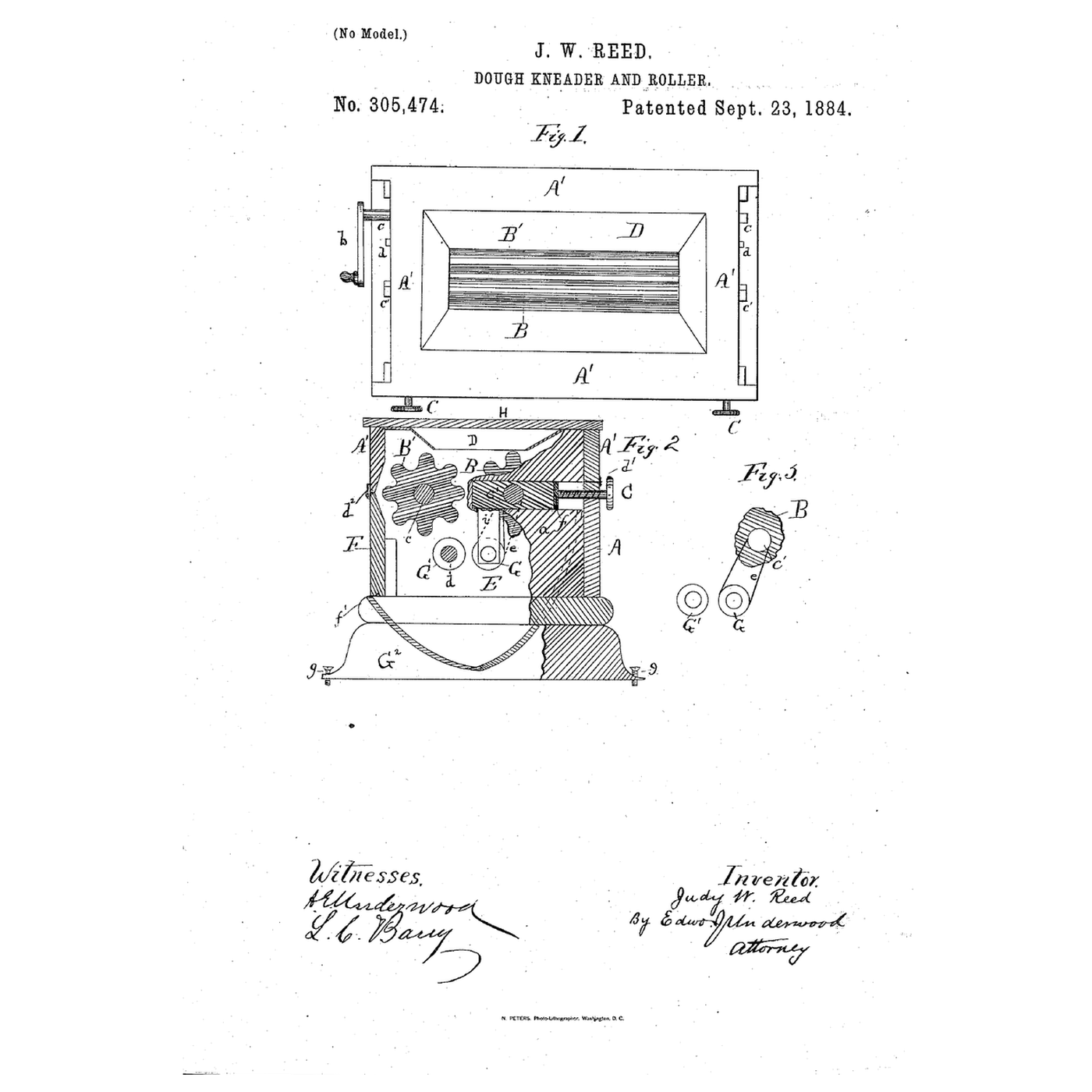

The Dough Kneader and Roller: Corrugated Rolls, Then Plain Ones
Kneading dough by hand is hard, slow work, and the dough on an open table collects whatever is in the air.
Judy W. Reed of Washington, D.C., filed US 305,474 on 21 January 1884; it is dated 23 September 1884, and its drawing sheet is titled "Dough Kneader and Roller". A closed box holds a pair of intermeshing corrugated metal rolls, one set by screws pressing on rubber plates so the squeeze can be increased or reduced, and below them a pair of plain rollers driven by a belt. Dough is put into a covered hopper, cranked through both pairs, and drops into a closed receptacle with a door — kneaded, rolled, and kept from dust throughout.
This rung works out when rollers grip the dough and how much sheet a crank turn makes, and builds a two-roller model.
Trung cấp
About 3 hours
Hướng dẫn
1
1
The nip condition and the sheet
The nip condition and the sheet
Đang tải sổ tay Jupyter…
2
2
Two rollers and a spring
Two rollers and a spring
A wringer squeezes cloth between rollers pressed together by a spring. The embedded blueprint shows the same arrangement Reed used for dough.
3
3
Read US 305,474
Read US 305,474
Reed's objects are, first, "to subject the mass of dough to a thorough and equable mixing and working by causing it to pass between a pair of intermeshing corrugated rollers or cylinders", which approach or recede by regulating-screws "according as the pressure on the dough is desired to be increased or diminished, and then passing it between a pair of plain rollers to roll the dough"; second, a covered receiver and a receptacle for the dough; and third, "to protect the mass of dough from dust or impurities in the atmosphere throughout its working".
In the case A A′ are corrugated metallic rolls B B′ and plain rollers G G′; B′ carries a crank. Roll B runs in movable bearings c′ pressed by screws C that bear on rubber plates f, keeping it against B′. The plain roller G hangs from B's bearings and is driven by a belt from B's axle. The upper part A′ has a hopper-shaped receiver D, "preferably lined with tin or other thin metal to prevent any taste of the wood", hinged so it can be swung back to remove the rolls for cleaning; below is a receptacle E with a door F.
4
4
Build a two-roller model
Build a two-roller model
Mount two hardwood dowels about 30 mm thick in a plywood frame, one in fixed holes and one in slots, with wing nuts or screws to set the gap. Wrap one dowel's surface with evenly spaced ribs of more dowel glued lengthwise, to stand for corrugations, and fit a crank to the fixed one.
Mix a simple bread dough with flour and water. Feed a lump through with the ribbed roll, then with both rolls smooth, starting with a wide gap and narrowing it pass by pass. Note the thickest lump each set-up will draw in and compare with the notebook. Finish the sheet with a rolling pin and measure its thickness with the caliper.
Vật liệu cho bước này:
 Bột mì đa dụng1 cái
 Chốt gỗ cứng1 cái
 Tấm gỗ dán1 cái
 Vít gỗ8 cái
Công cụ cần thiết:
 Cây cán bột
 Máy khoan pin
 Bộ mũi khoan
 Thước cặp điện tử 6 inch
 Cân nhà bếp điện tử
 Súng bắn keo nóng
5
5
Rollers that will not take the dough
Rollers that will not take the dough
Dough roller troubleshooting.
Flow
Loading...
6
6
History and honest limits
History and honest limits
**Judy W. Reed** of Washington, D.C., filed US 305,474 on 21 January 1884; it is dated 23 September 1884. It claims the case with its corrugated rolls, one movable and one cranked, the belt-driven plain rollers, and the hopper above and receptacle below.
**Honest limits.** The friction coefficients in the notebook are assumptions; dough's grip varies with its water, flour and rest.
Vật liệu
4- 1 cáiTạm thời
- 1 cáiTạm thời
- 1 cáiTạm thời
- Vít gỗHoa hồng 10%8 cáiTạm thời
Công cụ yêu cầu
6- Tạm thời
- 1 vendor sell this, none ship to you yetTạm thời
- Tạm thời
- Tạm thời
- Tạm thời
- Tạm thời
Blueprint liên quan
Các blueprint này chia sẻ kiến thức — kỹ thuật, vật liệu hoặc nguyên tắc
Egyptian Emmer Bread — Baking Emmer Wheat Flatbread in a Clay Oven
bởi TheChef
Thực phẩm
74
0
0
0
0
0
Cultivating a Sourdough Starter from Wild Yeast — The Living Culture Behind the World's Oldest Bread
bởi Bob
Sinh học
54
0
0
0
6
0

The Clothes Wringer: Two Rollers and a Spring
bởi YourGrandma
Dụng cụ dệt
0
0
0
0
0
0
Gear Trains: Idlers, Compounding and Hitting a Given Ratio
bởi Martin
Cơ học
22
0
0
0
0
0
CC0 Phạm vi công cộng
Bản thiết kế này được phát hành theo CC0. Bạn tự do sao chép, sửa đổi, phân phối và sử dụng cho bất kỳ mục đích nào mà không cần xin phép.
Hỗ trợ nhà sáng tạo bằng cách mua sản phẩm qua bản thiết kế, nơi họ nhận Hoa hồng nhà sáng tạo do nhà bán hàng đặt, hoặc tạo phiên bản mới và kết nối trong bản thiết kế riêng để chia sẻ doanh thu.