NGHỆ THUẬT
LÀM ĐẸP VÀ SỨC KHỎE
THỦ CÔNG
VĂN HÓA VÀ LỊCH SỬ
GIẢI TRÍ
MÔI TRƯỜNG
THỰC PHẨM VÀ ĐỒ UỐNG
KỸ THUẬT NGƯỢC
KHOA HỌC
THỂ THAO
CÔNG NGHỆ
THIẾT BỊ ĐEO



The Porcelain-Lined Lemon Squeezer: Cast-Iron Handles, Porcelain Where the Juice Runs
Wooden lemon squeezers soak up stale juice, and bare iron ones are eaten by the acid and stain the juice.
Thomas C. Smith of New York received US 76,539, dated 7 April 1868, for "having the body of the device of cast iron or other cast metal, and in the manner of applying the porcelain parts to the same". A cast-iron cup on one handle holds a porcelain concave perforated with holes, resting on a ring of india-rubber and held by lips; a plate on the other handle carries a porcelain compress screwed to it. Only porcelain touches the lemon.
This rung works out how much iron the juice could take, then makes the porcelain concave and compress, fires them, fits them to flat-bar handles with a rubber ring, and compares juice left on iron and on porcelain.
Nâng cao
About 2 days, with drying and firing
Hướng dẫn
1
1
The acid and the iron
The acid and the iron
Đang tải sổ tay Jupyter…
2
2
A metal squeezer before it
A metal squeezer before it
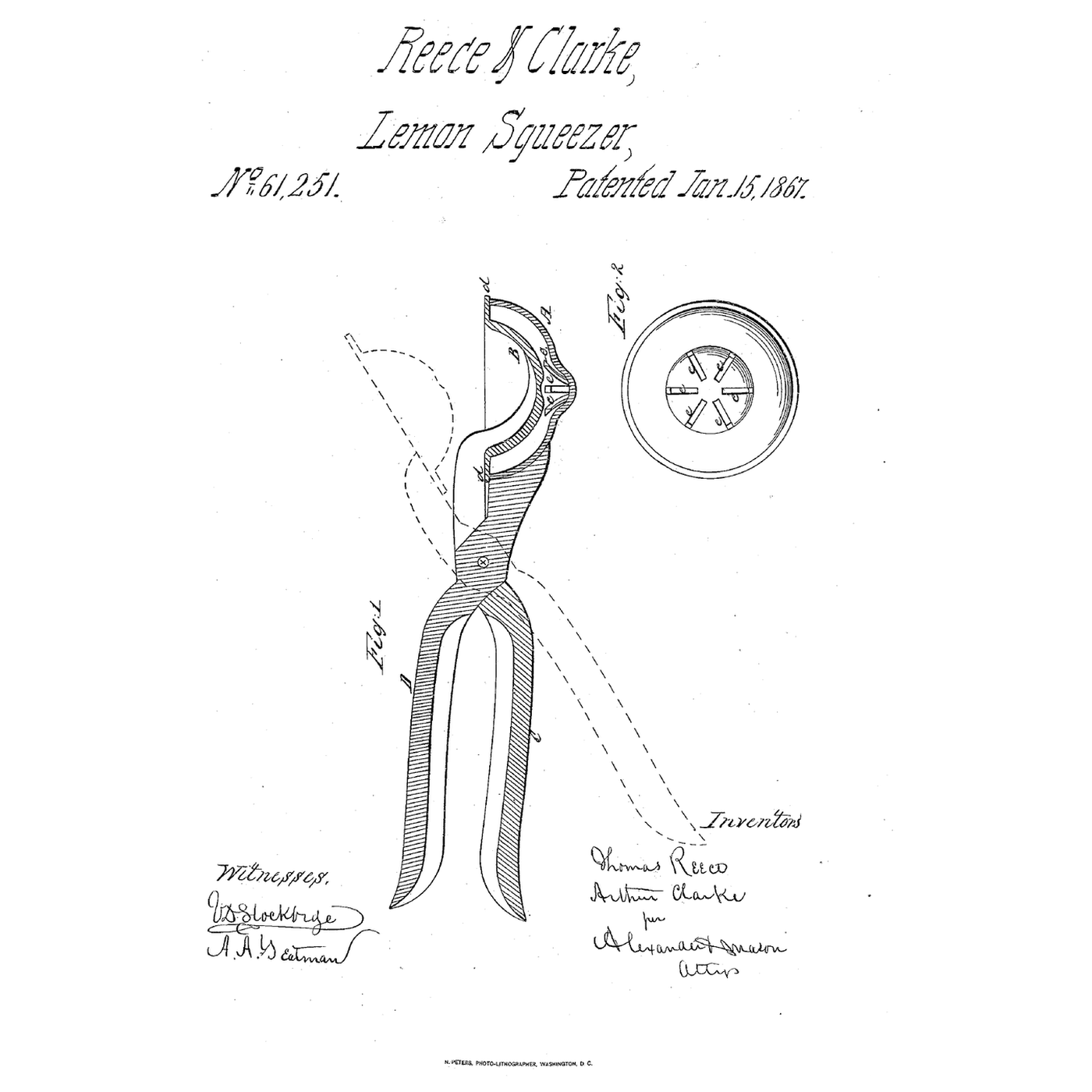
The embedded blueprint tins or galvanizes its cups against the acid. Smith lines his cast-iron squeezer with porcelain wherever the juice runs.
3
3
Read US 76,539
Read US 76,539
"G is a concave, which is the half of a hollow sphere, made also of porcelain, with a series of holes, d′, in its bottom or lower part, and having a flange, e, projecting horizontally from it all around its upper edge. This flange, e, rests or bears upon an annular piece of India rubber, f, which is placed on the shoulder a, in the interior of the cup B."
"The India-rubber ring f serves as a packing for the concave, holding it firmly in position without danger of breakage, and effectually prevents the acid juice of the lemons finding its way down between the concave and cup, as will be understood by referring to fig. 2."
4
4
Make the porcelain parts and fit them
Make the porcelain parts and fit them
**Concave.** Press porcelain clay into the inside of a small bowl to make a half-sphere about 7 cm across with a flat flange round its rim, and pierce its bottom with a ring of small holes.
**Compress.** Press a solid half-sphere of clay a few millimetres smaller, with a flat top for fixing.
**Fire.** Dry both slowly, bisque-fire them in the kiln, glaze them with clear glaze, and glaze-fire them at the clay's stated temperature.
**Frame.** Cut the bottom 4 cm off a tin can wider than the concave, cut a hole in its base, and rivet it to a flat-bar handle. Seat the concave in it on a rubber O-ring and bend three tabs of the can's rim over its flange as the lips g g. Epoxy the compress to a disc riveted on the second handle, and pivot the handles so the compress closes into the concave.
**Test.** Squeeze lemons over a glass. Then leave a spoonful of lemon juice on a pad of steel wool and another in the porcelain concave for an hour, and compare their colour and their pH with test strips.
Vật liệu cho bước này:
 Đất sét sứ1 kg
 Men trong1 cái
 Lon thiếc1 cái
 Thanh thép dẹt0.5 mét
 Đinh tán rút6 cái
 Bộ bu lông lục giác nhiều cỡ1 cái
 Đai ốc lục giác1 cái
 Bộ gioăng chữ O1 cái
 Keo epoxy hai thành phần1 cái
 Chanh vàng3 cái
 Bùi nhùi thép1 cái
 Giấy thử pH1 cái
Công cụ cần thiết:
 Bộ dụng cụ làm gốm
 Lò nung
 Cưa sắt
 Máy khoan pin
 Bộ mũi khoan
 Kéo cắt tôn
 Bộ súng tán đinh rút
 Kìm mỏ dẹt
 Dao bếp
 Cốc uống nước
 Găng tay da bảo hộ
5
5
Porcelain that cracks, leaks or rattles
Porcelain that cracks, leaks or rattles
Porcelain-lined lemon squeezer troubleshooting.
Flow
Loading...
6
6
History and honest limits
History and honest limits
**Thomas C. Smith** of New York, New York, received US 76,539, dated 7 April 1868. His lower handle A was cast with the cup B, the upper A′ with a plate E holding the porcelain compress F by a screw e and nut d; the concave's flange had a notch h to pass it down past one of the lips g g before turning. He thought porcelain, glazed earthenware or other vitreous material suitable, and the metal parts japanned or silver-plated. His claims cover the shoulder, rubber ring, lips and notched flange, and the cast-metal handles with the porcelain compress and concave.
**Honest limits.** Pressed and glazed porcelain on flat-bar handles and a tin cup stand in for his cast iron and made porcelain. The notebook's iron is a ceiling, not a prediction; its volumes and acid content are examples. Your comparison is the result.
Vật liệu
12- 1 kgTạm thời
- 1 cáiTạm thời
- 1 cáiTạm thời
- 0.5 métTạm thời
- 6 cáiTạm thời
- Tạm thời
- 1 cáiTạm thời
- 1 cáiTạm thời
- Tạm thời
- 3 cáiTạm thời
- 1 cáiTạm thời
- 1 cáiTạm thời
Công cụ yêu cầu
11- Tạm thời
- Tạm thời
- Tạm thời
- 1 vendor sell this, none ship to you yetTạm thời
- Tạm thời
- Tạm thời
- Tạm thời
- Tạm thời
- Tạm thời
- Tạm thời
- Tạm thời
Bản thiết kế này làm ra

Blueprint liên quan
Các blueprint này chia sẻ kiến thức — kỹ thuật, vật liệu hoặc nguyên tắc



CC0 Phạm vi công cộng
Bản thiết kế này được phát hành theo CC0. Bạn tự do sao chép, sửa đổi, phân phối và sử dụng cho bất kỳ mục đích nào mà không cần xin phép.
Hỗ trợ nhà sáng tạo bằng cách mua sản phẩm qua bản thiết kế, nơi họ nhận Hoa hồng nhà sáng tạo do nhà bán hàng đặt, hoặc tạo phiên bản mới và kết nối trong bản thiết kế riêng để chia sẻ doanh thu.