NGHỆ THUẬT
LÀM ĐẸP VÀ SỨC KHỎE
THỦ CÔNG
VĂN HÓA VÀ LỊCH SỬ
GIẢI TRÍ
MÔI TRƯỜNG
THỰC PHẨM VÀ ĐỒ UỐNG
KỸ THUẬT NGƯỢC
KHOA HỌC
THỂ THAO
CÔNG NGHỆ
THIẾT BỊ ĐEO

The Scroll Compressor: Two Spirals, One Orbiting, No Valves
Two identical spiral walls, one fixed, one turned half a turn and moved round a small circle without ever rotating. Where they touch they seal off crescent-shaped pockets, and as the orbit goes round each pocket is carried inward and squeezed, until it opens into a port at the centre.
Léon Creux patented it in 1905 as a steam engine — steam in at the centre, expanding outward — and noted in the same patent that it *"may of course be used also as a pump for compressing"*. It has no valves, no pistons changing direction and almost no vibration.
It also demands walls cut to within microns, which is why it took the rest of the century to become practical. Today it is the compressor inside most household air conditioners and heat pumps. This rung generates the real involute geometry, prints a hand-cranked pair and shows why the tolerance matters more than anything else in the machine.
Nâng cao
About 8 hours
Hướng dẫn
1
1
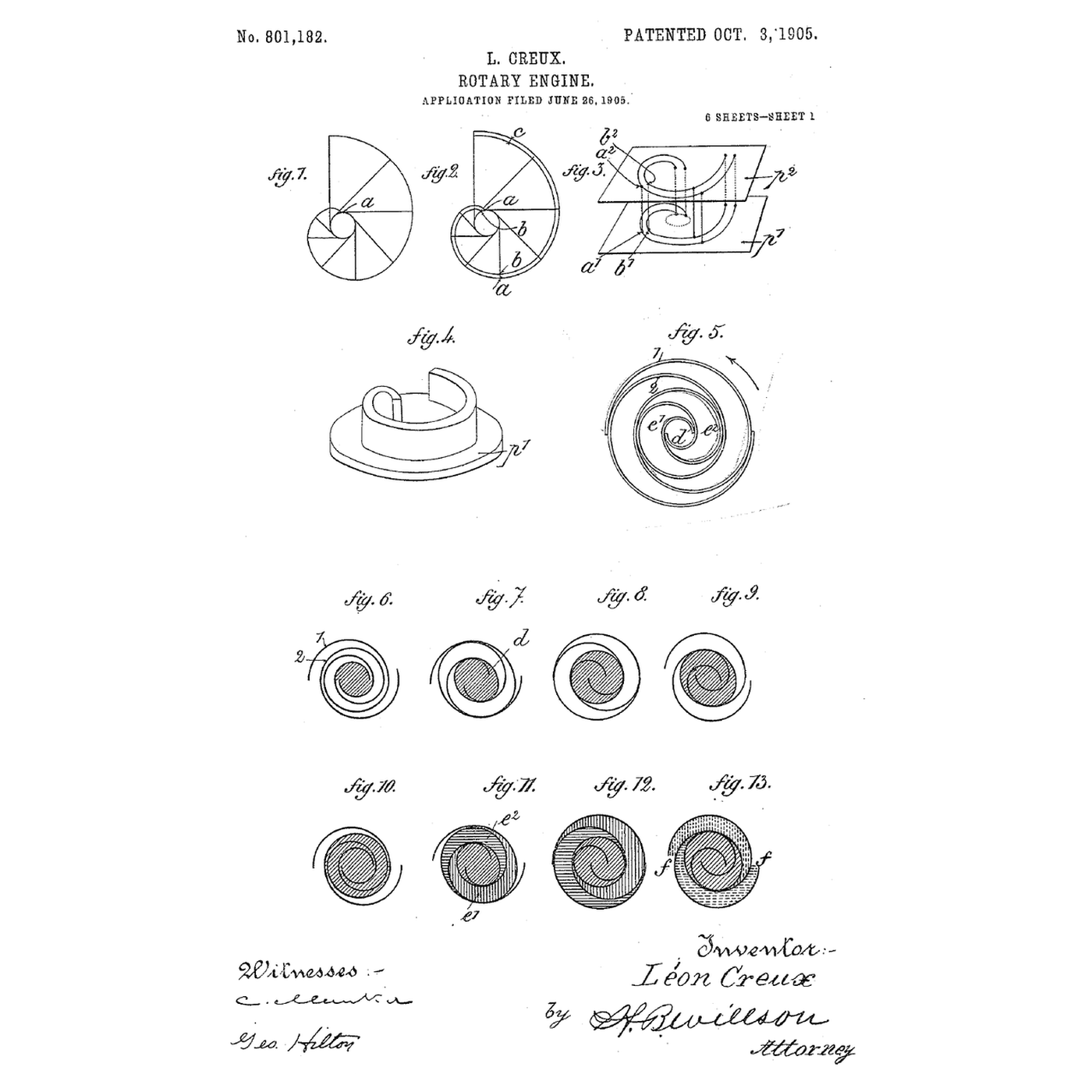
Read Creux's drawing: a steam engine that runs backwards as a compressor
Read Creux's drawing: a steam engine that runs backwards as a compressor
In US 801,182 the two *"spiral bands"* are engaged one inside the other. Steam is *"introduced at the center of the spirals"* and, as the moving band travels round, the sealed pockets carry it outward and let it expand, driving the shaft. In his words the steam *"will always operate at full pressure in the central chamber"*, expand *"at each revolution in the lateral chambers"*, and escape at the rim; his figures hatch the pockets three ways to show which is which. The bands have *"the shape of developed arc of a circle"* — the involute.
The moving band does not rotate. Creux calls its motion a *"circular movement of translation"*: every point of it moves round an identical small circle, the way a hand polishing a table in circles keeps its fingers pointing the same way. Run it the other way — turn the shaft, feed gas at the rim — and the pockets travel inward and shrink. That is the compressor.
Find on the drawing: the two bands; the central crank; the **bent shafts 12** running in the frame 13 through extensions of the plates, which *"only allow each"* plate *"to make a circular movement of translation the radius of which is equal to the radius of the cranks"* — the anti-rotation device; and the **segments 33 pressed by springs 34** that seal the edges. Step 4 copies the bent-shaft idea.
2
2
Generate the involute walls and watch the pockets form
Generate the involute walls and watch the pockets form
Đang tải sổ tay Jupyter…
3
3
Print the fixed and orbiting scrolls
Print the fixed and orbiting scrolls
Use the notebook's numbers: pitch 12 mm, wall 2 mm, wall height 20 mm, three wraps, orbit radius 4 mm. Model each scroll as a wall standing on its own base plate, with the wall following the two involute curves (one for each face). Print them in PETG, wall upright, at the finest layer height your printer holds.
The **fixed scroll**'s plate carries a 6 mm port at the centre and an inlet gap at the rim. The **orbiting scroll**'s plate carries a bearing boss on its back, on the scroll's centre.
Offer them together, one wall inside the other, and check with a feeler gauge where they touch. Sand the wall tips flat on sandpaper laid on glass so each tip seals against the other plate. A printed pair will not be gas-tight — the step 6 notebook explains why — but it will move air.
Vật liệu cho bước này:
 Sợi in PETG180 g
Công cụ cần thiết:
 Máy in 3D sợi nhựa (FDM)
 Thước cặp điện tử 6 inch
 Bộ giấy nhám nhiều loại
4
4
Orbit without rotating: the crank and the three anti-rotation cranks
Orbit without rotating: the crank and the three anti-rotation cranks
Drive the orbiting scroll from a central crank: a shaft in a bearing through the base frame, carrying an eccentric pin offset exactly **4 mm** — the orbit radius — which runs in the bearing boss on the back of the orbiting plate.
On its own that pin would let the orbiting scroll spin freely. Stop it with three small identical cranks at the corners of the plate, each also with a 4 mm throw, pivoted in the frame and pinned into the plate. Three equal parallel cranks can only let the plate translate: any point of it moves on a 4 mm circle and it cannot turn. (Production scrolls use a sliding cross-shaped Oldham ring for the same job; Creux used exactly these parallel cranks — his bent shafts 12.)
Use skateboard bearings on the main crank and machine screws running in drilled holes for the three small cranks. Get the four throws equal with calipers; a crank 0.2 mm long binds the whole mechanism at one point of every turn.
Vật liệu cho bước này:
 Vòng bi ván trượt2 cái
 Thép thanh thô1 cái
 Vít máy12 cáiSợi in PETG60 g
Công cụ cần thiết:
 Máy khoan pin
 Bộ mũi khoanThước cặp điện tử 6 inch
 Bộ lục giác
5
5
Turn it and measure what it delivers
Turn it and measure what it delivers
Smear the wall tips with a thin film of silicone grease and assemble. Turn the crank slowly and watch through the inlet gap: the crescent pockets close off at the rim and walk inward, one wrap per turn.
Push a length of clear vinyl tube onto the centre port and dip its other end 10 cm deep in a jug of water. Crank steadily: bubbles come out of the tube, so the pump is beating 10 cm of water — about 1 kPa. Lower the tube further until the bubbles stop; that depth is the most pressure your printed pair can hold against its own leakage.
Now crank faster and repeat. The depth increases: leakage is a fixed rate through fixed gaps, so the faster the pockets move, the less time they spend leaking. That is why real scroll compressors run at motor speed.
Vật liệu cho bước này:
 Ống nhựa vinyl trong1 mét
 Nước1 lít
Công cụ cần thiết:
 Ca đong
 Thước kẻ
6
6
Built-in volume ratio, and why the tolerance is everything
Built-in volume ratio, and why the tolerance is everything
Đang tải sổ tay Jupyter…
7
7
History and context
History and context
**US 801,182, 'Rotary Engine', Léon Creux, engineer, of 54 Rue Taitbout, Paris; filed 26 June 1905, granted 3 October 1905.** Creux presented it as a steam engine whose *"operation is soft and silent"*, and saw that it would also compress.
It could not be made well. The walls must match the involute to within microns and the tips must seal against the opposite plate, and nothing in 1905 could cut a spiral to that accuracy in quantity. The idea stayed on paper for most of the century and became a production compressor only once numerically controlled machine tools could hold the tolerance. It then took over residential air conditioning and heat pumps, where its quietness and smoothness matter most.
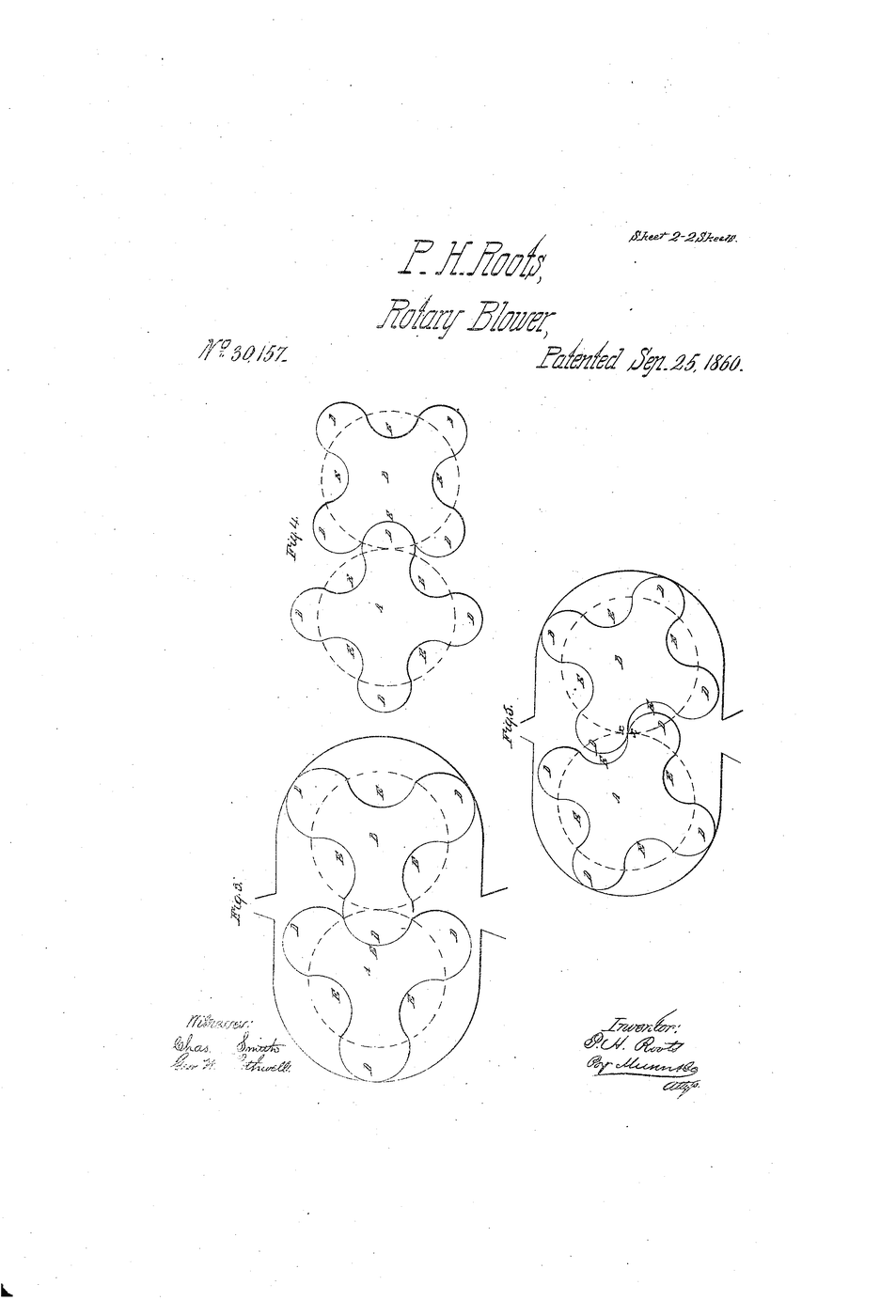
Its relatives in this catalogue are the other rotary displacement machines: the Roots blower (which does not compress internally at all), the rotary vane pump, and the gear pump.
**Honest limits.** The built-in ratio is fixed, so a scroll working away from its design pressure ratio wastes work. It is limited in size: large flows need screws or centrifugals. It cannot swallow liquid — a slug of liquid in a pocket that is still shrinking has nowhere to go. And it is only ever as good as its machining.
Vật liệu
6- 240 gTạm thời
- Vòng bi ván trượtHoa hồng 10%2 cáiTạm thời
- 1 cáiTạm thời
- 12 cáiTạm thời
- 1 métTạm thời
- 1 lítTạm thời
Công cụ yêu cầu
8- Tạm thời
- Tạm thời
- Tạm thời
- 1 vendor sell this, none ship to you yetTạm thời
- Tạm thời
- Tạm thời
- Tạm thời
- Tạm thời
Blueprint liên quan
Các blueprint này chia sẻ kiến thức — kỹ thuật, vật liệu hoặc nguyên tắc
Roots Blower
bởi Karen
Cơ học
39
0
0
0
0
0
Rotary Vane Vacuum Pump
bởi Emma
CÔNG NGHỆ
40
0
0
0
0
0
Gear Pump
bởi Karen
CÔNG NGHỆ
35
0
0
0
0
0
The Involute: Why Gear Teeth Are That Shape and No Other
bởi Martin
Cơ học
25
0
0
0
0
0
Air Conditioning
bởi Volt
Điện tử
37
0
0
0
0
0
Watt Indicator Diagram
bởi Martin
CÔNG NGHỆ
54
0
0
0
0
0
The Centrifugal Pump: Speed Squared, and Why It Cannot Lift Air
bởi Emma
Cơ học
11
0
0
0
0
0
CC0 Phạm vi công cộng
Bản thiết kế này được phát hành theo CC0. Bạn tự do sao chép, sửa đổi, phân phối và sử dụng cho bất kỳ mục đích nào mà không cần xin phép.
Hỗ trợ nhà sáng tạo bằng cách mua sản phẩm qua bản thiết kế, nơi họ nhận Hoa hồng nhà sáng tạo do nhà bán hàng đặt, hoặc tạo phiên bản mới và kết nối trong bản thiết kế riêng để chia sẻ doanh thu.