NGHỆ THUẬT
LÀM ĐẸP VÀ SỨC KHỎE
THỦ CÔNG
VĂN HÓA VÀ LỊCH SỬ
GIẢI TRÍ
MÔI TRƯỜNG
THỰC PHẨM VÀ ĐỒ UỐNG
KỸ THUẬT NGƯỢC
KHOA HỌC
THỂ THAO
CÔNG NGHỆ
THIẾT BỊ ĐEO


The Tesla Turbine: Discs, Not Blades, Driven by the Boundary Layer
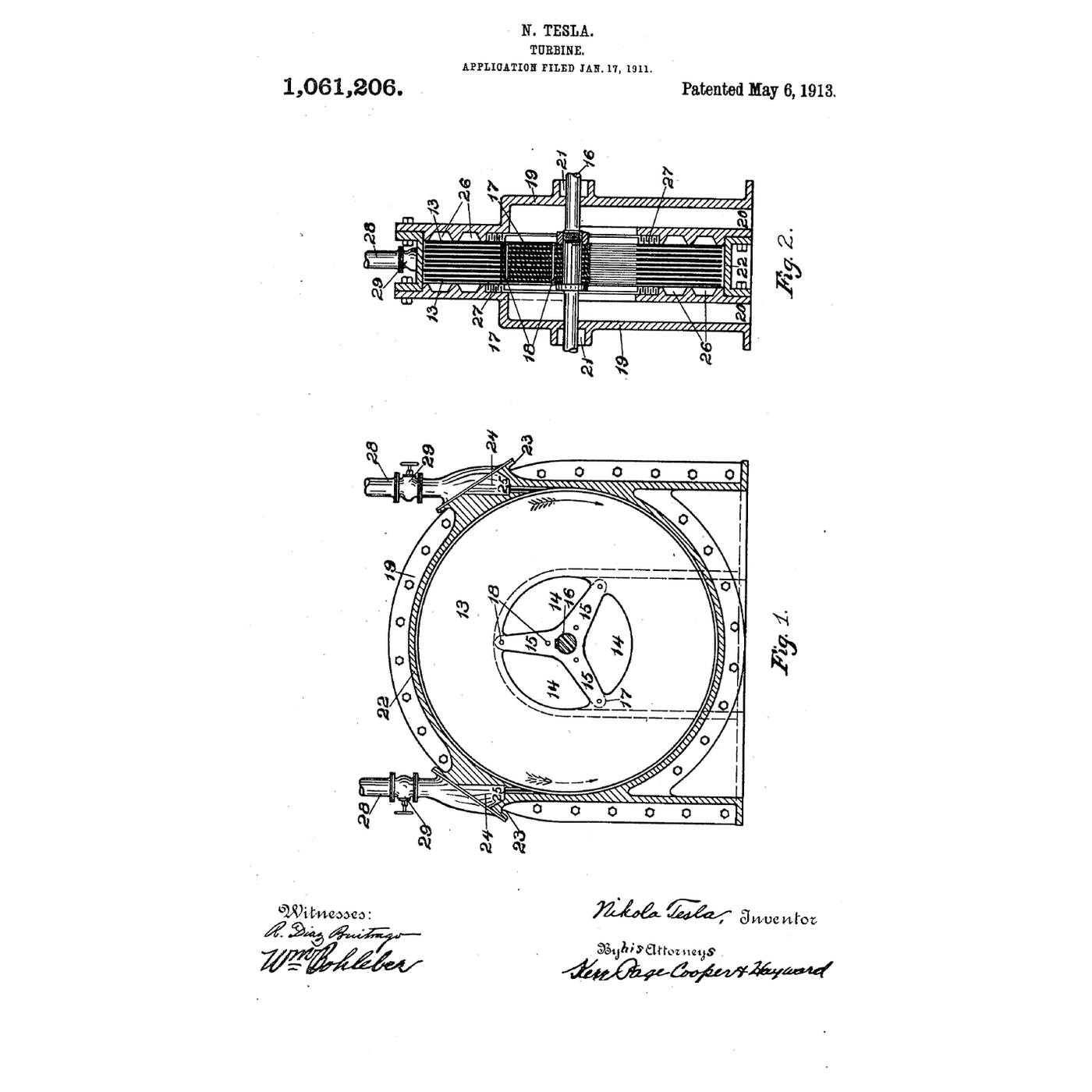
Nikola Tesla's turbine has no blades at all. A stack of flat discs with narrow gaps between them turns on a shaft; gas or steam enters tangentially at the rim, spirals inward through the gaps, and drags the discs round by viscosity before leaving near the centre. He patented it in 1913 and claimed it could be run as a turbine or, reversed, as a pump.
It never displaced bladed turbines: its practical efficiency was too low. But it is the clearest demonstration there is of the boundary layer — the thin film of fluid that sticks to every surface — and it is a classic maker build from old CDs.
This rung works out the gap the discs need and builds a CD Tesla turbine run on compressed air.
Trung cấp
About 5 hours
Hướng dẫn
1
1
Read the patent's rule for the gap
Read the patent's rule for the gap
US 1,061,206, 'Turbine', Nikola Tesla. The runner is *"a plurality of flat rigid disks"* keyed to a shaft and spaced by washers, with *"openings"* near the centre for the exhaust. The fluid acts on them through *"adhesion and viscosity"*.
The design rule is in plain words: the spacing *"should be the greater, the larger the diameter of the disks, the longer the spiral path of the fluid and the greater its viscosity"*. Tesla drew only a few widely spaced discs *"for the sake of clearness"* — a real runner has many, close together.
2
2
The boundary layer sets the gap
The boundary layer sets the gap
Đang tải sổ tay Jupyter…
3
3
Build a CD turbine
Build a CD turbine
Drill out the centres of eight CDs to fit a length of threaded rod as the shaft. Drill six 10 mm exhaust holes round each disc near the centre, all in line. Stack the discs with two thin flat washers between each pair, clamped between nuts.
Print a housing that fits round the stack with 1–2 mm clearance, with one tangential inlet at the rim and exhaust ports in the side plates over the disc holes. Run the shaft in two skateboard bearings in the side plates.
Balance matters: spin the stack slowly by hand and check it does not wobble before any air goes near it.
Vật liệu cho bước này:
 Đĩa compact8 cái
 Vòng đệm phẳng20 cái
 Ty ren1 cái
 Vòng bi ván trượt2 cái
 Sợi in PETG150 g
Công cụ cần thiết:
 Máy khoan pin
 Bộ mũi khoan
 Máy in 3D sợi nhựa (FDM)
 Mỏ lết
 Thước cặp điện tử 6 inch
4
4
Run it on compressed air, behind a guard
Run it on compressed air, behind a guard
Stand the turbine behind a clear guard and wear goggles and ear protection. Connect the air compressor through the regulator to the inlet, starting at 0.5 bar.
Read the speed with the tachometer (a strip of reflective tape on the stack) at each pressure, raising it in small steps. **Stop well below 10,000 rpm** — the notebook's rim speeds show why.
Then change the gap: rebuild with one washer between discs instead of two and repeat. Compare free-running speed at the same pressure. The gap that works best is close to the notebook's boundary-layer estimate for air.
Công cụ cần thiết:
 Máy nén khí (kiểu bánh kếp)
 Van giảm áp
 Máy đo tốc độ vòng quay
 Kính bảo hộ trong suốt
 Bảo vệ thính giác
5
5
History and context
History and context
**US 1,061,206, 'Turbine', Nikola Tesla; original application filed 21 October 1909, divided and this application filed 17 January 1911 (Serial 603,049); patented 6 May 1913.** A companion patent of the same family covered the machine run as a pump.
Tesla expected high efficiency and a cheap, rugged machine. In practice the discs flexed at speed, the gaps had to be very fine, and efficiency with steam fell well short of bladed turbines; the bladed Parsons turbine in this catalogue won. Disc pumps survive for abrasive and delicate fluids, where their bladeless shear is gentle.
**Honest limits.** Low efficiency at useful power; discs that flex; very close tolerances; and on a CD build, the hazard of a disc bursting.
Vật liệu
5- 8 cáiTạm thời
- 20 cáiTạm thời
- 1 cáiTạm thời
- Vòng bi ván trượtHoa hồng 10%2 cáiTạm thời
- 150 gTạm thời
Công cụ yêu cầu
10- 1 vendor sell this, none ship to you yetTạm thời
- Tạm thời
- Tạm thời
- Tạm thời
- Tạm thời
- Tạm thời
- Tạm thời
- Tạm thời
- Tạm thời
- Bảo vệ thính giácHoa hồng 10%Tạm thời
Blueprint liên quan
Các blueprint này chia sẻ kiến thức — kỹ thuật, vật liệu hoặc nguyên tắc


CC0 Phạm vi công cộng
Bản thiết kế này được phát hành theo CC0. Bạn tự do sao chép, sửa đổi, phân phối và sử dụng cho bất kỳ mục đích nào mà không cần xin phép.
Hỗ trợ nhà sáng tạo bằng cách mua sản phẩm qua bản thiết kế, nơi họ nhận Hoa hồng nhà sáng tạo do nhà bán hàng đặt, hoặc tạo phiên bản mới và kết nối trong bản thiết kế riêng để chia sẻ doanh thu.