
The Transistor Logic Gate
Hướng dẫn
Build the same three gates, a thousand times faster
Build the same three gates, a thousand times faster
Rebuild the relay blueprint's gates with transistors and compare them directly.
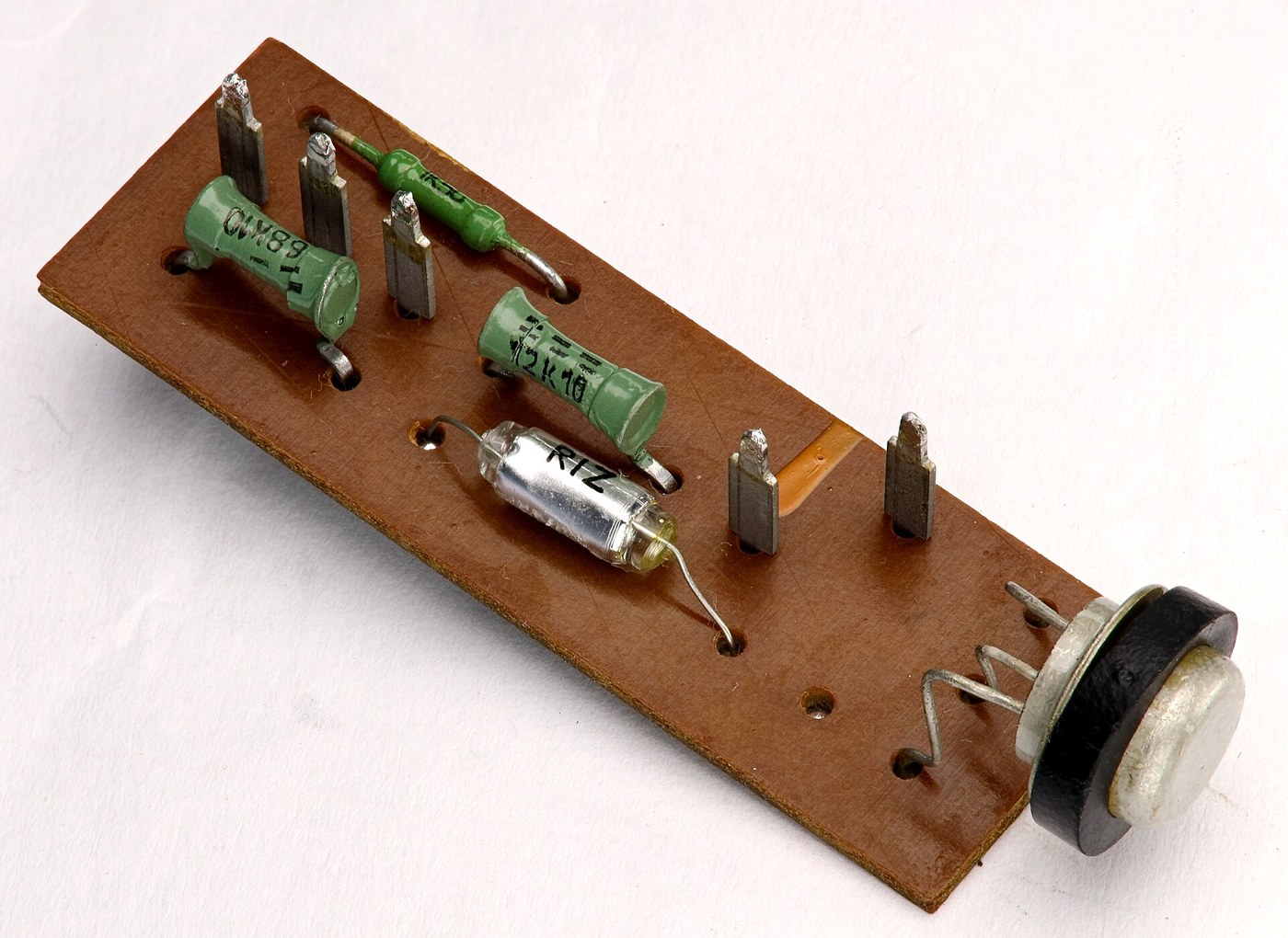
- NOT: one NPN transistor, base through a resistor to the input, collector through a resistor to supply. Output at the collector.
- NOR: two transistors sharing one collector resistor — either input high pulls the output low.
- NAND: two transistors in SERIES — both inputs must be high to pull the output low.
- Verify each truth table, then measure propagation delay with the oscilloscope.
Series is AND and parallel is OR, exactly as with relay contacts — the topology did not change, only what is doing the switching. The delay will be tens of nanoseconds against the relay's milliseconds.
Note that the natural transistor gates are the INVERTING ones — NAND and NOR — because a transistor pulls its output DOWN when driven. A non-inverting AND costs an extra inverter. That is why real logic families are built from NAND and NOR, and why the next step matters so much.Vật liệu cho bước này:
 Bộ transistor các loại1 bộ
 Bộ điện trở1 bộ
 Bộ LED báo hiệu1 bộ
 Bo mạch lỗ / bo mạch thử1 cái
 Dây đấu nối1 reel
Công cụ cần thiết:
 Trạm hàn thiếc
 Máy hiện sóng
 Máy phát hàm
 Đồng hồ vạn năng số cấp phòng thí nghiệm
 Nguồn điện bàn điều chỉnh được
NAND is enough for everything
NAND is enough for everything
Không gian làm việc Blockly
Loading Blockly workspace...
Công cụ cần thiết:
 Máy tính để bàn
Fan-out, noise margin and why digital is reliable
Fan-out, noise margin and why digital is reliable
Công cụ cần thiết:
Máy tính để bànMeasure the power, and find the real wall
Measure the power, and find the real wall
The valve machine's limit was heat. Measure whether that limit really went away.
- Measure the current your transistor gate draws with the output high, and again with it low.
- Now drive it with a square wave and measure average current against frequency.
- Plot it and extrapolate.
Static current is small; average current rises roughly in proportion to switching frequency, because every transition charges and discharges the capacitance of the next stage, and that energy is dissipated as heat every single time.
So the heat problem never disappeared — it was postponed, and it returns the moment you have enough gates switching fast enough. That is precisely the wall processors hit around 2005, when clock speeds stopped rising and manufacturers began adding cores instead: not because faster was impossible, but because the heat was.
CMOS was the escape from the static half of the problem — it draws almost no current when it is not switching, which is why it displaced everything else and why a modern chip's power is almost entirely switching energy. ENIAC's engineers left their valves powered continuously because switching them on and off killed them; the same instinct, for a different reason, is why your phone aggressively idles its cores.Vật liệu cho bước này:
Bộ transistor các loại1 bộBộ điện trở1 bộ Bộ tụ điện1 bộ
Công cụ cần thiết:
Máy hiện sóngMáy phát hàmĐồng hồ vạn năng số cấp phòng thí nghiệm Ampe kìm AC/DC 600 ANguồn điện bàn điều chỉnh được
Assemble the batch into a computer
Assemble the batch into a computer
Everything needed has now been built. Put it together and notice that nothing is missing.
- Gates — from this blueprint, or from relays if you prefer to hear it working.
- An adder — from the binary adder blueprint.
- Registers — flip-flops from the Eccles-Jordan blueprint.
- Memory — core, or simply more flip-flops at small scale.
- A program counter, an instruction decoder and a conditional jump — from the stored-program blueprint.
- An assembler — from the previous blueprint, to make it usable by a human.
That is a complete general-purpose computer, and every part of it was invented before 1950. Everything since has been the same architecture made smaller, faster and cheaper — which is not a small thing, since it changed the world, but it is not a different thing.
The batch's real lesson is the one it has repeated at every step: the logic was finished in 1937 and the engineering was never finished at all. Shannon's algebra describes a relay machine, a valve machine, a transistor machine and the processor rendering this page, without alteration. What changed a million-fold, twice, was the switch — and each time the switch improved, the same ideas simply became affordable in larger quantities. If you want to know what computing does next, do not look at the algebra. Look at what is replacing the transistor.Công cụ cần thiết:
Máy tính để bànVật liệu
6- Tạm thời
- Tạm thời
- 1 bộTạm thời
- Tạm thời
- 1 reelTạm thời
- 1 bộTạm thời
Công cụ yêu cầu
7- Tạm thời
- Tạm thời
- Tạm thời
- Tạm thời
- Tạm thời
- Tạm thời
Blueprint liên quan
Các blueprint này chia sẻ kiến thức — kỹ thuật, vật liệu hoặc nguyên tắc

CC0 Phạm vi công cộng
Bản thiết kế này được phát hành theo CC0. Bạn tự do sao chép, sửa đổi, phân phối và sử dụng cho bất kỳ mục đích nào mà không cần xin phép.
Hỗ trợ nhà sáng tạo bằng cách mua sản phẩm qua bản thiết kế, nơi họ nhận Hoa hồng nhà sáng tạo do nhà bán hàng đặt, hoặc tạo phiên bản mới và kết nối trong bản thiết kế riêng để chia sẻ doanh thu.