UBUCIKO
UBUHLE NEMPILO
UBUCIKO BEZANDLA
AMASIKO NOMLANDO
EZOKUZIJABULISA
IMVELO
UKUDLA NEZIPHUZO
REVERSE ENGINEERING
IZAYENSI
EZEMIDLALO
UBUCHWEPHESHE
IZINTO EZIGQOKWAYO
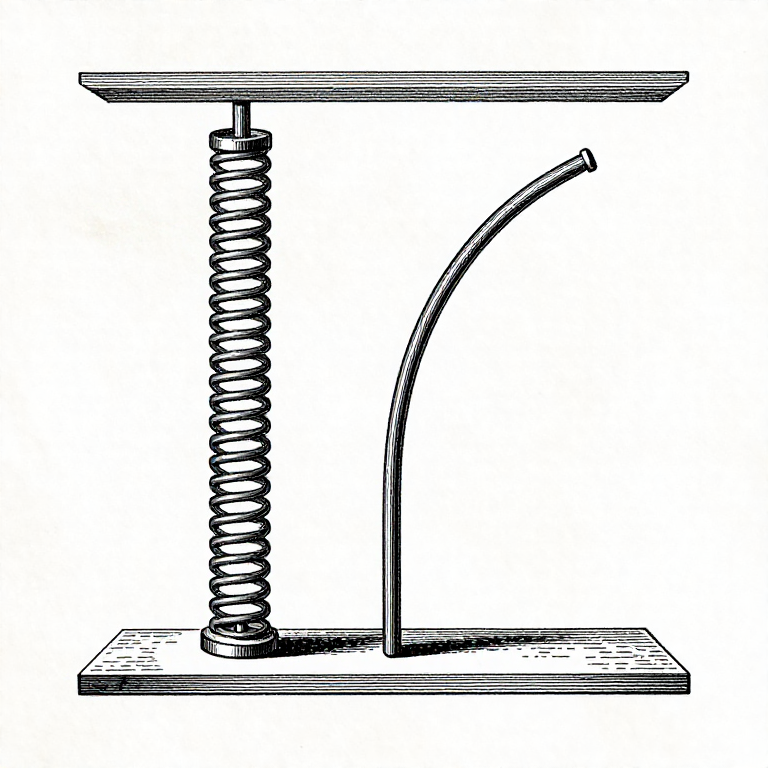


Buckling and Guiding: Why a Long Spring Flicks Sideways
A compression spring that is long compared with its coil diameter does not crush when it is pushed — it flicks out sideways. No stress has been exceeded and nothing is damaged; the spring has found a cheaper way to get shorter, exactly as a column does.
What makes it worth a rung of its own is that buckling is decided as much by the mounting as by the spring. The same spring is safe at a free length over five times its coil diameter when it sits between two flat faces, and unsafe past 1.3 times when one end is free to wander. A spring seat is therefore a piece of engineering, not a hole to drop a spring into.
This rung is the slenderness criterion, what each mounting is worth, and the three ways to fix a spring that will not stay straight.
Ophakathi
3 hours
Imiyalelo
1
1
What buckling looks like, and what it is not
What buckling looks like, and what it is not
**What you see.** The spring compresses normally for most of its travel, then at some point the middle bows out to one side and the force needed suddenly drops. Release it and it comes back perfectly straight, with no damage at all.
**What it is not.** It is not the spring being too weak, and no amount of stronger wire will fix it. It is not a manufacturing fault. It is not a set. A buckled spring measures exactly the same as it did before.
**Why it happens.** A compressed spring stores energy. If it can shed some of that energy by bending sideways instead of compressing further, it will — and whether it can depends on how much sideways stiffness the coil geometry gives it against how much axial energy is pushing.
**What it costs.** Usually much more than the spring. A buckled spring rubs on whatever surrounds it, so it wears a groove in a bore, or saws through a rod, or jumps off its seat entirely. The rate goes unpredictable because part of the spring is now rubbing. And on a valve or a clutch it can hang up and not come back.
**The one useful diagnostic:** if the force needed falls when it should be rising, and the spring is visibly leaning, it has buckled. If the force rises faster than it should, it has gone solid. Those are the two ends of the same travel and they feel completely different.
Izinto zokwakha zalesi sinyathelo:
 Iqoqo lezintambo zokucindezela1 ucezu
Amathuluzi adingekayo:
 Isilinganiso Samandla (Isikali Sensimbi Esontekile)
 Irula
Irula2
2
Slenderness, end conditions and the critical deflection
Slenderness, end conditions and the critical deflection
Ilayisha incwadi ye-Jupyter…
Amathuluzi adingekayo:
 Ikhompyutha Yasetafuleni
3
3
Guiding: rod inside or bore outside
Guiding: rod inside or bore outside
If the spring must be slender, it has to be held straight by something else. There are two ways and they fail differently.
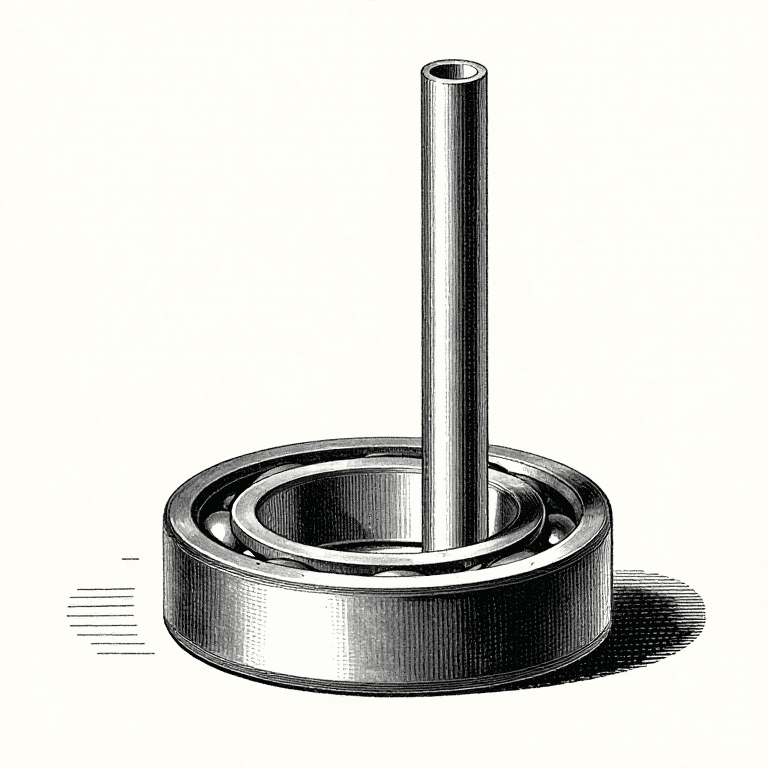
**A rod down the middle.** The spring's inside diameter must clear the rod with room to spare, because the coils get FATTER as the spring compresses — the mean diameter grows slightly as the helix flattens. A rule of thumb is to leave at least a tenth of the coil diameter as diametral clearance, more for a long spring. Too tight and the spring grips the rod at full compression and will not return.
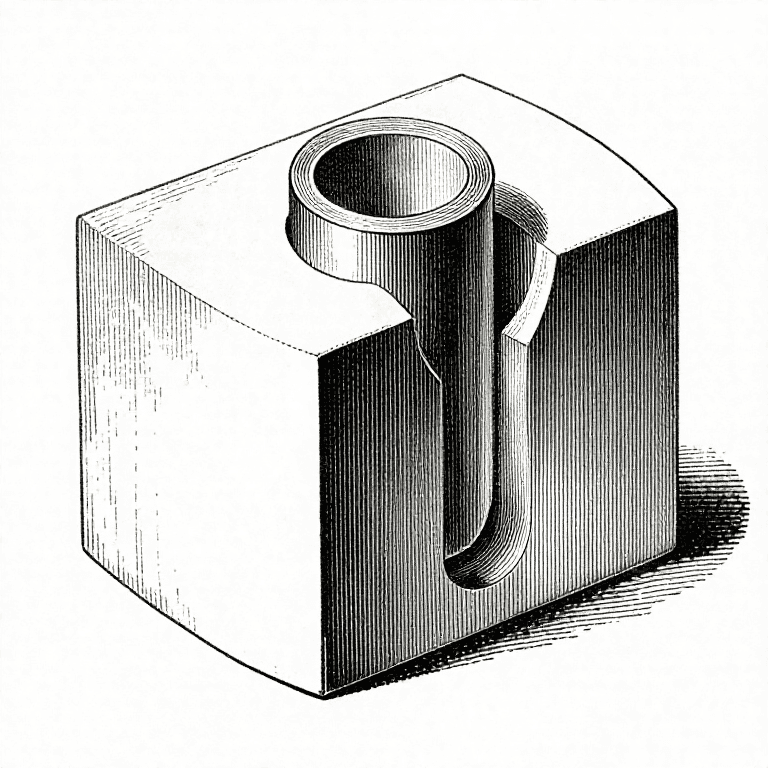
**A bore around the outside.** Same clearance argument, same direction: the outside grows too. A spring that just fits its bore when relaxed will bind when compressed.
**Either way the guide rubs.** A guided spring is a spring that is wearing, and the debris ends up in whatever is below it. That is acceptable in a slow mechanism and a poor idea in anything that cycles fast or must stay clean.
**Two shorter springs in series with a floating washer between them** is the third answer, and often the best one: each half is well within its own slenderness limit, the washer keeps them aligned, and nothing rubs. It costs one extra part and no length at all.
**Make the seats flat, square and big enough.** The end coil must bear on its whole ground face. A seat smaller than the coil diameter, or a seat with a raised edge, turns a flat end into a pivoted one and throws away the factor of 1.4 the notebook just measured.
Izinto zokwakha zalesi sinyathelo:
Iqoqo lezintambo zokucindezela1 ucezu Insimbi yokubumba1 ucezu
Amathuluzi adingekayo:
 I-Vernier Caliper
 I-Micrometer
4
4
Fixes, in order of what they cost
Fixes, in order of what they cost
**Make the seats flat.** Free, if you are still designing. A machined flat face square to the spring axis at both ends is the single highest-value change, worth a factor of 1.4 in slenderness over a pivoted end and nearly 4 over a free one.
**Use a bigger coil diameter.** Slenderness is length over coil diameter, so a fatter spring at the same length is a straighter spring. It is also a softer one at the same wire, so the wire must usually go up too. This is the standard fix when the space allows.
**Split it into two springs in series.** Halves the slenderness of each, keeps the total rate the same (two identical springs in series have half the rate of one, so each half must be twice as stiff as the target — which means shorter, which is exactly what is wanted). Needs a guide washer.
**Guide it.** A rod or a bore, with generous clearance. Cheapest to add to an existing design and the only one that introduces wear.
**Reduce the travel.** If the notebook says a spring buckles at 60% of its free length and the mechanism only uses 40%, there is no problem to fix — but the stop that guarantees the 40% must be a real one, not an assumption.
**Use a different spring.** A Belleville stack, a wave spring or a short stiff spring with more preload will often do the same job in a length where buckling never arises.
**What does not work:** a stiffer wire, a stronger material, or more coils. More coils makes it longer, which makes it worse.
Izinto zokwakha zalesi sinyathelo:
Iqoqo lezintambo zokucindezela1 ucezu Isethi Yezinsimbi Ezisontekile Zokucindezela1 ucezu
Amathuluzi adingekayo:
Ikhompyutha YasetafuleniIrulaIzinto
3- Isibambeli
- 1 ucezuIsibambeli
- Isibambeli
Amathuluzi Adingekayo
5- Isibambeli
- Isibambeli
- Isibambeli
- Isibambeli
Ama-blueprint ahlobene
Lama-blueprint abelana ngolwazi — amasu, izinto noma izimiso
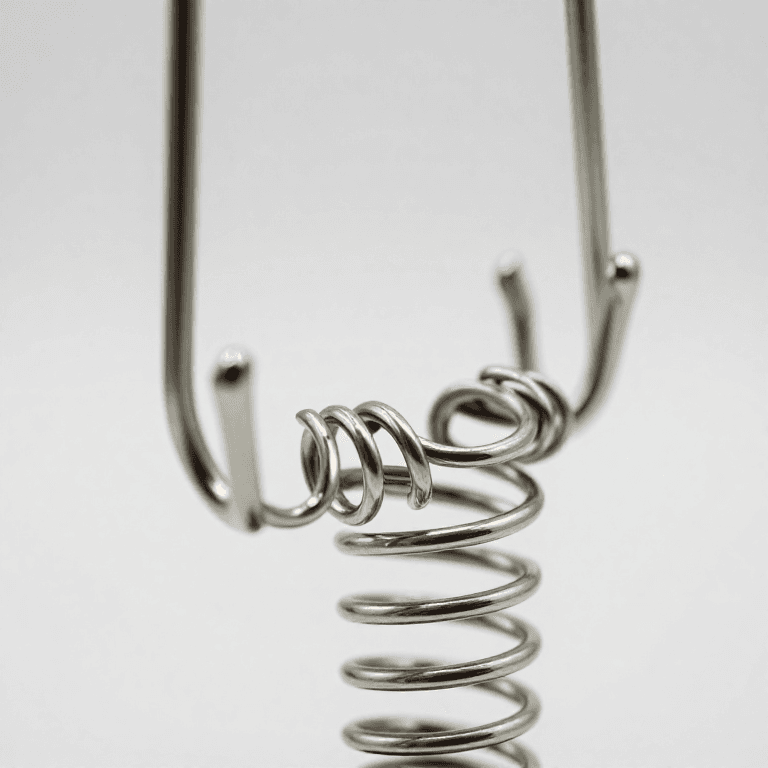


CC0 Isizinda Somphakathi
Le blueprint ikhishwe ngaphansi kwe-CC0. Ukhululekile ukukopisha, ukuguqula, ukusabalalisa, nokusebenzisa ngaphandle kwemvume.
Sekela uMenzi ngokuthenga imikhiqizo nge-Blueprint yabo IKhomishane Yomenzi kumiswe ngabathengisi, noma dala inguqulo entsha yale Blueprint bese uyifaka njengoxhumaniso ku-Blueprint yakho ukuze wabelane ngemali engenayo.