Ukusebenzisana
UBUCIKO
UBUHLE NEMPILO
UBUCIKO BEZANDLA
AMASIKO NOMLANDO
EZOKUZIJABULISA
IMVELO
UKUDLA NEZIPHUZO
REVERSE ENGINEERING
IZAYENSI
EZEMIDLALO
UBUCHWEPHESHE
IZINTO EZIGQOKWAYO
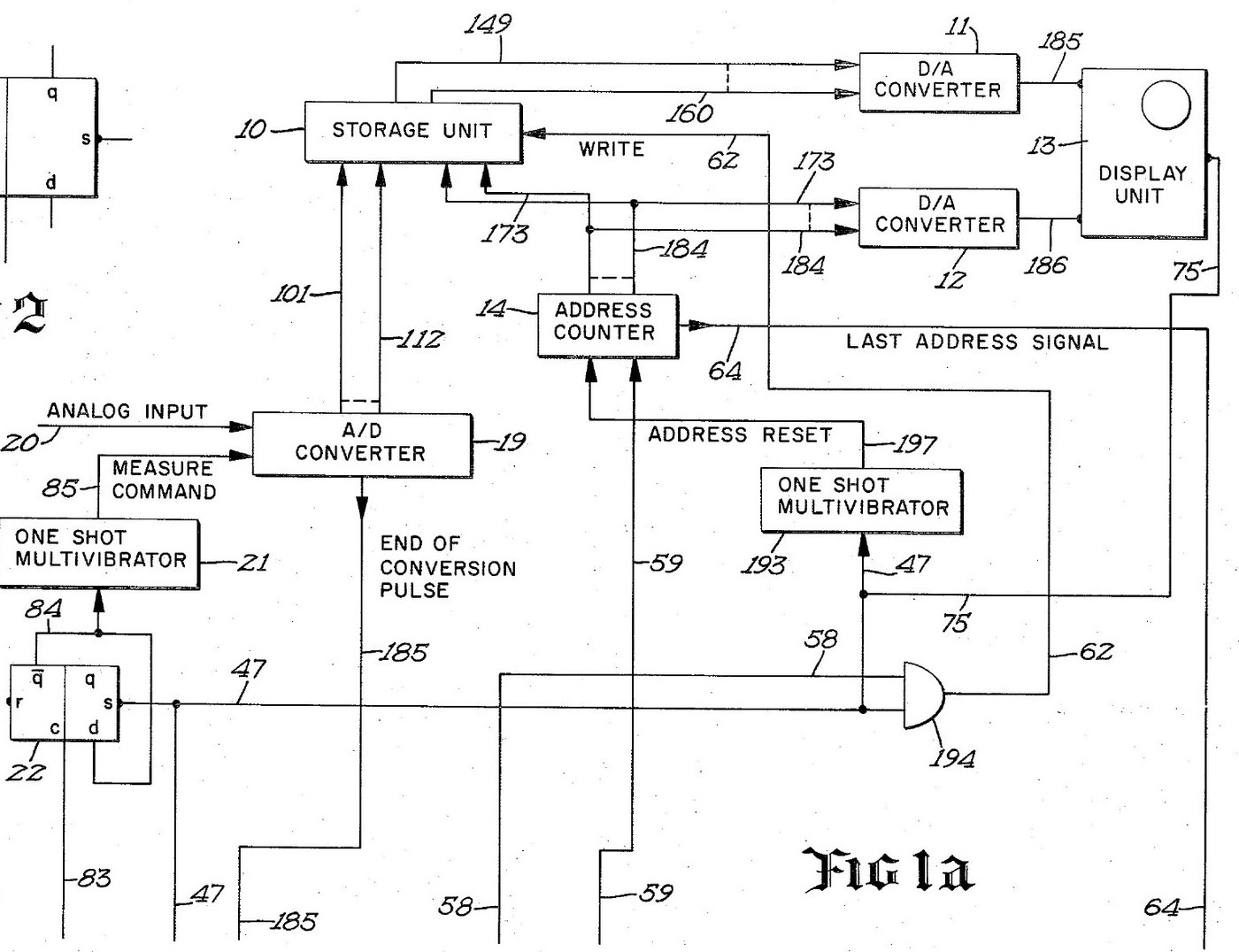


Digital Oscilloscope: Waveform Stored in Memory and Shown on a CRT (Schumann, Nicolet, US 3,816,815, 1974)
An oscilloscope with a memory. After a trigger, an analog-to-digital converter measures the input at regular intervals and writes each reading into its own memory register, replacing the old one. The screen then shows the memory: each register's number sets the beam's height, its address sets the beam's place across. The last waveform can be held on the screen as long as you like.
Result: a digital storage oscilloscope with 4,096 points of 12 bits, refresh and hold modes and single-shot capture.
Source: R. W. Schumann (Nicolet), US 3,816,815 (1974). Unknown: sample rate, bandwidth, voltages and the parts used. Picture: the patent drawing.
Ingcweti
Unknown
Imiyalelo
1
1
Sample and convert the input
Sample and convert the input
Bring the analog input to an analog-to-digital converter, through a BNC socket. A sampling oscillator, divided by four by two flip-flops so the first reading comes soon after the sweep starts, fires a one-shot multivibrator that gives the converter its measure command. The converter holds each 12-bit result on its output lines and signals the end of each conversion. Ours: a BNC socket. Not given: the sample rate.
Izinto zokwakha zalesi sinyathelo:
 Isiguquli Se-analogi Siye Kudijithali1 12-bit converter
 I-oscillator yewashi1 sampling oscillator
 Inhlanganisela yama-IC e-logic1 flip-flops, one-shots, gates
 Isethi yezixhumi ze-coaxial (BNC / SO-239)1 input socket
Amathuluzi adingekayo:
 Insimbi yokushisela
 Isihlubuli sikawaya
2
2
Store each reading in memory
Store each reading in memory
Wire an integrated-circuit memory of 4,096 registers, 12 bits each, that can be read without changing it. A 12-bit address counter picks the register. On each write command the register at the current address takes the last reading from the converter, and the counter steps on. When the sweep starts, a one-shot resets the counter to zero. When it reaches the last address, its last-address signal ends the sweep.
Izinto zokwakha zalesi sinyathelo:
 Inkumbulo yesekethe ehlanganisiwe1 4,096 x 12-bit store
Amathuluzi adingekayo:
Insimbi yokushiselaIsihlubuli sikawaya3
3
Drive the CRT from the memory
Drive the CRT from the memory
Feed the addressed register's number to one digital-to-analog converter and the address to a second. Their outputs drive the vertical and horizontal deflection plates of a cathode-ray tube, so the beam always stands at the height of the stored reading and at the place of its address. Wire the sweep line to the tube's intensifier, to brighten the trace while a waveform is being taken.
Izinto zokwakha zalesi sinyathelo:
 Isiguquli sedijithali siye ku-analog2 vertical and horizontal
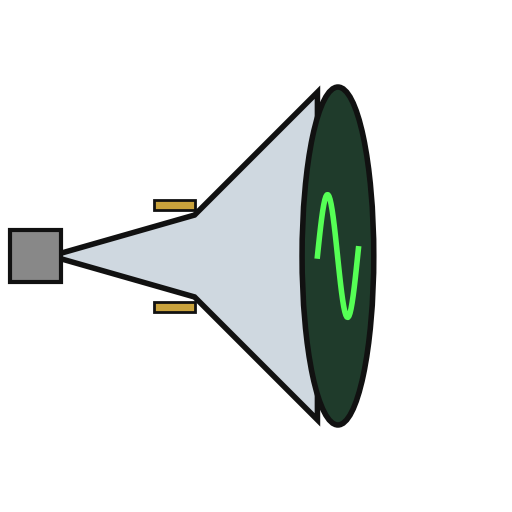 Ishubhu ye-cathode-ray1 display tube
Amathuluzi adingekayo:
Insimbi yokushiselaIsihlubuli sikawaya4
4
Wire the trigger and the modes
Wire the trigger and the modes
A trigger input, usually from the leading edge of the input waveform, starts the sweep, once a measure flip-flop has armed it. Put a two-position mode switch on the face: MODE I and MODE II. Add a push button in the probe, a switch on the panel and an external initiate input; each goes through a flip-flop that removes contact bounce. Two more oscillators step the memory round to refresh the display between waveforms. Mount it all in a case with its supply. Ours: toggle switches, an aluminium case, a DC supply. Not given: the supply voltages.
Izinto zokwakha zalesi sinyathelo:
I-oscillator yewashi2 display sequencing oscillators Isivula esinesikhonkwane2 mode and panel switches
 Inkinobho yokucindezela1 probe switch
 Ibhokisi le-aluminium1 case
Amathuluzi adingekayo:
 Umthombo kagesi we-DC
 Ibhola ElimileInsimbi yokushisela
5
5
Capture and hold a waveform
Capture and hold a waveform
In MODE I, refresh: each new triggered waveform replaces the last on the screen. Press the probe or panel switch to hold: new waveforms are rejected and the last one stays on the screen. In MODE II the screen normally holds; on command, it takes the first waveform after the command, stores it and shows it steadily. Test it with a known signal.
Amathuluzi adingekayo:
 Isenzi Semisebe
Izinto
10- 1 12-bit converterIsibambeli
- 2 display sequencing oscillatorsIsibambeli
- 1 flip-flops, one-shots, gatesIsibambeli
- 1 input socketIsibambeli
- 1 4,096 x 12-bit storeIsibambeli
- 2 vertical and horizontalIsibambeli
- 1 display tubeIsibambeli
- Isibambeli
- Isibambeli
- 1 caseIsibambeli
Amathuluzi Adingekayo
5- 2 vendors sell this, none ship to you yetIsibambeli
- Isibambeli
- Isibambeli
- Isibambeli
- Isibambeli
Le blueprint yenza

Ama-blueprint ahlobene
Lama-blueprint abelana ngolwazi — amasu, izinto noma izimiso
CC0 Isizinda Somphakathi
Le blueprint ikhishwe ngaphansi kwe-CC0. Ukhululekile ukukopisha, ukuguqula, ukusabalalisa, nokusebenzisa ngaphandle kwemvume.
Sekela uMenzi ngokuthenga imikhiqizo nge-Blueprint yabo IKhomishane Yomenzi kumiswe ngabathengisi, noma dala inguqulo entsha yale Blueprint bese uyifaka njengoxhumaniso ku-Blueprint yakho ukuze wabelane ngemali engenayo.