UBUCIKO
UBUHLE NEMPILO
UBUCIKO BEZANDLA
AMASIKO NOMLANDO
EZOKUZIJABULISA
IMVELO
UKUDLA NEZIPHUZO
REVERSE ENGINEERING
IZAYENSI
EZEMIDLALO
UBUCHWEPHESHE
IZINTO EZIGQOKWAYO
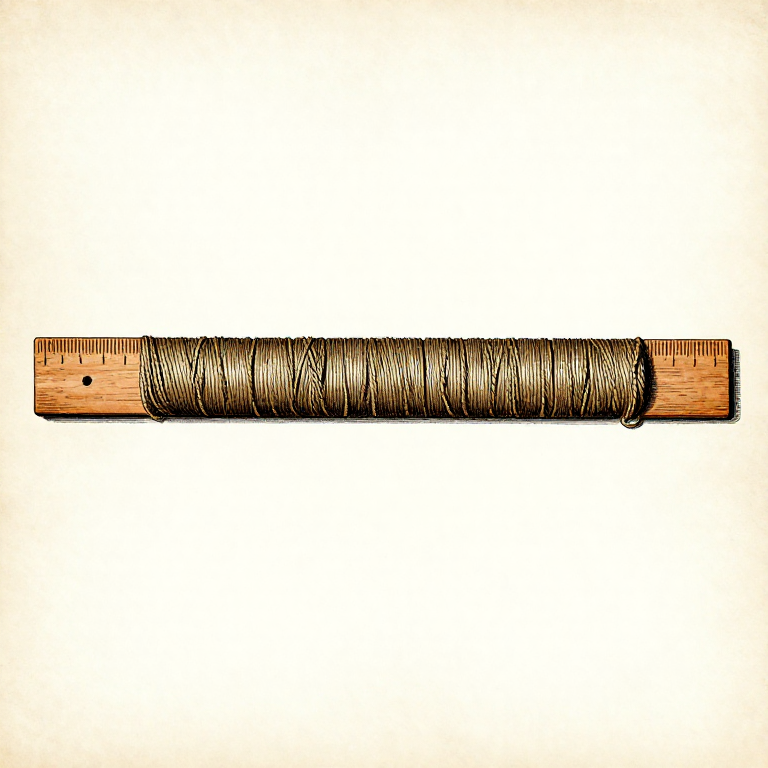


Grist: Measure a Yarn by Length per Weight, Not by Eye
A yarn's thickness cannot usefully be measured with a caliper, because it squashes and because it is never the same twice along its length.
So the trade measures **grist** — a length per unit weight. Metres per gram, yards per pound, or one of the count systems. It is easy to measure precisely, it does not depend on how hard anything is squeezed, and it is what every other number in a project is calculated from.
The field version is **wraps per inch**: wind the yarn round a ruler and count. It needs no scale, it takes ten seconds, and it is accurate enough to plan with.
Ophakathi
2 hours
Imiyalelo
1
1
Measuring grist properly
Measuring grist properly
**Wind a skein of known length**, using a niddy-noddy or a warping board or two chair backs a measured distance apart. Count the wraps and multiply. A niddy-noddy that gives a two-metre circuit makes this trivial.
**Wash and dry the skein before weighing it.** Two reasons, and both matter: yarn takes up moisture from the air, so an unwashed skein's weight depends on the weather; and washing sets the twist and lets the yarn relax to its finished length, which is what you will actually be using.
**Weigh it on a scale reading to a tenth of a gram**, and divide.
**Yarn shrinks in length when it is washed**, sometimes by ten per cent or more for a woollen yarn, because the crimp comes back. A skein measured before washing over-states the length you have.
**Record it with the fibre and the twist.** "Corriedale, worsted prep, 35 degrees, 11 m/g" is a yarn that can be made again. "DK weight" is not.
Izinto zokwakha zalesi sinyathelo:
 Intambo kavolo engadayiwe1 ucezu
Amathuluzi adingekayo:
 Isikali Esinembile
 Irula Lensimbi
 Ibhuku Lokubhala
2
2
The numbers, and how much a project needs
The numbers, and how much a project needs
Ilayisha incwadi ye-Jupyter…
Amathuluzi adingekayo:
 Ikhompyutha YasetafuleniIbhuku Lokubhala
3
3
The count systems, and why they run backwards
The count systems, and why they run backwards
Commercial yarn is sold by **count**, and the systems are a genuine historical mess worth being able to read.
**Indirect systems — a bigger number means a FINER yarn.** They ask "how many hanks of a fixed length make a pound?"
*Worsted count (NeW)*, hanks of 560 yards per pound. *Cotton count (Ne)*, hanks of 840 yards. *Woollen (YSW)*, 256 yards. *Linen lea*, 300 yards.
**Direct systems — a bigger number means a THICKER yarn.** They ask "what does a fixed length weigh?"
*Tex*, grams per 1000 metres. *Denier*, grams per 9000 metres. *Decitex*, grams per 10000 metres.
**Tex is the modern standard** and the only one that is not tied to a particular fibre's history. Tex = 1000 divided by metres per gram, which makes it trivial to convert.
**A plied yarn is written as two numbers** — 2/20 worsted is two singles of 20s plied together, which is thicker than a single 20s, not thinner. Which way round the numbers go varies by country, which is why a sample is worth more than a label.
Izinto zokwakha zalesi sinyathelo:
Intambo kavolo engadayiwe1 ucezu Intambo ye-linen1 ucezu
Amathuluzi adingekayo:
Isikali EsinembileIbhuku LokubhalaIkhompyutha Yasetafuleni4
4
Consistency, and the control card
Consistency, and the control card
Spinning a consistent yarn over many hours is harder than spinning a good one for a minute, and there is one technique that solves it.
**Make a control card.** Wind a short length of the yarn you want around a piece of card, and keep it attached to the wheel. Compare the yarn coming off the bobbin against it every few minutes. The eye drifts over an hour and the card does not.
**Keep a sample of the fibre too**, drafted to the width it should be. Most drift is in the drafting, not the twist.
**Fill bobbins to the same level** if the yarn is to be plied, or the plying runs out on one side.
**Spin the whole project's singles before plying any of it**, and ply from bobbins taken from across the whole run rather than in order. That averages the drift out instead of concentrating it at one end of the finished yarn.
**Where consistency truly cannot be achieved**, alternate. A garment knitted alternately from two skeins shows no join at all, and one knitted from skein after skein shows a band at every change. That is the standard answer to variable handspun, and it is worth planning for rather than discovering.
Izinto zokwakha zalesi sinyathelo:
Intambo kavolo engadayiwe2 izicucuAmathuluzi adingekayo:
Isikali EsinembileIrula LensimbiIbhuku LokubhalaIzinto
2- 4 izicucuIsibambeli
- 1 ucezuIsibambeli
Ama-blueprint ahlobene
Lama-blueprint abelana ngolwazi — amasu, izinto noma izimiso
CC0 Isizinda Somphakathi
Le blueprint ikhishwe ngaphansi kwe-CC0. Ukhululekile ukukopisha, ukuguqula, ukusabalalisa, nokusebenzisa ngaphandle kwemvume.
Sekela uMenzi ngokuthenga imikhiqizo nge-Blueprint yabo IKhomishane Yomenzi kumiswe ngabathengisi, noma dala inguqulo entsha yale Blueprint bese uyifaka njengoxhumaniso ku-Blueprint yakho ukuze wabelane ngemali engenayo.