

Liquefying Air
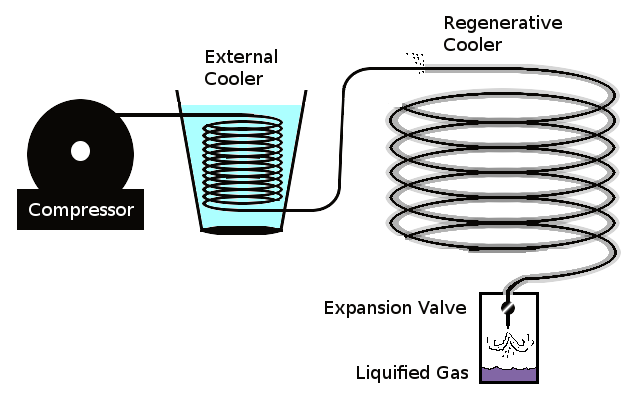
Every machine so far has cooled things by boiling a liquid. To liquefy air you need to reach about −195°C, and there is no liquid left that boils that cold to help you. You have to make the cold out of the gas itself.
Two ideas do it together, and neither works alone.
The first is the Joule-Thomson effect. Let a compressed gas expand through a small nozzle without doing any external work and, below a certain starting temperature, it comes out colder. The drop per pass is unimpressive — a few degrees.
The second is what makes those few degrees add up: regenerative cooling. The chilled gas, instead of being thrown away, is led back over the incoming pipe to pre-cool the gas that is about to expand. That gas then starts colder, so it expands colder still, and pre-cools the next. The machine bootstraps itself downward — a positive feedback loop deliberately built into a heat exchanger.
It takes twenty to twenty-five minutes of this before liquid begins to collect. Nothing about the apparatus is cold when you start it; the cold is manufactured entirely by the gas cooling itself, over and over.
William Hampson filed 23 May 1895; Carl von Linde filed 5 June 1895 — two weeks apart and entirely independently. The cycle carries both their names.
Imiyalelo
Feel a gas cool as it expands
Feel a gas cool as it expands
Hold a can of compressed air upright and discharge it for several seconds, then feel the can.
It is cold — often cold enough to condense frost on the outside.
Measure it with the infrared thermometer before and after.
Some of that is liquid propellant boiling, but the effect persists with a plain compressed-gas cylinder too. Expanding gas cools, and that is the raw material of everything below.
Amathuluzi adingekayo:
 Ithemomitha Ye-Infrared
Separate the two ways a gas can cool
Separate the two ways a gas can cool
Compare two expansions. Let air out of a pump against a piston you must hold back — it does work on your hand. Then let the same air escape freely through a nozzle into the room, doing no external work at all.
Both cool. They are not the same mechanism.
The first gives up energy as work. The second — Joule-Thomson — does no work on anything, and cools because the molecules must climb out of each other's attraction as they spread apart. That energy comes from their own motion, which is what temperature is.
Note why it matters: the second needs no engine at the cold end, only a hole. Nothing mechanical has to survive −195°C.
Build the feedback that makes it add up
Build the feedback that makes it add up
Make a counterflow heat exchanger: run a small tube inside a larger one, with cold water flowing back along the outside against warm water going in.
Measure the inlet and outlet of both streams.
Expect the incoming stream to be substantially pre-cooled before it even reaches the end.
Now apply that to step 2. Each expansion cools the gas a few degrees; the counterflow hands those degrees back to the incoming gas; the next expansion therefore starts lower. Regeneration turns a small one-off effect into an unbounded descent, and it is the entire reason this works.
Izinto zokwakha zalesi sinyathelo:
 Ishubhu lethusi2 m
 Ipayipi Le-silicone1 m
Amathuluzi adingekayo:
 Ithemomitha
Find the temperature below which it must start
Find the temperature below which it must start
Look up the inversion temperature for a few gases: air is around 600 K, hydrogen about 200 K, helium about 40 K.
Above its inversion temperature, a gas expanding through a nozzle gets warmer, not colder. The whole method reverses.
Air is comfortably below its inversion temperature at room temperature, so a Hampson-Linde machine can be started cold-blooded from ambient. Hydrogen cannot — it must first be pre-cooled with liquid air before Joule-Thomson will help at all.
That is why Dewar needed liquid air in hand before he could liquefy hydrogen in 1898, and why the cryogenic ladder has to be climbed one rung at a time.
Separate the air once you have it
Separate the air once you have it
Look up the boiling points: nitrogen −196°C, oxygen −183°C, argon in between.
They differ by thirteen degrees, which is enough.
Warm liquid air gently and the nitrogen boils off first, leaving the liquid progressively richer in oxygen. Run that as a continuous distillation in a tall column and you have pure oxygen down one pipe and pure nitrogen down another.
This is why liquefying air mattered commercially far more than making things cold: it is the only practical way to pull the atmosphere apart into industrial quantities of pure gas.
History & Context
History & Context
Two filings, two weeks apart, no collusion. William Hampson registered his preliminary patent on 23 May 1895; Carl von Linde filed on 5 June 1895. They worked independently and arrived at the same combination of Joule-Thomson expansion with regenerative counterflow cooling. The cycle is named for both, which is the fair outcome and a rarer one than it should be.
What each did with it. Linde exhibited his apparatus at the 1900 Paris World Fair and won the Grand Prix, then built it into an industrial gas empire that still bears his name. Hampson took the industrial route directly, installing his apparatus at the newly founded Brin's Oxygen Company — which became BOC. One man is remembered as an industrialist and the other barely remembered at all, on two weeks and a difference in temperament.
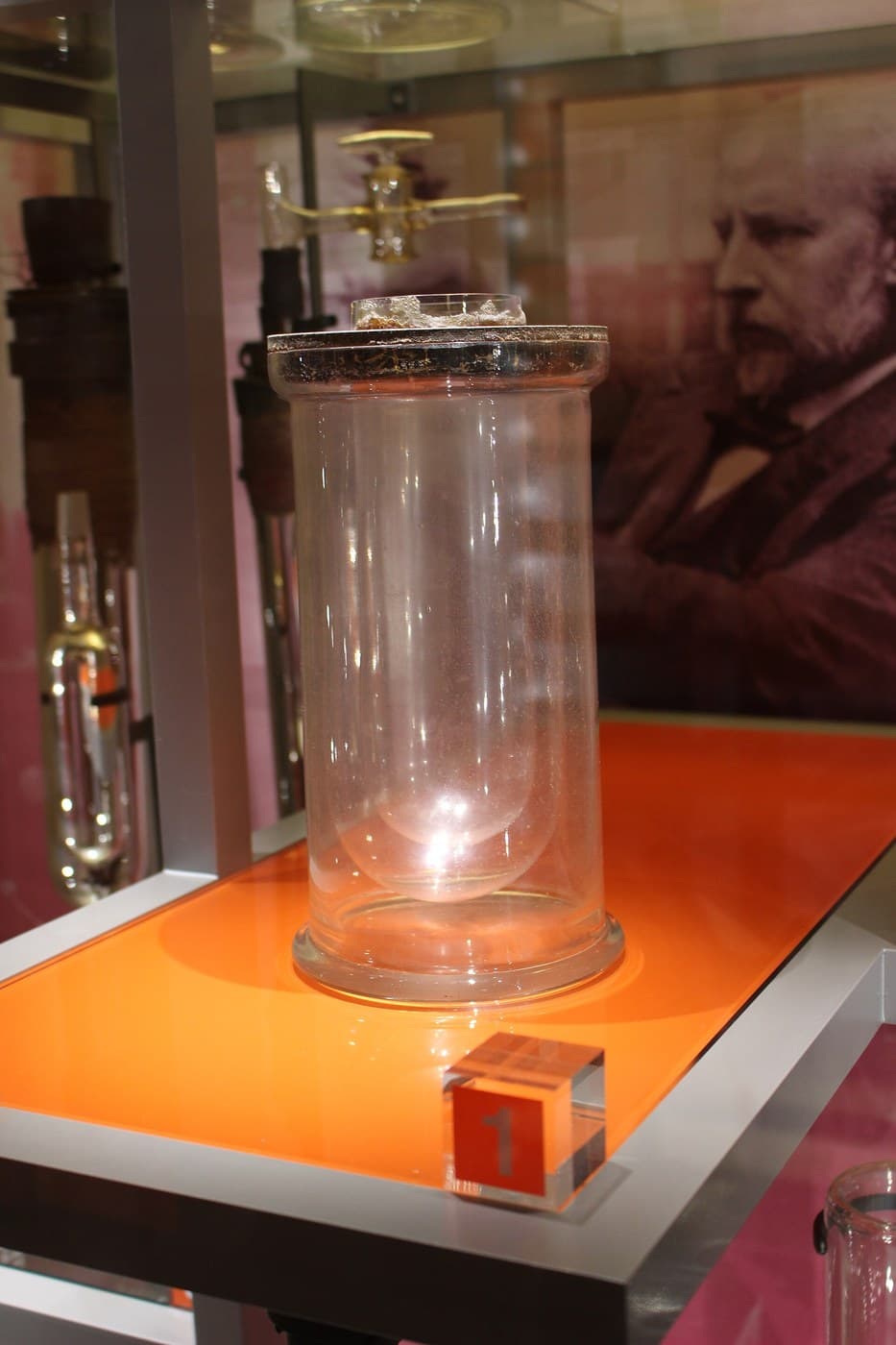
The cold ladder. Liquid air made the next rung reachable. Dewar liquefied hydrogen in 1898 using liquid air as a pre-coolant and his own vacuum flasks to hold the result — the two inventions in this batch depending directly on each other. Helium fell to Kamerlingh Onnes in 1908, and superconductivity was discovered three years later because there was finally somewhere cold enough to look.
What it actually built. Cheap pure oxygen made the basic oxygen steel process possible, which is how most of the world's steel is made. Liquid nitrogen underpins food freezing, semiconductor fabrication, MRI scanners, cryopreservation and biological sample storage. Liquid oxygen flies rockets. An industry founded on making things extremely cold turned out to be, mostly, an industry for separating the air — the refrigeration was the means.
Honest limits. It is energy-hungry: separating air costs real power, and no clever cycle avoids that, only reduces it. The plant must be scrupulously dry, since water and carbon dioxide freeze solid and block the passages long before the air liquefies. And liquid oxygen is a fierce oxidiser that will make grease and asphalt burn violently — the cryogenic hazards are as much chemical as thermal.
Izinto
2- Isibambeli
- Isibambeli
Amathuluzi Adingekayo
2- Isibambeli
- Isibambeli
Izinto Zokwakha Ze-Blueprint Exhunyiwe

Ama-blueprint ahlobene
Lama-blueprint abelana ngolwazi — amasu, izinto noma izimiso

CC0 Isizinda Somphakathi
Le blueprint ikhishwe ngaphansi kwe-CC0. Ukhululekile ukukopisha, ukuguqula, ukusabalalisa, nokusebenzisa ngaphandle kwemvume.
Sekela uMenzi ngokuthenga imikhiqizo nge-Blueprint yabo IKhomishane Yomenzi kumiswe ngabathengisi, noma dala inguqulo entsha yale Blueprint bese uyifaka njengoxhumaniso ku-Blueprint yakho ukuze wabelane ngemali engenayo.