UBUCIKO
UBUHLE NEMPILO
UBUCIKO BEZANDLA
AMASIKO NOMLANDO
EZOKUZIJABULISA
IMVELO
UKUDLA NEZIPHUZO
REVERSE ENGINEERING
IZAYENSI
EZEMIDLALO
UBUCHWEPHESHE
IZINTO EZIGQOKWAYO
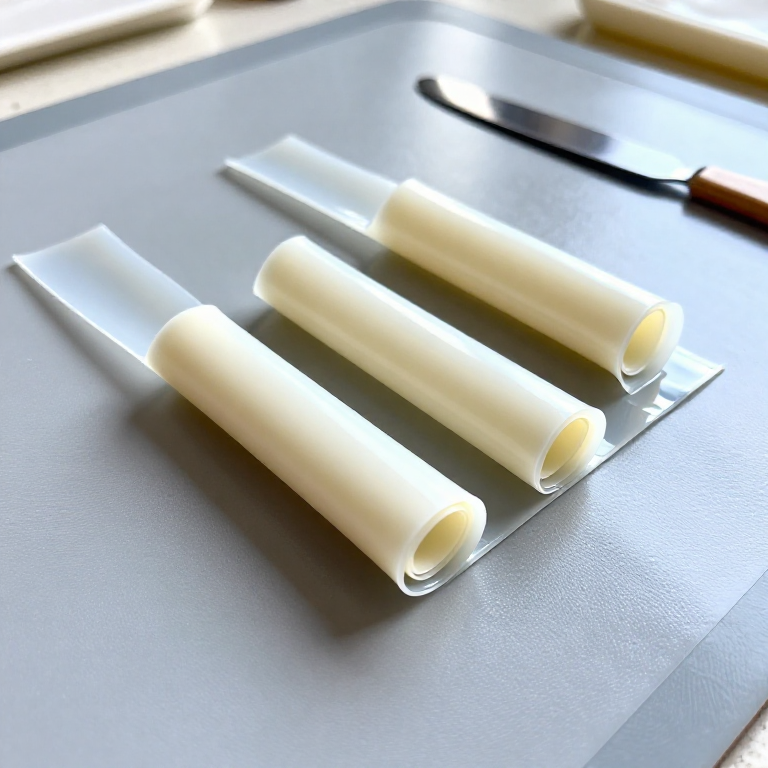


Plasticised PVC (Plastisol)
PVC was known for decades as a hard, brittle powder nobody could use. In 1926 Waldo Semon at B.F. Goodrich found that certain liquids dissolve it only when hot, and that the hot solution sets on cooling into a soft, rubber-like gel - flexible PVC.
**US 1,929,453**, "Synthetic rubber-like composition and method of making same", Semon, assigned to B.F. Goodrich, granted 10. October 1933, claims dissolving "an insoluble polymerized vinyl halide at an elevated temperature" in a liquid that dissolves it only well above room temperature, and gelling it by cooling. One example: 8 parts PVC, 8 parts tricresyl phosphate, 3 parts dibutyl phthalate.
**Plastisol is that idea in a bottle**: PVC grains suspended, undissolved, in plasticiser. Heat makes the liquid dissolve the grains and fuse into solid flexible PVC. You bake test films at three temperatures and pull them apart to find where it truly fuses.
Oqalayo
2 hours
Imiyalelo
1
1
Ventilate and set the oven
Ventilate and set the oven
Use a toaster oven kept for crafts, never food, by an open window. Put the probe thermometer inside - dial settings are rarely accurate.
Amathuluzi adingekayo:
 Uhhavini wetafula
 Ithemomitha enenaliti eshiywa ngaphakathi
 Imaski yokuphefumula N95
2
2
Stir the plastisol
Stir the plastisol
The PVC grains settle. Stir the plastisol from the bottom for 2 minutes until even. Read the label's fusion temperature.
Amathuluzi adingekayo:
 Induku Yokugovuza
 I-plastisol
3
3
Spread three films
Spread three films
On the silicone mat, spread three 100 x 40 mm films about 1.5 mm thick with the palette knife.
Amathuluzi adingekayo:
 Umata we-silicone wokubhaka
 Isethi yemimese yepaleti
 IrulaI-plastisol
4
4
Bake at three temperatures
Bake at three temperatures
Bake one film 10 minutes each at 130 °C, 150 °C and the label's fusion temperature (commonly 160–180 °C). Never exceed the label maximum.
Amathuluzi adingekayo:
Uhhavini wetafula Ithemomitha Ye-Infrared
 Amagilavu okushisela
5
5
Cool and cut strips
Cool and cut strips
Cool 10 minutes. Peel each film and cut a 10 mm strip from its centre. Mark its temperature.
Amathuluzi adingekayo:
 Ummese wemisebenziIrula
6
6
Stretch and pull
Stretch and pull
Clamp one end in the vise. Hook the spring scale to the other and pull slowly. Record the peak force and how it failed.
Amathuluzi adingekayo:
 Isilinganiso Samandla (Isikali Sensimbi Esontekile)
 Isibambo Sebhentshi
 Izibuko Zokuphepha Ezicwathile
7
7
Recipe, cure curve, siblings
Recipe, cure curve, siblings
Ilayisha incwadi ye-Jupyter…
8
8
History & Context
History & Context
**What the patent specifies:** gelling PVC in high-boiling liquids such as tricresyl phosphate and dibutyl phthalate. **Modern build (derived):** a commercial plastisol; many now use phthalate-free plasticisers.
Flexible PVC became cable insulation, shower curtains, hoses and flooring. Its limits: the plasticiser slowly migrates out, so old soft PVC stiffens and turns sticky; and overheated PVC yellows and releases hydrogen chloride, which is why the label's maximum temperature matters.
Amathuluzi Adingekayo
14- Isibambeli
- Isibambeli
- Isibambeli
- Isibambeli
- Isibambeli
- Isibambeli
- Isibambeli
- Isibambeli
- Isibambeli
- Isibambeli
- Isibambeli
- Isibambeli
Ama-blueprint ahlobene
Lama-blueprint abelana ngolwazi — amasu, izinto noma izimiso

CC0 Isizinda Somphakathi
Le blueprint ikhishwe ngaphansi kwe-CC0. Ukhululekile ukukopisha, ukuguqula, ukusabalalisa, nokusebenzisa ngaphandle kwemvume.
Sekela uMenzi ngokuthenga imikhiqizo nge-Blueprint yabo IKhomishane Yomenzi kumiswe ngabathengisi, noma dala inguqulo entsha yale Blueprint bese uyifaka njengoxhumaniso ku-Blueprint yakho ukuze wabelane ngemali engenayo.