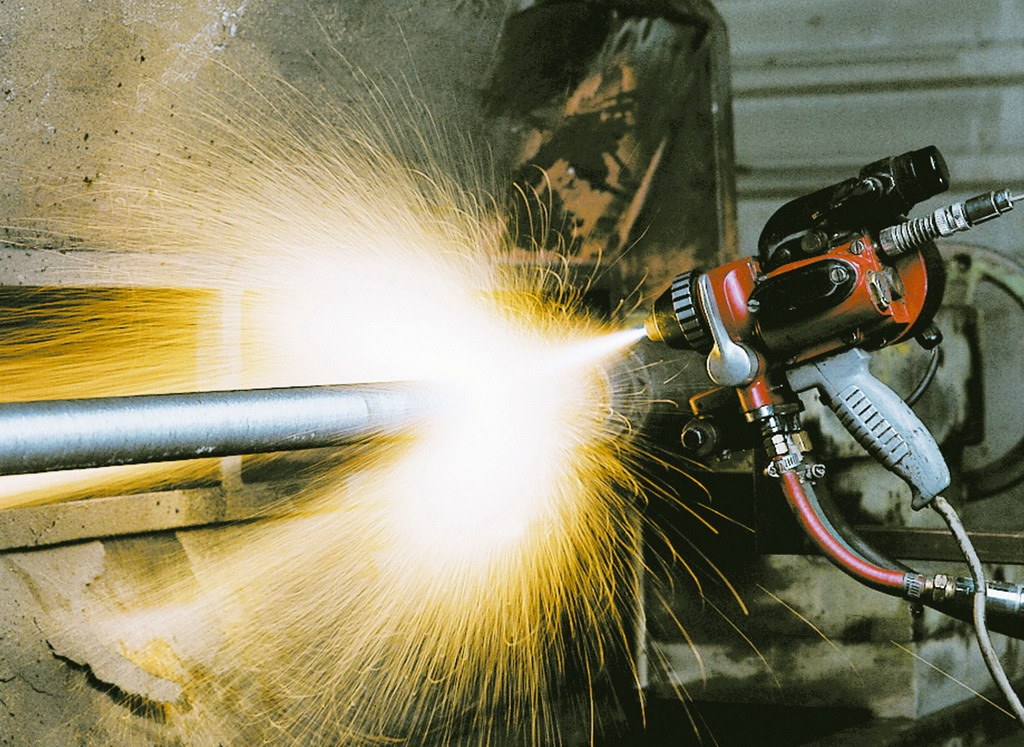


Metal Spraying
Every coating process before this one had a size limit. Electroplating needs a tank the part fits in. Galvanizing needs a kettle of molten zinc the part fits in. Sherardizing needs a drum the part fits in. A bridge, a ship's hull or a finished steel tank fits in none of them.
Metal spraying removed the vessel. Melt the metal, atomise it into a stream of gas under pressure, and throw the droplets at the work. Each droplet flattens on impact and freezes almost instantly, keying into the roughness of the surface and onto the droplets already there. The coating builds up from splats. There is no bath, so there is no size limit — you take the process to the structure instead of the structure to the process.
It also stays cold. The metal is molten in flight but the droplets are tiny and give up their heat on landing, so the workpiece barely warms. You can spray zinc onto a finished, hardened, painted-adjacent assembly without annealing it.
Max Ulrich Schoop, a Swiss engineer, patented it. The British specification is GB 191005712, "Improvements in or connected with the Coating of Surfaces with Metal, applicable also for Soldering or Uniting Metals and other Materials", filed 7 March 1910 and published 26 January 1911 — describing molten metal applied "in the form of spray mixed with steam or hot gas under pressure". The wire-fed spray pistol most people picture came later.
Imiyalelo
Ventilate and mask up before anything is melted
Ventilate and mask up before anything is melted
Work outdoors or under forced extraction. Wear a half-face respirator with P2/P3 particulate filters and a face shield.
Molten zinc gives off zinc oxide fume. Breathing it causes metal fume fever — fever, chills and aching some hours after exposure. It passes in a day or two and it is entirely avoidable. A dust mask is not a respirator and will not stop fume.
Amathuluzi adingekayo:
 Isivikelo sokuphefumula sengxenye yobuso
 Isivikelo Sobuso
Roughen the surface — this is not optional
Roughen the surface — this is not optional
Grit-blast the steel plate with aluminium oxide abrasive to a uniformly matt, angular profile. Spray within 4 hours, before the fresh surface re-oxidises.
A sprayed coating is held on mechanically — the droplets key into the surface texture. There is no alloying and no diffusion bond, so on a smooth surface it simply peels off in sheets. Surface preparation is the process.
Izinto zokwakha zalesi sinyathelo:
 Ibha Eyisicaba Yensimbi Ethambile1 ucezu
Amathuluzi adingekayo:
 I-compressor yomoya
 Uhlalu lokugudla lwe-aluminium oxide
Melt the zinc
Melt the zinc
Melt 200 g zinc dust in the iron crucible. Zinc melts at 419 °C; hold it at roughly 450–480 °C — hot enough to stay fluid, not so hot that it burns off.
Skim the grey dross off the surface before spraying. Dross in the stream blocks the nozzle.
Izinto zokwakha zalesi sinyathelo:
 Isigaxa Sikazinki200 g
Amathuluzi adingekayo:
 Ibhodwe lokuncibilikisa lensimbi
 Isithando Samalahle
 Udlawu Lwesitsha Sokuncibilikisa
Atomise the melt into the gas stream
Atomise the melt into the gas stream
Feed the melt into a stream of compressed gas at 4–6 bar, directed at the plate from 150–200 mm.
The gas does two jobs at once: it tears the liquid into droplets, and it carries them to the work. Schoop's specification is explicit that the spray is "mixed with steam or hot gas under pressure" — steam was his own first carrier.
Hold the stream perpendicular to the surface. Spraying at a shallow angle lands the droplets sideways, and they build a porous, weakly-keyed layer.
Build the coating in passes
Build the coating in passes
Sweep steadily across the plate, overlapping each pass by half its width. Build up in several thin passes, not one slow heavy one.
Target 100–150 µm total for atmospheric corrosion protection.
Feel the back of the plate between passes: it should stay merely warm. That is the point of the process — the metal is molten in flight, but each droplet is small enough to dump its heat on landing, so the workpiece is never heat-treated by the coating.
Inspect the structure you just built
Inspect the structure you just built
Look at the surface: matt, grey and granular — visibly rougher than galvanizing or sherardizing.
Cross-section a test piece if you can. A sprayed coating is a stack of flattened droplets with oxide skins between them and some porosity, not the solid continuous metal a dipped or diffused layer gives.
That porosity is why sprayed zinc is usually sealed with a thin paint or wax afterwards, and why the same structure is an advantage elsewhere — porous sprayed coatings hold lubricant, which is why the technique is now used to rebuild worn bearing journals.
History & Context
History & Context
The date almost everyone gets wrong. Nearly every account says Schoop "patented metal spraying in 1909". The British specification, GB 191005712, was filed 7 March 1910 and published 26 January 1911. The 1909 date belongs to his earlier German and Swiss filings, which are separate documents with separate numbers. Both statements can be true at once, but citing "GB, 1909" is wrong.
The origin story is probably tidier than the truth. Schoop is said to have got the idea watching his son fire a toy cannon at a wall and noticing the lead shot flattened and stuck. It is repeated everywhere and it traces back to Schoop's own later telling. Treat it as an anecdote, not a documented event.
What came after. The 1910 process sprays from a melt. Schoop's next development fed wire into a flame and atomised it as it melted — that is the pistol in every photograph, and it is what made the process portable. Arc spray, plasma spray and HVOF all descend from the same idea: melt it, throw it, let it splat.
Why it survived. Not because it protects better than galvanizing — it does not, on a small part. It survived because it has no size limit and needs no heat in the workpiece. Bridges, lock gates, ship hulls and steel-framed buildings get sprayed zinc or aluminium in place. And rebuilding worn shafts by spraying metal back on is now a larger industry than the corrosion work Schoop was aiming at.
About the photograph on this blueprint. It shows a wire-fed spray pistol — the later development described above, not the 1910 molten-bath apparatus this blueprint follows. It is the clearest authentic photograph of metal spraying available under an open licence, and the physics it shows is identical: melt, atomise, splat. The feedstock is what differs. Said plainly here so the picture cannot imply what the text denies.
Honest limitation. Adhesion is purely mechanical. A sprayed coating on inadequately prepared steel will pass inspection and fail in service, which is why blast standards for spray work are unusually strict.
Izinto
2- Isibambeli
- 200 gIsibambeli
Amathuluzi Adingekayo
7- Isibambeli
- Isibambeli
- 1 vendor sell this, none ship to you yetIsibambeli
- Isibambeli
- Isibambeli
- Isibambeli
- Isibambeli
Izinto Zokwakha Ze-Blueprint Exhunyiwe


Le blueprint yenza
Ama-blueprint ahlobene
Lama-blueprint abelana ngolwazi — amasu, izinto noma izimiso


CC0 Isizinda Somphakathi
Le blueprint ikhishwe ngaphansi kwe-CC0. Ukhululekile ukukopisha, ukuguqula, ukusabalalisa, nokusebenzisa ngaphandle kwemvume.
Sekela uMenzi ngokuthenga imikhiqizo nge-Blueprint yabo IKhomishane Yomenzi kumiswe ngabathengisi, noma dala inguqulo entsha yale Blueprint bese uyifaka njengoxhumaniso ku-Blueprint yakho ukuze wabelane ngemali engenayo.