Ukusebenzisana
UBUCIKO
UBUHLE NEMPILO
UBUCIKO BEZANDLA
AMASIKO NOMLANDO
EZOKUZIJABULISA
IMVELO
UKUDLA NEZIPHUZO
REVERSE ENGINEERING
IZAYENSI
EZEMIDLALO
UBUCHWEPHESHE
IZINTO EZIGQOKWAYO
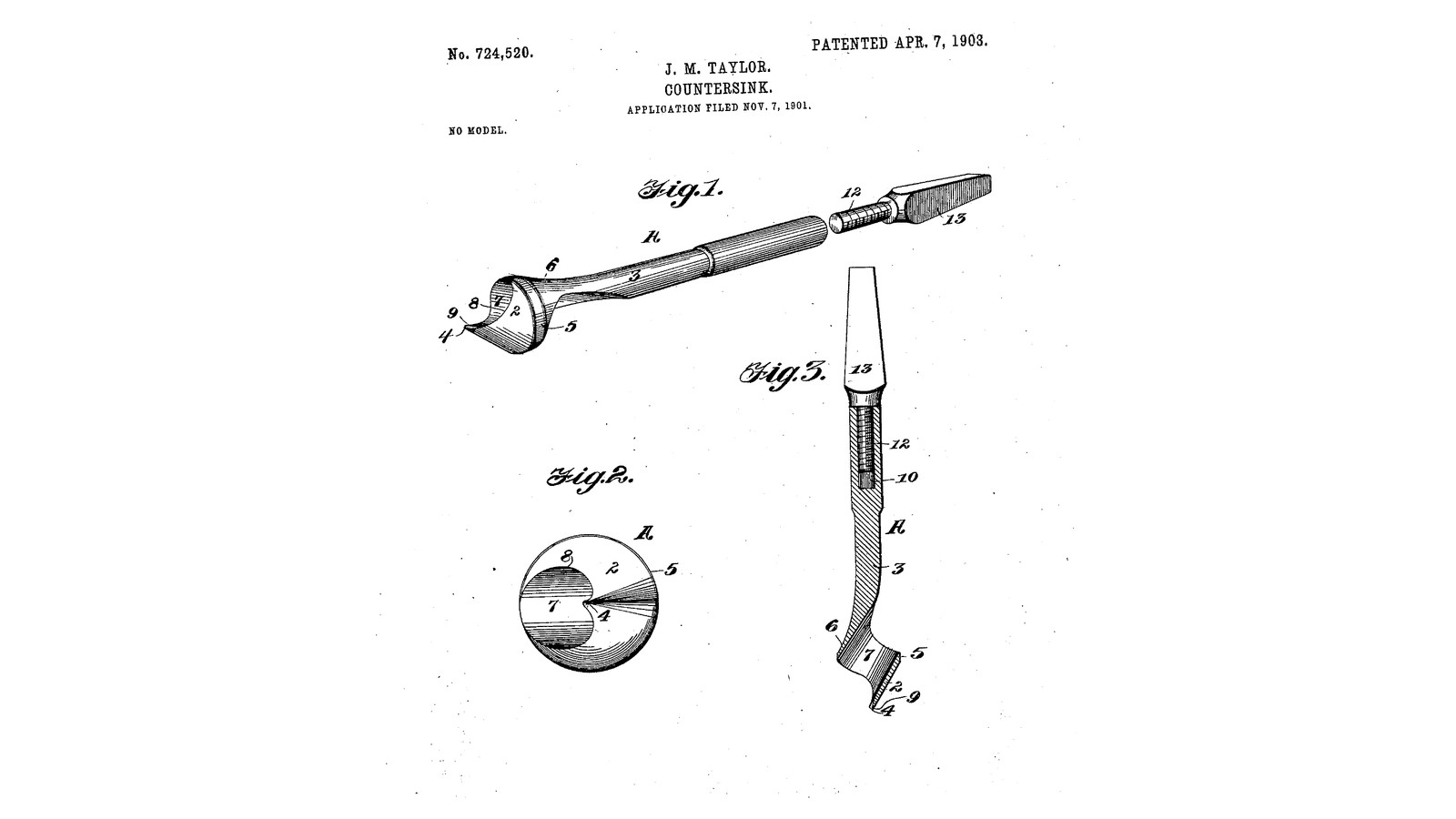


Cross-Hole Countersinks: A Slanting Hole Through the Cone Makes One Spiral Shearing Lip (Taylor, 1903)
John M. Taylor of Hartford, Connecticut, received US 724,520, dated 7 April 1903, for a countersink that shears wood smoothly. Its conical head has a hole drilled through it at a slant that crosses the axis and reaches the point. One edge of that hole is the cutting lip, a spiral curve from the point out to the rim, and the chips go straight out through the hole to the back. A short band behind the cone guides it.
We turn a set of three from tool steel and harden them. The patent gives no sizes; every size here is ours.
Ophakathi
About 1 day
Imiyalelo
1
1
Where the slanting hole must go
Where the slanting hole must go
Ilayisha incwadi ye-Jupyter…
2
2
Read US 724,520
Read US 724,520
"One of the outer edges of the wall of the opening forms a cutting-lip 8, which is of spiral formation, whereby it is effective to make a shear cut, and terminates in a shoulder 9, forming an entering or cutting point 4 at the apex of the conical head 2."
3
3
Turn the blanks
Turn the blanks
From octagonal tool steel big enough for each head, turn three blanks: a 90 degree cone 2 to a sharp point, 12, 16 and 20 mm across at its base; a band 5 2 mm long at that diameter as the guide; a truncated cone 6 down to an 8 mm shank 50 mm long. File three flats on each shank's end for the chuck. Heat each to a cherry red and let it cool slowly in the air, to soften it for drilling.
Izinto zokwakha zalesi sinyathelo:
 Induku enezinhlangothi eziyisishiyagalombili yensimbi yamathuluzi2 izicucu
Amathuluzi adingekayo:
 Umshini Wokuphendula Insimbi
 Isibambi somshini wokuphenda esinemilomo emithathu
 Ithuluzi lokusika le-lathe
 Insimbi yokuhlukanisa emshinini wokuphotha
 Iphrothrakta
 I-Caliper Yedijithali Yamayintshi Ayi-6
 Iqoqo Lamafayela
 Iziko Lokukhanda
 Udlawu Lomkhandi
 Izibuko zokuphepha
4
4
Drill the slanting opening 7
Drill the slanting opening 7
Hold a blank in the machine vice tilted so the drill meets the cone's side at 35 degrees to the tool's axis, aimed to cross the axis just behind the point (the notebook gives how far). Drill through with a drill 0.45 of the head across: 5.5, 7 and 9 mm, so the hole breaks out through the point on one side and out of the back cone on the other. Open the back of the hole a little larger, so it tapers towards the shank.
Amathuluzi adingekayo:
 Ibhola Elimile
 Isibambo SomshiniIphrothrakta
 Iqoqo Lamakhanda EbholaI-Caliper Yedijithali Yamayintshi Ayi-6
5
5
File the lip 8
File the lip 8
With a round needle file, clean the hole's edge on the side that leads as the countersink turns, leaving it sharp from the point to the band: that is the spiral cutting lip. File a little relief on the cone just behind it, and leave the shoulder 9 at the point.
Amathuluzi adingekayo:
 Isethi Yamafayela AmancaneIsibambo Somshini
 Umshini wokugaya wetafula
6
6
Harden and temper
Harden and temper
Heat each head to a cherry red, until a magnet no longer sticks, and quench it point first in water, moving it about. Rub it bright with a stone, heat the shank gently 20 mm behind the head, and quench again as soon as a light straw colour reaches the cutting lip.
Amathuluzi adingekayo:
Iziko LokukhandaUdlawu Lomkhandi Uzibuthe Omncane
 Ibhakede lokupholisa
 Amanzi
 Itshe Lokulola
 Amagilavu okushiselaIzibuko zokuphepha
7
7
Hone and test
Hone and test
Hone the lip lightly with the stone. Drill a few screw holes in hardwood and countersink them in the drill: the cone should cut a smooth bell without chatter and the chips should come out of the hole at the back.
Amathuluzi adingekayo:
Itshe Lokulola Ibhola ElingenantamboIqoqo Lamakhanda Ebhola
 Ipulangwe Lokhuni OluqinileIzibuko zokuphepha
8
8
Troubleshooting
Troubleshooting
Countersink troubleshooting.
Flow
Loading...
9
9
History and honest limits
History and honest limits
**John M. Taylor** of Hartford, Connecticut, US 724,520, dated 7 April 1903, filed 7 November 1901. He claimed "a countersink having a cone-shaped head provided with an opening crossing diagonally to the axis within the length of the tool and intersecting the apex of the cone, said opening having a curved edge forming a cutting-lip", and a two-part shank for brace or chuck. We make one-piece shanks for a chuck. He gives no sizes, angle or steel; our 90 degree cones, sizes and the house hardening are ours.
Izinto
1- Isibambeli
Amathuluzi Adingekayo
22- Isibambeli
- Isibambeli
- Isibambeli
- Isibambeli
- Isibambeli
- Isibambeli
- Isibambeli
- Isibambeli
- Isibambeli
- Isibambeli
- Isibambeli
- Isibambeli
- Isibambeli
- Isibambeli
- Isibambeli
- Isibambeli
- Isibambeli
- Isibambeli
- 1 vendor sell this, none ship to you yetIsibambeli
- Isibambeli
Le blueprint yenza

Ama-blueprint ahlobene
Lama-blueprint abelana ngolwazi — amasu, izinto noma izimiso
CC0 Isizinda Somphakathi
Le blueprint ikhishwe ngaphansi kwe-CC0. Ukhululekile ukukopisha, ukuguqula, ukusabalalisa, nokusebenzisa ngaphandle kwemvume.
Sekela uMenzi ngokuthenga imikhiqizo nge-Blueprint yabo IKhomishane Yomenzi kumiswe ngabathengisi, noma dala inguqulo entsha yale Blueprint bese uyifaka njengoxhumaniso ku-Blueprint yakho ukuze wabelane ngemali engenayo.