UBUCIKO
UBUHLE NEMPILO
UBUCIKO BEZANDLA
AMASIKO NOMLANDO
EZOKUZIJABULISA
IMVELO
UKUDLA NEZIPHUZO
REVERSE ENGINEERING
IZAYENSI
EZEMIDLALO
UBUCHWEPHESHE
IZINTO EZIGQOKWAYO

The Centrifugal Pump: Speed Squared, and Why It Cannot Lift Air
Every pump in the catalogue so far moves a fluid by trapping a pocket of it and pushing the pocket along — a piston, a gear tooth, a screw flight. The centrifugal pump traps nothing. It spins the liquid and lets the rim throw it outward into a spiral casing that turns speed into pressure.
That makes it the pump of choice for water supply, heating circuits, cooling systems and most process plants: no valves, no rubbing seals on a piston, steady flow, and a single moving part.
It also gives it two habits a maker has to understand before building one. The head it produces goes with the square of its speed. And it cannot pump air, so it will not pick up its own suction — which is why the foot valve on the suction pipe and the ten-metre ceiling on how high it can sit above the water are part of the machine.
Ophakathi
About 5 hours
Imiyalelo
1
1
Know the three kinds of impeller before you print one
Know the three kinds of impeller before you print one
Look at a real impeller in your hand before drawing your own. There are three kinds:
- **Closed** — vanes sandwiched between two discs (shrouds). Most efficient, clogs on fibre and grit.
- **Semi-open** — one shroud behind the vanes, open at the front. Tolerates some solids; the running clearance to the casing matters.
- **Open** — bare vanes on a hub. Least efficient, least prone to clog, easiest to print.
Now look at how the vanes curve. On almost every pump they curve **backward** — away from the direction of rotation. A straight radial vane gives more head on paper but the head rises and falls unstably with flow; backward curving trades a little head for a curve that falls steadily as flow rises, which is what lets two pumps share a pipe and one pump settle at one flow.
Measure the outer diameter, the vane height at the tip and the eye diameter. Those three numbers are the design.
Amathuluzi adingekayo:
 I-Caliper Yedijithali Yamayintshi Ayi-6
 Irula
Irula Isondo lamaphiko lephampu
2
2
Print the impeller and a volute, and seal the shaft
Print the impeller and a volute, and seal the shaft
Print a **semi-open** impeller of 60 mm tip diameter with six backward-curved vanes, 10 mm tall at the eye tapering to 6 mm at the tip, on a boss that takes a steel shaft. Print the casing as a **volute**: a spiral whose gap to the impeller grows steadily round the circumference to the outlet, so the flow collected at each point has room to join what is already there without speeding up. The outlet leaves tangentially; the inlet enters on the axis, into the eye.
Use PETG — it takes water indefinitely and does not creep like PLA when warm. Print a clear acrylic front cover instead of a printed one if you can: seeing the flow is half of this blueprint.
Where the shaft leaves the casing, fit two O-rings in a printed gland and grease them. It will weep a little; a pump shaft seal is its own subject (see the face-seal and packing blueprints). Leave 0.5 mm between the vane tips and the front cover — tighter rubs, looser leaks flow back round the vanes.
Izinto zokwakha zalesi sinyathelo:
 Ifilamenti ye-PETG150 g
 Ipuleti Le-akhriliki1 ishidi
 Insimbi eluhlaza eyindukwana1 ucezu
 Isethi Yezindandatho Ze-O1 ikhithi
 Izikulufu zomshini8 izicucu
 Isivalo Se-silicone1 ucezu
Amathuluzi adingekayo:
 Iphrinta ye-3D yentambo (i-FDM)I-Caliper Yedijithali Yamayintshi Ayi-6
 Ibhola Elingenantambo
 Iqoqo Lamakhanda Ebhola
 Isethi yezikhiye ze-hex
 Iqoqo lamaphepha okuhlikihla
3
3
Prime it, then measure the shut-off head against speed
Prime it, then measure the shut-off head against speed
Put the pump below the surface of a bucket of water, or fill the casing and suction hose by hand with a check valve at the bottom of the hose as a foot valve. Try it once dry first: the impeller will spin and nothing will come up. The notebook in step 5 shows why.
Run a length of clear vinyl tube from the outlet straight up a wall and tape a tape measure beside it. Chuck the shaft in the cordless drill, hold the drill on its trigger at a steady speed and read the speed with the tachometer off a strip of reflective tape on the shaft.
The water climbs the tube and stops: nothing flows, and the height is the **shut-off head**. Record it at four or five speeds. Plot head against speed squared. It should be a straight line, and it should sit at or a little above the solid-body figure of u²/2g — the volute wins back some of the tip's speed — and well below the Euler figure of u²/g.
Wear safety glasses — a printed impeller that lets go at 3000 rpm throws its pieces.
Izinto zokwakha zalesi sinyathelo:
 Amanzi10 amalitha
 Ishubhu le-vinyl eliqhakazile3 amamitha
 Ivalvu engabuyisi emuva1 ucezu
 Inhlanganisela yezibambi zempompi1 isethi
Amathuluzi adingekayo:
Ibhola Elingenantambo Isilinganiso Sokuzungeza Sedijithali
 Ithephu Lokulinganisa
 Ibhakede
 Izibuko Zokuphepha Ezicwathile
4
4
The foot valve is a check valve — this is how it works
The foot valve is a check valve — this is how it works
A centrifugal pump cannot hold its own prime: when it stops, the water in the suction pipe runs back down and leaves the casing full of air. The foot valve at the bottom of the suction pipe is a check valve that lets water up and not down. How it seats, and why a speck of grit on the seat empties the pipe overnight, is in the embedded blueprint.
5
5
Speed squared, the affinity laws, and priming
Speed squared, the affinity laws, and priming
Ilayisha incwadi ye-Jupyter…
6
6
Throttle the outlet and draw the pump curve
Throttle the outlet and draw the pump curve
Fit a ball valve in the outlet and lead the tube to a measuring jug at a fixed height. Hold the drill at one speed throughout.
Wide open, time how long the jug takes to fill to a litre: that is the flow. Read the pressure on a gauge teed into the outlet before the valve: that is the head (10 kPa is about a metre of water). Close the valve a little and repeat, five or six times, down to fully closed.
Plot head against flow. You will get a curve falling from shut-off head at zero flow towards zero head at maximum flow. That curve belongs to the pump. The pipe has its own curve — head needed rising with flow — and the pump runs where the two cross. Closing the valve steepens the pipe's curve and slides that crossing point up the pump's.
Note what happens to the drill as you close the valve: it runs easier. A radial-flow centrifugal pump takes least power at shut-off, which is why they are started against a closed valve.
Izinto zokwakha zalesi sinyathelo:
 Ivalvu eyibhola yethusi1 ucezu
 Iqoqo Lezixhumanisi Zepayipi Le-PVC1 isethi
 Itheyiphu ye-PTFE yokuvala izintambo1 umqulu
Amathuluzi adingekayo:
 Isilinganiso Sengcindezi
 Ujeke wokukala
 Iwashi Lokumisa IsikhathiIbhola ElingenantamboIsilinganiso Sokuzungeza Sedijithali
 Isipanela esilungisekayo
7
7
Suction lift, vapour pressure and cavitation
Suction lift, vapour pressure and cavitation
Ilayisha incwadi ye-Jupyter…
8
8
It runs but delivers nothing: find out why
It runs but delivers nothing: find out why
The five faults behind almost every silent centrifugal pump, in the order to check them. Each one follows from something measured or calculated above.
Flow
Loading...
9
9
History and context
History and context
The idea of throwing water outward from a spinning wheel is old; making it efficient took until the middle of the nineteenth century. **John George Appold's pump, shown at the Great Exhibition in London in 1851, used vanes curved backward against the direction of rotation**, and the comparison with straight-vaned pumps at the same exhibition made the case for curved vanes. That is the form that stuck. No patent number is asserted here: the mechanism is what matters, and it is fully documented.
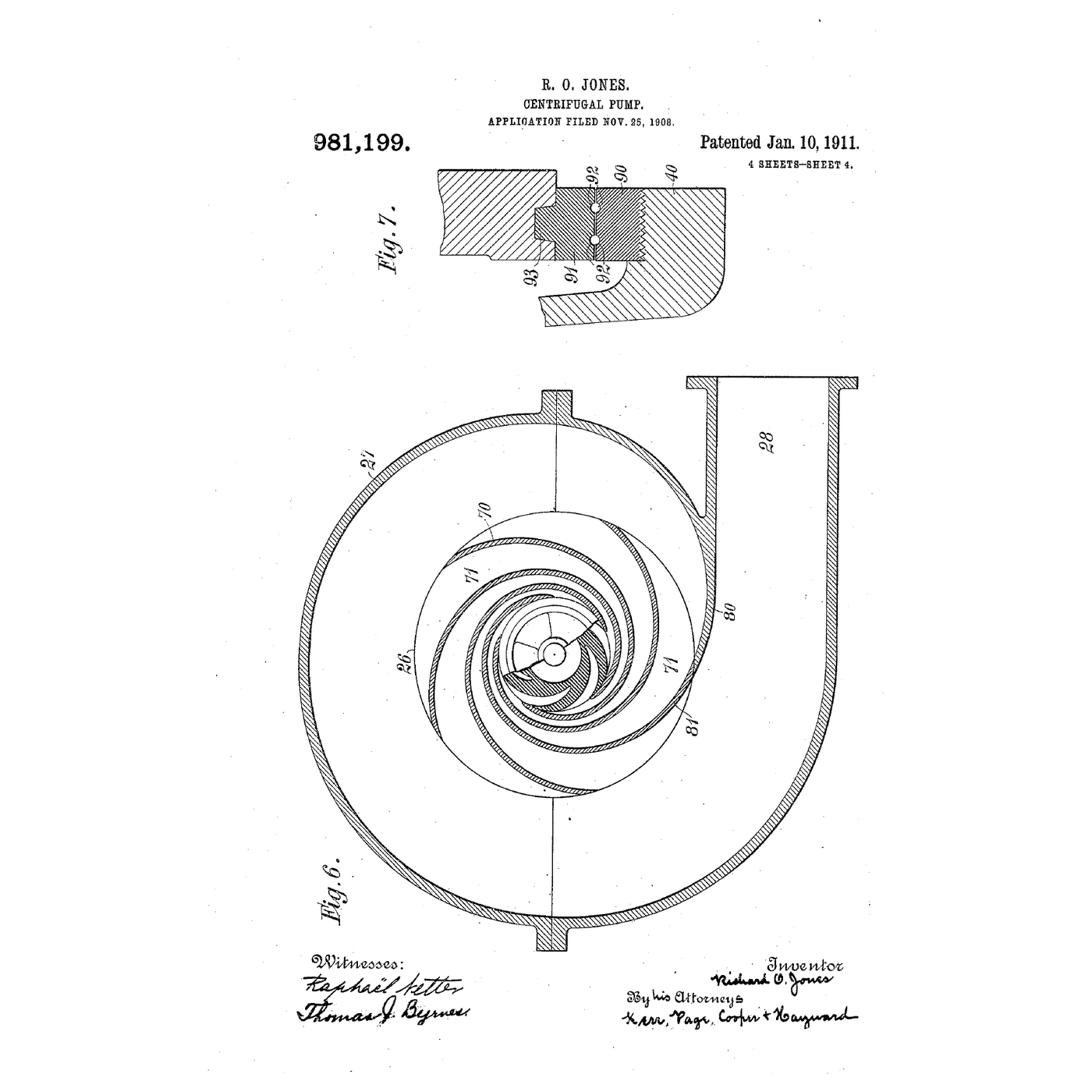
The drawing shown with this blueprint is a later, fully developed form: **US 981,199, 'Centrifugal Pump', Richard O. Jones of Dayton, Ohio, assignor to the Computing Scale Company; filed 25 November 1908, granted 10 January 1911.** Water enters the eye from both sides of the impeller, leaves through a vaned *"diffusion ring"*, and is collected by a volute casing that, *"as is usual, increases from a small to a large diameter to the discharge pipe"* — the growing gap step 2 asks you to print.
What made the centrifugal pump dominant came later and from outside it: the electric motor and the steam turbine, both of which run fast and smoothly — exactly the drive a machine whose head goes with speed squared wants. A reciprocating pump has to be geared down from those drives; a centrifugal pump bolts straight on.
The reverse machine is the turbine. A Francis turbine is, in outline, a centrifugal pump run backward — water in at the rim, energy out at the shaft.
**Honest limits.** It cannot prime itself. Its efficiency falls steeply away from the flow it was designed for. It is poor at high heads with small flows, where a piston or gear pump wins. Viscous liquids — oils, syrups — cripple it. And it cavitates if sited too high above its supply or fed hot liquid, which is why the notebook in step 7 matters more than any number on the nameplate.
Izinto
13- 150 gIsibambeli
- 1 ishidiIsibambeli
- 1 ucezuIsibambeli
- 1 ikhithiIsibambeli
- 8 izicucuIsibambeli
- 1 ucezuIsibambeli
- 10 amalithaIsibambeli
- 3 amamithaIsibambeli
- 1 ucezuIsibambeli
- Isibambeli
- 1 ucezuIsibambeli
- Isibambeli
- Isibambeli
Amathuluzi Adingekayo
16- Isibambeli
- Isibambeli
- Isibambeli
- Isibambeli
- 1 vendor sell this, none ship to you yetIsibambeli
- Isibambeli
- Isibambeli
- Isibambeli
- Isibambeli
- 1 vendor sell this, none ship to you yetIsibambeli
- Isibambeli
- Isibambeli
- Isibambeli
- Isibambeli
- Isibambeli
- Isibambeli
Ama-blueprint ahlobene
Lama-blueprint abelana ngolwazi — amasu, izinto noma izimiso
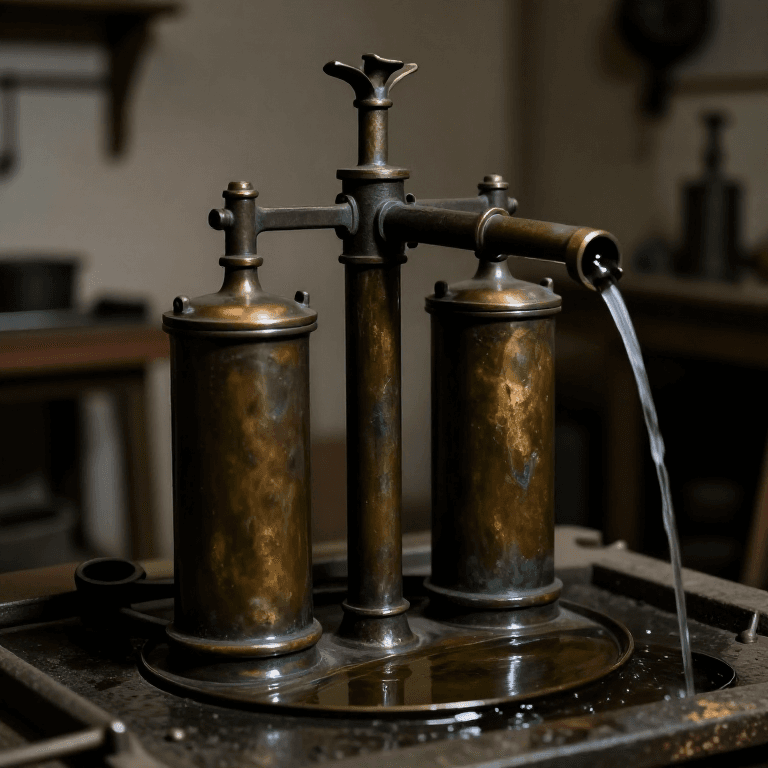
Building Ctesibius' Force Pump — The First Double-Acting Piston Pump
ngu-Emma
Ezomshini
150
0
0
0
3
0
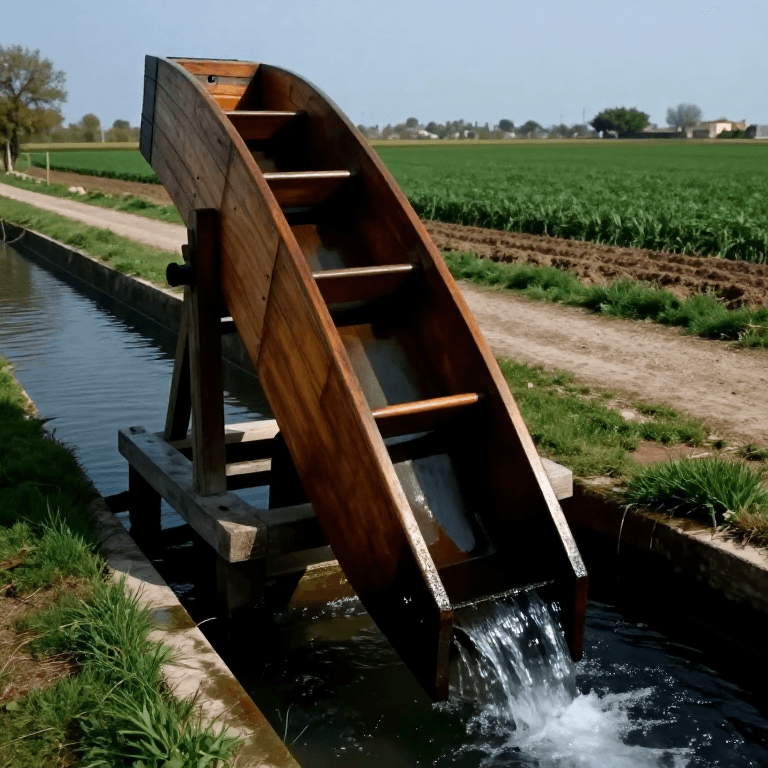
Building an Archimedes' Screw — The Spiral Pump That Lifts Water Uphill
ngu-Emma
Ezomshini
73
0
0
0
2
0
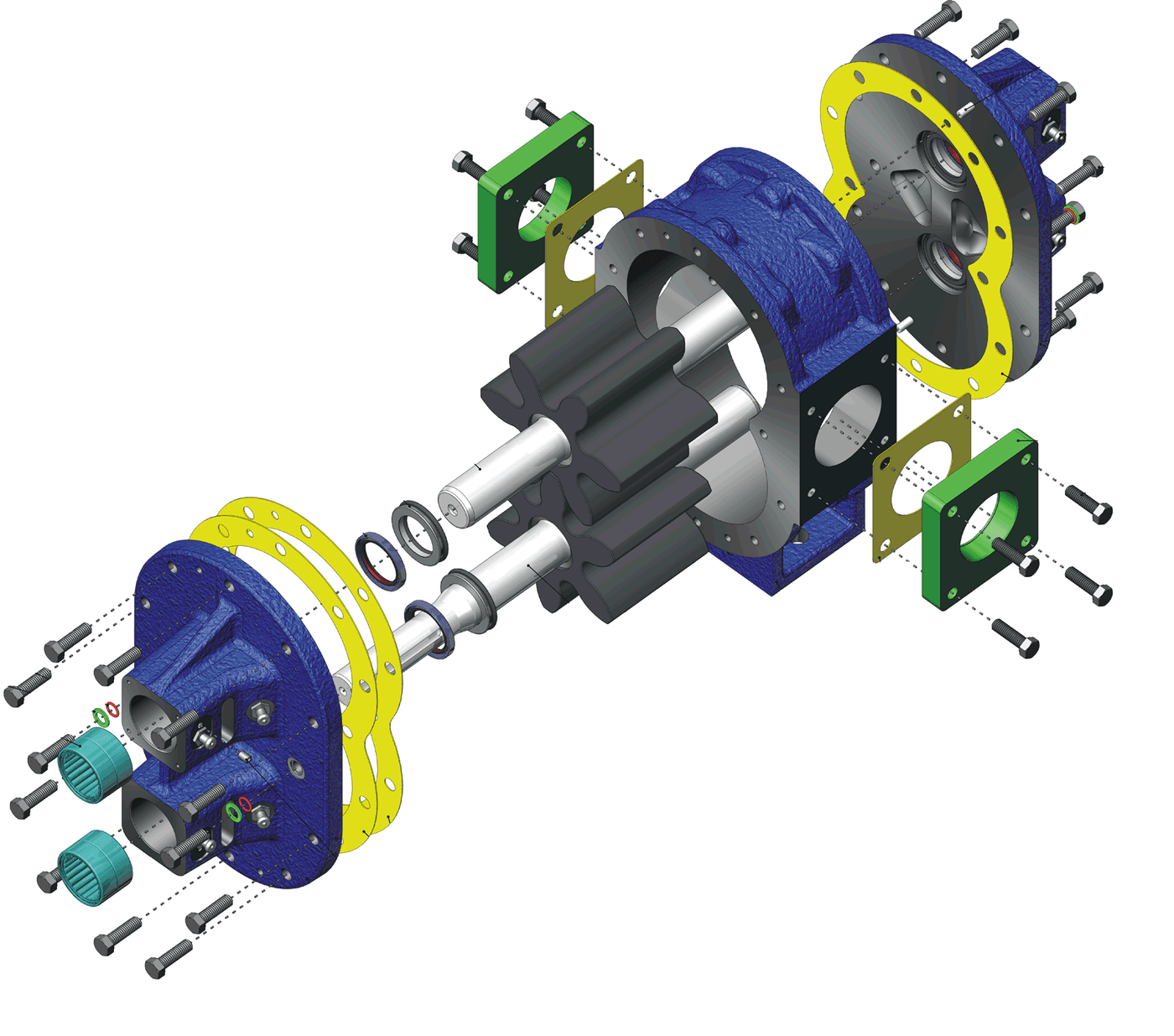
Gear Pump
ngu-Karen
UBUCHWEPHESHE
40
0
0
0
0
0
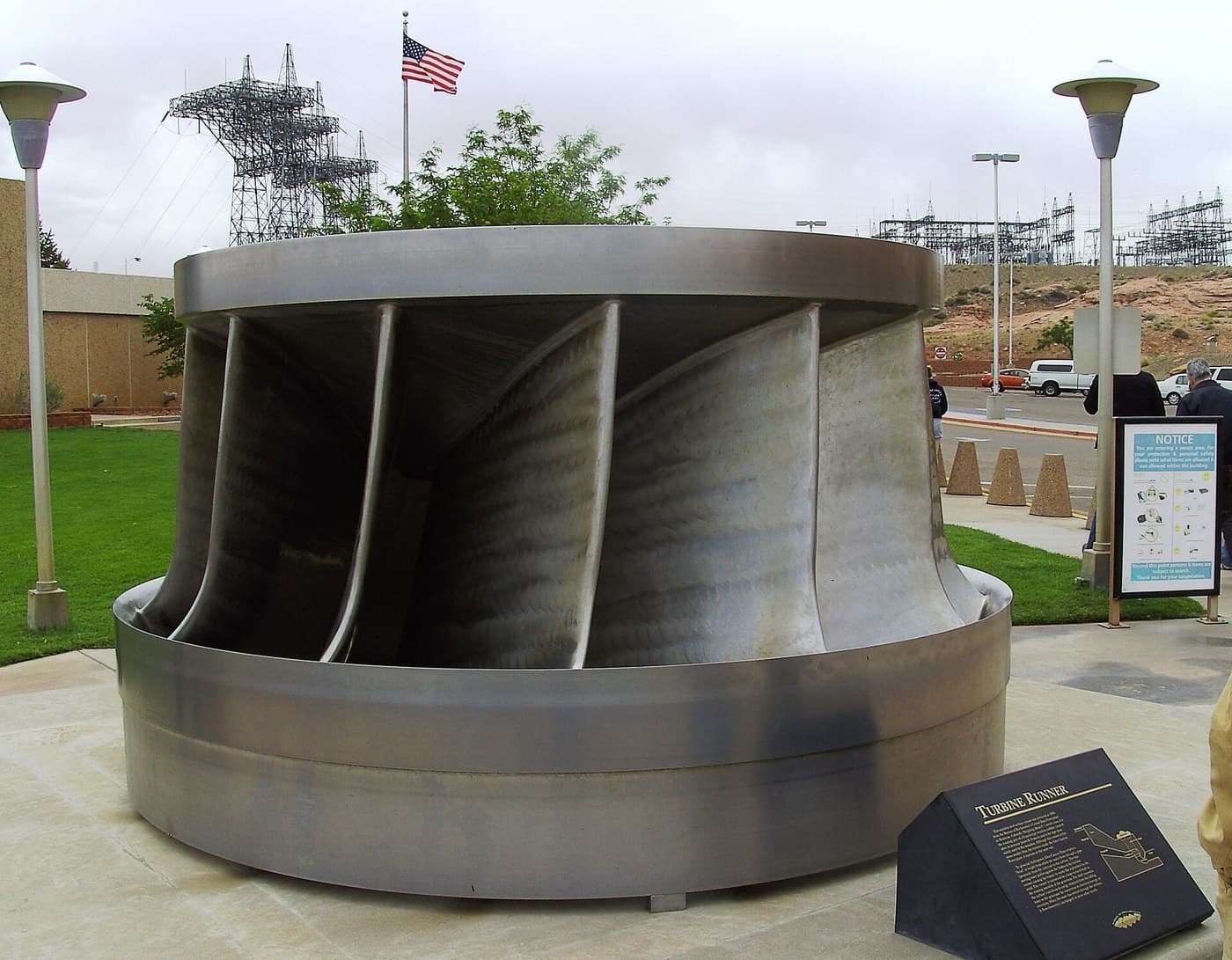
Francis Turbine
ngu-Emma
IMVELO
44
0
0
0
0
0
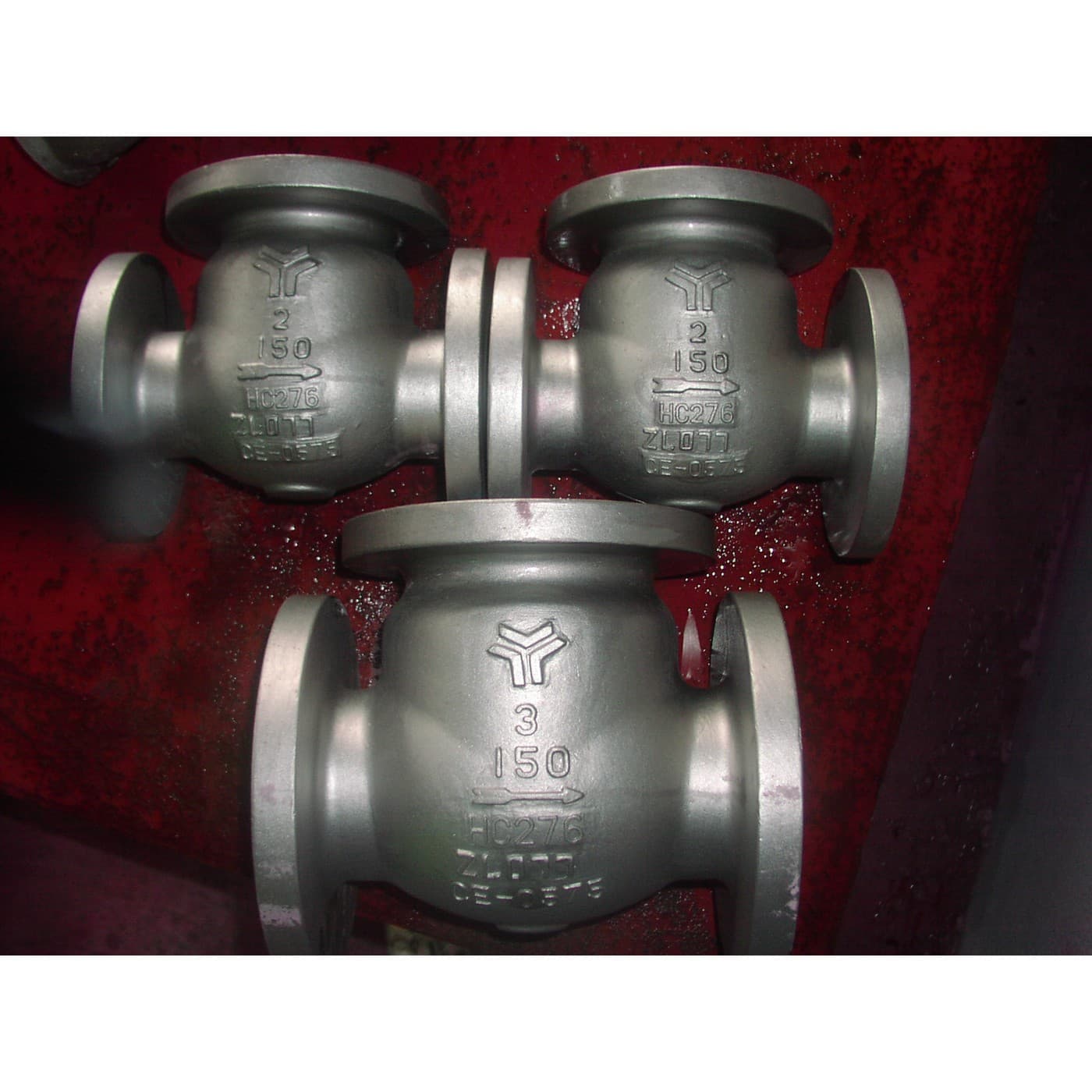
One Way Only: The Check Valve and the Bang It Makes
ngu-Martin
Amathuluzi
39
0
0
0
0
0
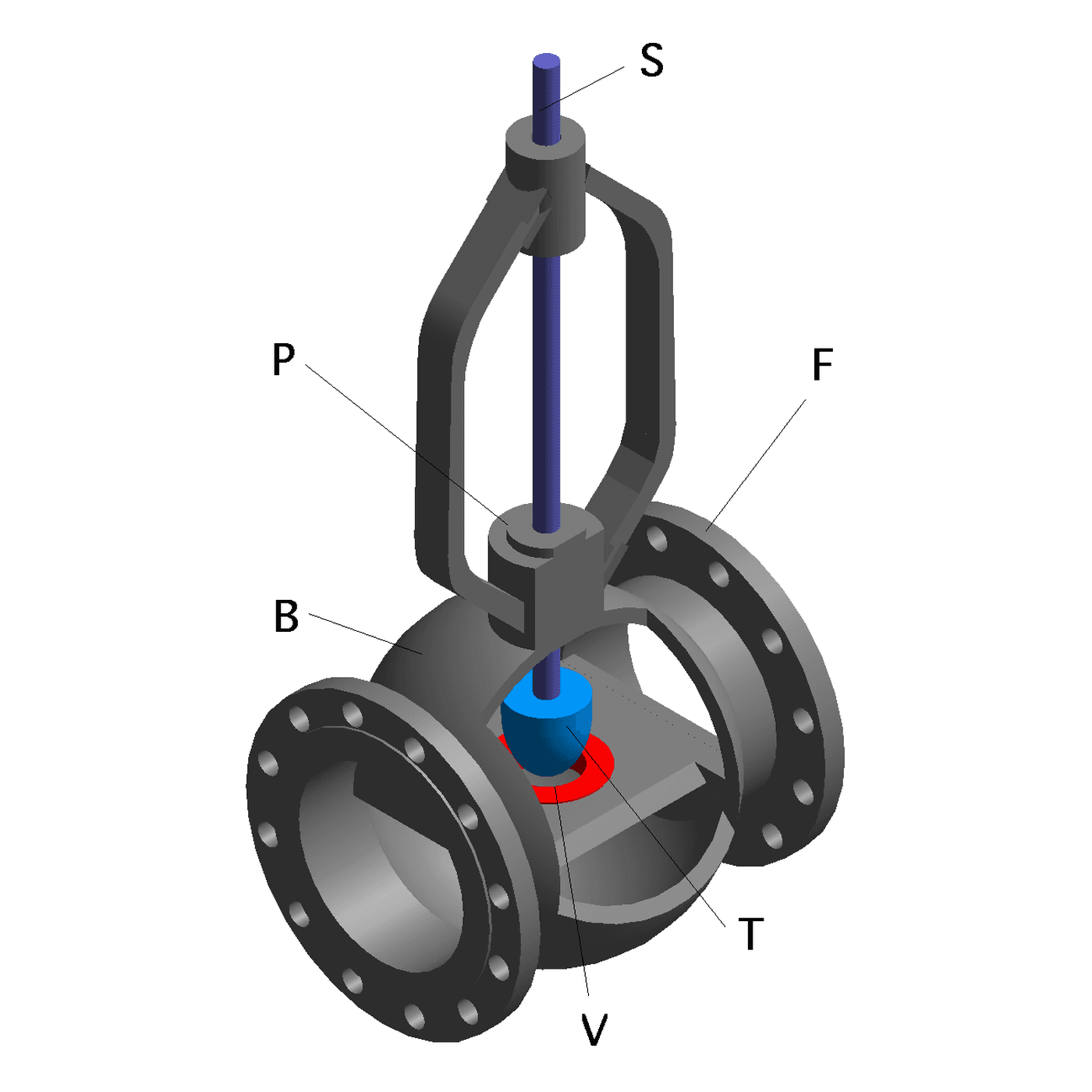
Throttling: Letting Some of It Past
ngu-Emma
Ezomshini
35
0
0
0
0
0
CC0 Isizinda Somphakathi
Le blueprint ikhishwe ngaphansi kwe-CC0. Ukhululekile ukukopisha, ukuguqula, ukusabalalisa, nokusebenzisa ngaphandle kwemvume.
Sekela uMenzi ngokuthenga imikhiqizo nge-Blueprint yabo IKhomishane Yomenzi kumiswe ngabathengisi, noma dala inguqulo entsha yale Blueprint bese uyifaka njengoxhumaniso ku-Blueprint yakho ukuze wabelane ngemali engenayo.