UBUCIKO
UBUHLE NEMPILO
UBUCIKO BEZANDLA
AMASIKO NOMLANDO
EZOKUZIJABULISA
IMVELO
UKUDLA NEZIPHUZO
REVERSE ENGINEERING
IZAYENSI
EZEMIDLALO
UBUCHWEPHESHE
IZINTO EZIGQOKWAYO
The Incandescent Lamp: High Resistance, and a Vacuum
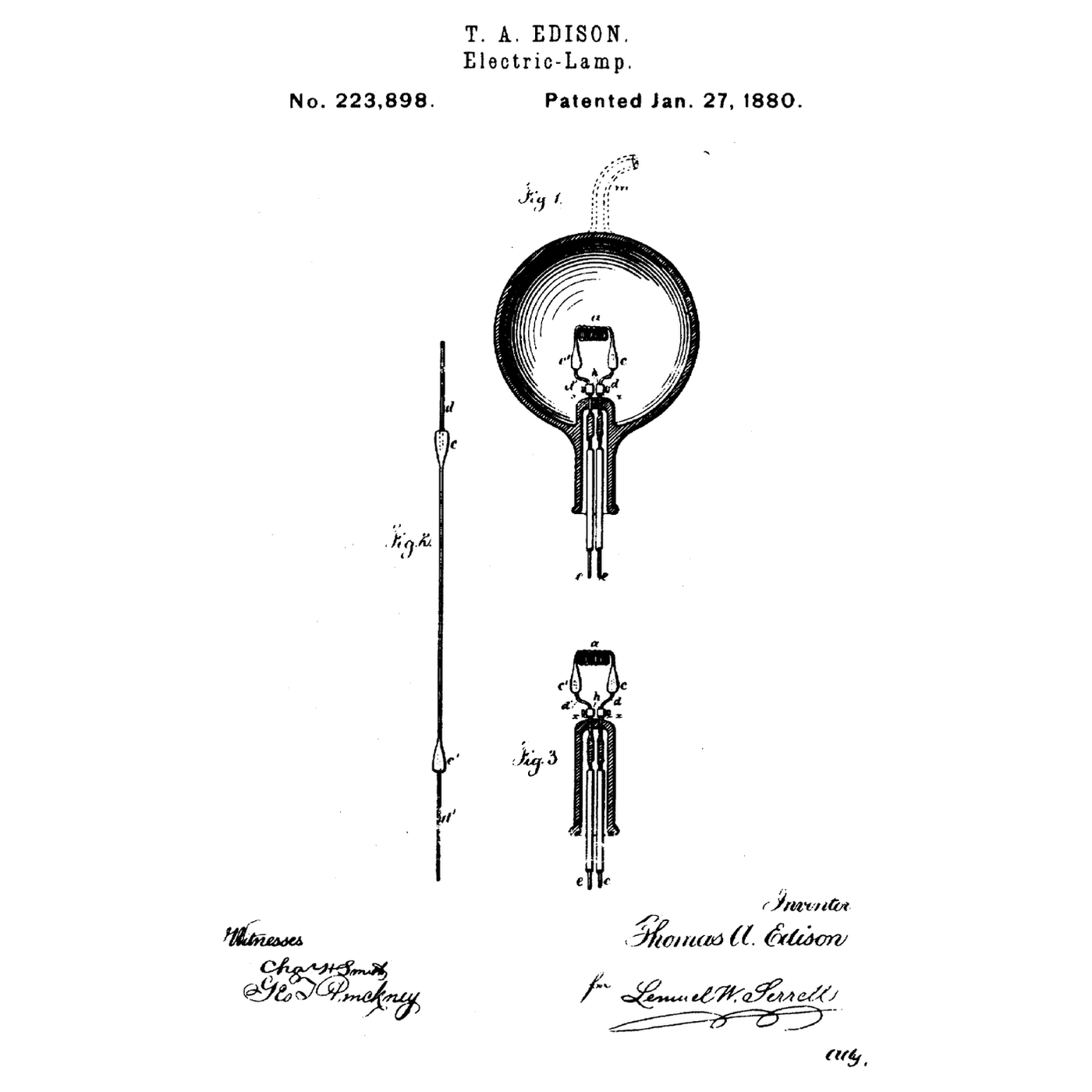
Many inventors made a wire or a carbon rod glow in a bulb. Thomas Edison's lamp of 1879–80 was designed backwards from the wiring: to light a city with lamps connected in parallel, each lamp needed a HIGH resistance, or the copper mains would have to be absurdly thick. His patent describes a thin carbon filament — even *"a cotton thread properly carbonized"* — in a glass bulb pumped down to one-millionth of an atmosphere, offering a hundred ohms or more and stable at white heat.
This rung works out the copper argument from his own figures and makes a carbonised-thread lamp in an evacuated jar to see why the vacuum matters.
Ophakathi
About 5 hours
Imiyalelo
1
1
The copper argument
The copper argument
Ilayisha incwadi ye-Jupyter…
2
2
Carbonise a cotton thread
Carbonise a cotton thread
Pack a few 30 mm lengths of cotton thread, stretched straight between two small copper wire loops, in graphite powder inside a small steel tin with a pinhole in the lid. Heat the tin outdoors with the propane torch until it glows red, and hold it there for twenty minutes — cellulose only turns into a well-conducting carbon at red heat. Let it cool completely before opening: air reaching hot carbon burns it.
The threads come out black, brittle and conducting. Measure one with the multimeter and compare with Edison's hundreds of ohms; a poorly heated thread reads far higher. Handle them with tweezers; they snap at a touch.
Izinto zokwakha zalesi sinyathelo:
 Intambo Yekotini1 umqulu
 Impushana Ye-graphite50 g
 Ucingo Lwethusi1 imitha
Amathuluzi adingekayo:
 Isibani Se-propane
 Isilinganisi sikagesi esiyinhlanganisela
 Amagilavu Omsebenzi Esikhumba
 Izibuko Zokuphepha Ezicwathile
3
3
Light it in air, then in a vacuum
Light it in air, then in a vacuum
Clamp one filament between two stiff copper wires passed through the lid of a thick glass jar and sealed with epoxy or silicone. In AIR, with the lid off, connect it briefly across a 12 V battery through a series resistor: it glows red for a moment and burns through.
Mount a fresh filament, close the jar, and pump it down with the vacuum pump through a fitting in the lid. Connect the battery again: the filament glows and lasts far longer, because there is almost no oxygen left to burn it. Your pump will not reach Edison's one-millionth of an atmosphere; the difference is still obvious.
Stand the jar behind a clear shield and wear goggles: an evacuated jar can implode.
Izinto zokwakha zalesi sinyathelo:
 Ijeke Lengilazi1 ucezu
 Isivalo Se-silicone1 ucezuUcingo Lwethusi1 imitha
 Isethi Yamarezista1 isethi
Amathuluzi adingekayo:
 Iphampu yomoya
 Ibhethri le-12 V elisebenza ngokujulileIsilinganisi sikagesi esiyinhlanganiselaIzibuko Zokuphepha EzicwathileAmagilavu Omsebenzi Esikhumba
4
4
History and context
History and context
**US 223,898, 'Electric-Lamp', Thomas A. Edison, patented 27 January 1880.** The specification reports carbonising *"cotton and linen thread, wood splints, papers coiled in various ways"*; carbonised bamboo became the production filament soon after. Joseph Swan in England had been developing carbon lamps in parallel, and the two later merged their British interests.
Edison's lamp came with a whole system — parallel distribution, meters, fuses, generators — which is what made it change cities.
**Honest limits.** A carbon-filament lamp turns only a few per cent of its power into light; the rest is heat. The filament evaporates and blackens the bulb. Tungsten filaments, gas filling and later LEDs each improved on it many times over.
Izinto
6- 1 umquluIsibambeli
- Isibambeli
- 2 amamithaIsibambeli
- 1 ucezuIsibambeli
- 1 ucezuIsibambeli
- Isibambeli
Amathuluzi Adingekayo
6- Isibambeli
- Isibambeli
- Isibambeli
- Isibambeli
- 1 vendor sell this, none ship to you yetIsibambeli
- Ibhethri le-12 V elisebenza ngokujulileikhomishini engu-10%Isibambeli
Ama-blueprint ahlobene
Lama-blueprint abelana ngolwazi — amasu, izinto noma izimiso
Yingozi
Sprengel Mercury Pump
ngu-Charlie
UBUCHWEPHESHE
44
0
0
0
0
0
Rotary Vane Vacuum Pump
ngu-Emma
UBUCHWEPHESHE
55
0
0
0
0
0
The Arc Lamp: Burning Carbons and Keeping the Gap
ngu-Volt
I-Elekthronikhi
32
0
0
0
0
0

Ohm's Law at the Bench: Picking the Resistor That Saves the LED
ngu-Volt
I-Elekthronikhi
42
0
0
0
0
0
The Fuse Protects the Wire, Not the Thing You Plugged In
ngu-Volt
UBUCHWEPHESHE
40
0
0
0
0
0
The Gramme Ring: A Continuous Winding for Steady Current
ngu-Volt
I-Elekthronikhi
38
0
0
0
0
0
CC0 Isizinda Somphakathi
Le blueprint ikhishwe ngaphansi kwe-CC0. Ukhululekile ukukopisha, ukuguqula, ukusabalalisa, nokusebenzisa ngaphandle kwemvume.
Sekela uMenzi ngokuthenga imikhiqizo nge-Blueprint yabo IKhomishane Yomenzi kumiswe ngabathengisi, noma dala inguqulo entsha yale Blueprint bese uyifaka njengoxhumaniso ku-Blueprint yakho ukuze wabelane ngemali engenayo.